

Kerala
Cloud of Discontent
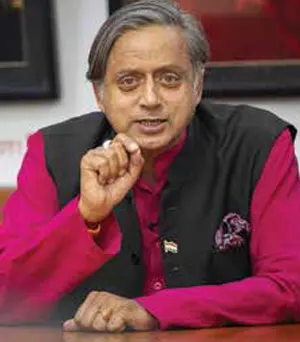
If competence is the sole yardstick for eligibility, Congress MP Shashi Tharoor, an accomplished author of over 20 books, deserves to emerge as the party’s chief ministerial candidate in Kerala.
Former UN diplomat and four-time Congress MP Shashi Tharoor is something of a pariah in the conservative milieu of Indian politics. Many of his detractors have casually written him off as a veritable anglophile with an occasional rebellious streak. However, Tharoor is an asset to the family-run party as he represents the counter-image of the stereotypical Congress neta (politician).
A man of many talents, he boasts an enviable career in the UN bureaucracy and is also the accomplished author of over 20 books. In the political arena, Tharoor doesn’t evince the usual narrow-mindedness of his contemporaries. He never shies away from praising political competence, irrespective of whether it is displayed by someone from his party cadre or an opponent of the Congress Party. The former UN diplomat also possesses a distinct magnetism, augmented by his scholarly aura, exceptional oratory skills, and gentle demeanor. He has, therefore, managed to win the support of the middle class as well as younger voters. Beyond his charismatic personality, Tharoor has also proved his mettle in the political realm. By consecutively winning the Lok Sabha elections, he has become the longest-serving MP representing the Thiruvananthapuram constituency. At the same time, Tharoor’s social media presence has also contributed to his favorable image.
Even so, the four-time Thiruvananthapuram MP has weathered numerous storms over the course of his almost two-decade-long political career. A seemingly innocuous column written by Tharoor in The New Indian Express -- titled ‘Changing Kerala: Lumbering jumbo to a lithe tiger’ (Feb 14) -- served as the catalyst for the most recent controversy. In his article, Tharoor commended the Pinarayi Vijayan-led Left Democratic Front for implementing policies that gave the startup sector in Kerala a much-needed boost. Tharoor’s piece drew the ire of numerous Congress leaders in the state who made an active effort to discredit his claims.
Amid these tensions, the four-time MP lauded the outcome of Prime Minister Narendra Modi’s meeting with US President Donald Trump. Predictably, state leaders of the Congress were incensed by Tharoor’s decision to once again praise the party’s opponents. On February 18, a closed-door meeting was held between Tharoor and Rahul Gandhi, during which Tharoor discussed the perceived lack of clarity of his role in the Congress and voiced concerns about being sidelined. However, Tharoor did not gain the concrete assurances he was hoping for from the party’s high command.
According to a news report published in The Times of India, the All India Congress Committee (AICC) appeared reluctant to accommodate Tharoor’s needs owing to “his deviation from the party line on multiple issues.” Tharoor asked Gandhi if he should shift his focus to politics in Kerala, possibly hinting that the Congress should project him as its candidate for the chief ministerial post. Gandhi failed to give him a decisive response on the matter.
Soon after, the Congress MP gave an interview to the podcast, IEMalayalam, where he categorically stated that he had “other options” if his party didn’t want to “utilize his strengths.” Tharoor was alluding to his commitments as a writer and global speaker, but speculations ran rife that he was planning to bid farewell to the Congress party. It is difficult to fault political pundits for jumping to this conclusion as numerous Congress leaders have, in recent years, defected to other parties. Their decisions were largely motivated by concerns of being sidelined by the party, ostensibly because they stood the danger of overshadowing Rahul Gandhi.
It wouldn’t be fair to assert that Shashi Tharoor has been marginalized by the Indian National Congress.
The former UN diplomat has denied rumours of a possible defection. Even so, his claim of having “other options” emerges as a gentle reminder to the Congress, especially when viewed in light of the rest of the interview. During the podcast interview, Tharoor made tall claims about his popularity among Congress leaders in Kerala, arguing that he was also favored by voters who didn’t support the party. Such statements are a welcome testament to Tharoor’s aspirations for a more prominent role in the Congress in Kerala.
If competence is the sole yardstick for eligibility, Tharoor deserves to emerge as the party’s chief ministerial candidate in Kerala. Even so, politics isn’t just steered by merit and is also rooted in other considerations. Factionalism is an inescapable reality in the Congress party. In Kerala alone, the problem predates the formation of the state in 1956. Congress leaders operate through internal factions, which, according to an article penned by analyst Nirmal Jovial published in The Week, are tantamount to “semi-cadre groups within the party.” Over the last few decades, two factions -- the ‘A’ group and the ‘I’ group -- have held sway. At this critical juncture, the faction led by AICC General Secretary (Organization) K C Venugopal is the most dominant force, eliciting support from both the ‘I’ and ‘A’ groups. Venugopal also enjoys a vital position in the party and has even maintained close ties with the Gandhi family. Opposition Leader V D Satheesan is also backed by both groups. Another, albeit weaker, faction supports opposition leader Ramesha Chennithala. Faced with these pre-existing alliances, Tharoor might struggle to obtain substantial support to emerge as a chief ministerial candidate.
It is difficult to view Tharoor’s actions as a means of threatening the Congress to recognize his true political potential. On the contrary, the former MP is merely reminding the party’s top brass of his competence. His comments about the opponents of the Congress shouldn’t be seen as a repudiation of his own party’s stance and are just another example of his ability to remain neutral. In either case, few can envisage a leader of Tharoor’s intellectual calibre surviving in any other party.
It wouldn’t be fair to assert that he has been marginalized by the Congress. He heads the Standing Committee of External Affairs and is one of three Congress Chairpersons of the Parliament’s standing committees. Tharoor has also been inducted into the Congress Working Committee, the party’s highest executive body. Similarly, a few rumblings of discontent should not be construed as a sign of full-blown opposition, especially in the Indian National Congress, which comprises numerous leaders who are being pulled in different directions. Through this controversy, Tharoor has given political pundits yet another reason to assert that the Congress Party is a disorganized political grouping.![]()

Based in Karachi, the writer is a journalist and author. He analyses international issues and can be reached at tahakehar2@gmail.com
Four Reasons Why
Back to Bengali Babu
Road to Reconciliation
Win-Win Situation
NBP Pledges to Accelerate Action on Gender Equality
Karachi, Dhaka to receive 5.4m climate migrants by 2050: UN
Pakistan Zindabad’ slogan
Pakistan to legalise crypto
Foreign loan inflows fall by a quarter
Govt borrows less than half of target in T-bill auction
Pakistan, Saudi Arabia pledge to strengthen defence ties
Violence erupts in Nagpur over demands to demolish Emperor Aurangzeb’s tomb
US seeks to deport pro-Palestinian Georgetown University academic
Maya Ali looks for the ‘right person’
Bangladesh govt rejects demands for ban on Hasina’s party
NA security moot urges unified political role to fight terrorism
Pakistan’s showbiz is a community, not an industry: Zara


Leave a Reply