Colombo
Too Minor to Matter
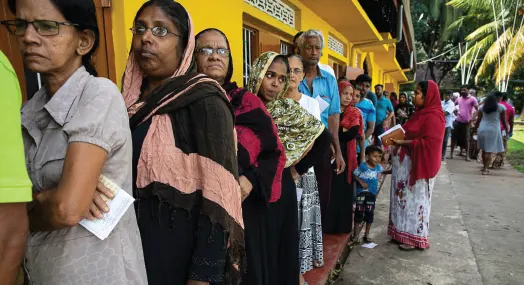
In Sri Lanka, the limited presence of minority women in electoral politics highlights a gap between formal democracy and substantive representation

Sri Lanka’s experience with minority women in politics cannot be understood without situating it in its historical trajectory. What appears today as underrepresentation is rooted in decades of political evolution shaped by identity, conflict, and institutional design. The marginal presence of minority women in the Sri Lankan parliament is not an isolated phenomenon, but an outcome of historical processes that have defined who gets to participate in power and on what terms.
At independence in 1948, Sri Lanka inherited a parliamentary system that, in theory, allowed for broad participation. However, early state-building quickly took on a majoritarian character. Policies such as the privileging of the Sinhala language and Buddhist identity redefined the relationship between the state and minority communities. In the language of Political Science, this marked the consolidation of ethnoreligious majoritarianism. Minority groups, particularly Tamils and later Muslims, found their political space narrowing as electoral incentives aligned with majority preferences.
During this early phase, women’s political participation itself was limited, though Sri Lanka was often seen as relatively progressive in South Asia due to milestones such as the election of Sirimavo Bandaranaike, the world’s first female prime minister. Yet this symbolic breakthrough did not translate into broad-based inclusion. Political power remained concentrated within elite families and male-dominated party structures. Minority women were almost entirely absent from these circles.
The outbreak of the Sri Lankan Civil War marked a turning point. The conflict was not only a military struggle but also a reordering of political priorities. Security became central to governance, and political discourse increasingly revolved around loyalty, nationalism, and territorial integrity. For minority communities, this meant heightened scrutiny and reduced political space. For minority women, the barriers became even more pronounced.
The war years did produce forms of female participation, but often outside formal democratic institutions. In conflict-affected areas, women took on roles in community organization, humanitarian work, and in some cases even armed movements. These experiences built leadership skills and local legitimacy. However, when the war ended, these forms of participation did not easily translate into representation within mainstream politics. The transition from conflict to post-conflict governance did not sufficiently integrate these actors into formal institutions.
In the post-2009 period, Sri Lanka entered a phase of reconstruction and political recalibration. There were efforts to introduce reforms aimed at inclusion, including gender quotas at local government levels. Yet the deeper structures of power remained largely intact. Political parties continued to operate through patronage networks, and candidate selection processes remained centralized and opaque. Minority women, despite their grassroots experience, struggled to break into national-level politics.
This is where the Sri Lankan perspective becomes particularly important. From within the country, the issue is not only about exclusion but also about negotiation. Minority women often frame their participation in terms that resonate with local cultural and social expectations. They position themselves as community representatives, mediators, and service-oriented leaders rather than as challengers to the system. This approach reflects a strategic adaptation to a context where overt confrontation can be politically costly.
The logic of this adaptation can be understood through the lens of Niccolò Machiavelli. His distinction between virtù and fortuna provides a useful framework. The structural conditions in Sri Lanka, including majoritarian politics and patriarchy, represent fortuna. They are constraints that individuals cannot easily change. The strategies adopted by minority women, such as building local legitimacy, forming alliances, and navigating party hierarchies, reflect virtù. They demonstrate the capacity to operate effectively within those constraints.
At the same time, the normative dimension of representation remains critical. John Stuart Mill argued that representative institutions must reflect the diversity of society to ensure just governance. In Sri Lanka, the limited presence of minority women highlights a gap between formal democracy and substantive representation. Policies that emerge from such a system risk overlooking the specific needs of marginalized communities, particularly in areas such as post-conflict reconciliation, education, and social welfare.
Sri Lanka’s experience with minority women in politics reflects a complex interplay of history, structure, and agency
From the perspective of International Relations, Sri Lanka’s case also illustrates the interaction between institutions and norms. Liberal institutionalism would suggest that mechanisms such as quotas can promote inclusion. However, the Sri Lankan experience shows that formal institutions are constrained by informal practices. Patronage networks, social hierarchies, and cultural expectations continue to shape political outcomes.
A constructivist approach adds another layer of understanding. It emphasizes that political norms evolve through repeated actions. Minority women entering politics, even in small numbers, challenge existing assumptions about leadership and participation. Their presence gradually reshapes societal expectations, though this process is slow and often contested.
There is also a broader geopolitical context. Sri Lanka’s internal dynamics have implications for regional stability. States that fail to integrate minority groups into political systems risk prolonged instability. The civil war itself was a manifestation of accumulated grievances. While the post-war period has avoided large-scale conflict, underlying tensions remain. Inclusive governance, including the participation of minority women, is therefore linked to long-term stability and state legitimacy.
For Islamabad, these historical and contemporary dynamics offer several important lessons.
First, the historical trajectory matters. Sri Lanka’s current situation is the result of decades of policy choices and political developments. For Pakistan, this underscores the importance of addressing inclusion proactively rather than reactively. Early interventions in political representation can prevent the entrenchment of exclusionary patterns.
Second, symbolic breakthroughs are not sufficient. The example of Sri Lanka having a female prime minister did not translate into widespread inclusion of women, particularly those from minority backgrounds. Pakistan’s own milestones in women’s representation should therefore be complemented by efforts to broaden participation across different social groups.
Third, post-conflict or high-tension environments require deliberate inclusion strategies. Sri Lanka’s experience shows that failing to integrate marginalized actors into the post-conflict process can limit the effectiveness of reconstruction efforts. For Pakistan, particularly in regions that have experienced instability, inclusive political processes can support long-term peacebuilding.
Fourth, institutional design must address informal power structures. Quotas and legal reforms are necessary but not sufficient. Political parties play a central role in shaping access to power. Strengthening internal party democracy, ensuring transparent candidate selection, and providing resources for underrepresented groups are critical steps.
Fifth, local-level engagement is essential. Minority women in Sri Lanka have often built their political careers through grassroots involvement.
Sixth, narrative framing can facilitate change. In Sri Lanka, minority women often present their political roles in terms of community service and social responsibility. This approach reduces resistance and allows for gradual acceptance. Similar strategies can be effective in Pakistan’s socio-political context.
Finally, inclusion is tied to geopolitical stability. States that manage diversity effectively are better positioned to maintain internal cohesion and project stability externally. In South Asia, where identity politics frequently intersects with security concerns, inclusive governance becomes a strategic asset.
Sustainable inclusion requires aligning historical awareness, institutional reform, and social transformation toward a more balanced and resilient political system. Sri Lanka’s experience with minority women in politics reflects a complex interplay of history, structure, and agency. The roots of exclusion lie in decades of majoritarian politics and conflict, while the persistence of minority women highlights the capacity for adaptation and gradual change. Their participation, though limited in numbers, carries broader implications for governance and stability.
Based in Lahore, the writer is a Ph.D. scholar and political analyst. She can be reached at gulnaznawaz1551@gmail.com


Leave a Reply