



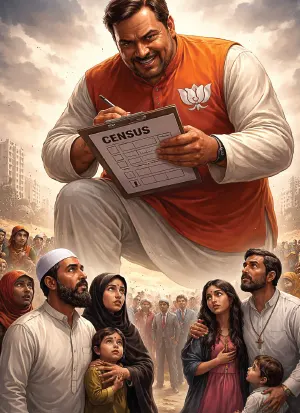
 India is starting its biggest-ever population census after more than 15 years. Over one billion people will respond to questions. This will be the country’s 16th census and will be carried out in two phases by more than three million workers. It is a mammoth task, indeed. Transparency will be of paramount significance.
India now has a population of over 1.4 billion and became the world’s most populous country in 2023. Despite this, it is still a young country with a large working-age population.
The last census was carried out in 2011. The next census was delayed because of the COVID-19 pandemic, which also highlighted administrative challenges.
The census will cover all states, cities, towns, and villages across the country. For the first time, it will be conducted digitally. Officials will use mobile apps, and people can also fill in their information online in multiple languages. It is yet to be seen how strong internet access is across the country, especially in remote areas, so that everyone can take part.
The process will have two main stages. The first will collect data about housing conditions and household facilities. The second stage, planned for 2027, will gather detailed information about people, such as education, jobs, migration, and family size. It will also include caste data, which is a delicate issue and must be handled carefully. The census will begin in selected regions first. People in these areas can submit their details online before officials conduct door-to-door surveys.
India’s census has changed a lot over time. Early censuses mainly recorded basic details such as name, age, religion, and occupation. Over the years, more questions were added about education, work, and living conditions to get a deeper understanding of the population.
After independence, the census included more social and economic information, such as migration, employment, and land ownership. In recent years, it has also tracked details like commuting, types of work, and education levels.
The latest census reflects changing social realities. For example, couples in live-in relationships may now be recorded as married if they consider their relationship stable.
However, there are concerns about how the data will be used. Some people fear that it could be linked to issues like citizenship. Because of this, some families may give incorrect information to avoid any risk of exclusion.
Another major issue is that India has been making policies without updated population data. Without a recent census, the government has relied on surveys, which may not always be accurate.


Based in Karachi, the author is a novelist and science fiction writer. He has a special interest in the social and political affairs of South Asia and can be reached at omariftikhar82@gmail.com
Leave a Reply