



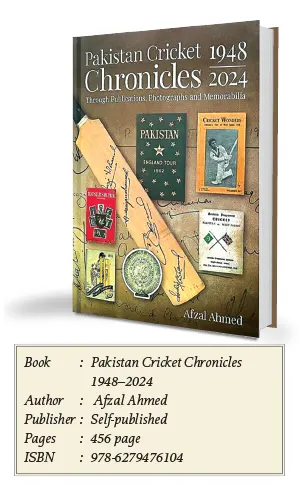
 Cricket. Seven letters, one word. It is our passion, escape, and the topic of debate at family gatherings. We love to watch cricket, but hate it when our Team Green collapses in front of its opponents. The matches against India are the most watched and highly combustible, indeed. Afzal Ahmed’s book, Pakistan Cricket Chronicles 1948–2024, is a coffee-table book, celebrating Pakistan’s most cherished sport. It merges rare print materials and visual archives to tell the story of the nation’s cricketing legacy.
Over the last many decades, Afzal Ahmed has painstakingly collected archives of books and memorabilia on cricket. After bidding farewell to his banking career, Afzal Ahmed began the task of promoting his cherished memorabilia of cricket into a single-volume book titled Pakistan Cricket Chronicles 1948–2024.
For years, studying Pakistan’s cricket history required assembling pieces and fragments from scattered and often sources that were nearly impossible to access. These included auction records, private collections, and narratives that are often incomplete. Pakistan Cricket Chronicles resolves this challenge by consolidating these dispersed materials into a carefully curated volume. This book is more than a compilation; it is an annotated, structured, and accessible reference that brings to the surface the history of the national team.
The book’s progression is like reading a script of a documentary on the same topic. The readers go through the history to learn and explore the cricketing seasons beginning from 1948 to 2024. A clear overview opens each section, which is accompanied by images carefully selected to balance the content with the context. The author has also placed memorabilia, souvenirs, and brochures related to each season to further add depth to the narrative.
Each section ends with a curated listing of Pakistan cricket publications from its respective period, both domestic and international. The book brings to the fore the very essence of how cricket developed in Pakistan over these decades.
The opening sections stand out for their historical depth. They showcase uncommon artefacts from Pakistan’s earliest cricketing years. These include one of the first cricket souvenirs and the earliest known book on the sport published in the country, both linked to the 1948–49 season. It marked Pakistan’s initial step onto the international stage. Also featured is a rare team photograph from the national side’s first overseas tour, captured during their 1949 visit to Ceylon (the former name of Sri Lanka).
The book goes on to present various significant pieces from Pakistan’s cricket past. There are early editions of Omar Kureishi’s The Pakistan Cricketer, details of Pakistan’s lesser-known tour to the United States in the late 1950s, and a signed scoresheet of Majid Khan’s fast century in 1976. One meaningful item records Pakistan’s last international match in Dhaka before the separation of East Pakistan, which was abandoned due to unrest. It shows that cricket and political history are often closely linked.
Readers will also come across a handwritten batting order by Intikhab Alam for a Test at Lord’s in 1974, and a rare 1928 publication on early cricket in Sindh and Karachi. The inclusion of works by well-known writers like Qamaruddin Butt and Abdul Hafeez Kardar adds further value to the collection. The book also shows how literature on cricket, in the form of non-fiction narrative, has developed in Pakistan.
Despite its wide scope, it may be noted that some sensitive and controversial parts of Pakistan’s cricket history—such as match-fixing inquiries—are not included. While these may not fit within the category of memorabilia or published works, they are still important. Including them could add another perspective to the story, showing how cricket in Pakistan developed and the challenges it faced when the line between right and wrong was blurred.
Leave a Reply