



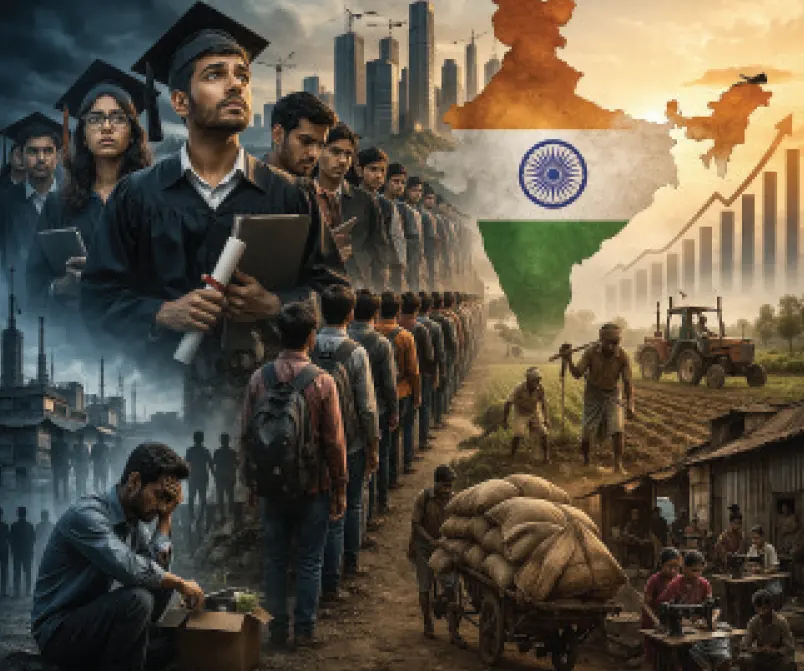
India stands at a defining crossroads. With a population exceeding 1.4 billion people and nearly three-quarters in the working-age bracket, the country possesses what economists have long described as a “demographic dividend.” Its young population is more educated, more aspirational, and more globally aware than any generation before it. Yet, this promise is shadowed by a stark and growing contradiction: millions of young Indians, despite their qualifications, remain unemployed or underemployed. The question is no longer whether India has the human capital to power its future, but whether its economy can keep pace with the expectations and needs of its youth.
Over the past two decades, India has made significant strides in expanding access to education. Universities have multiplied, technical institutes have flourished, and digital learning has bridged gaps once considered insurmountable. As a result, today’s young Indian enters the job market armed with degrees, certifications, and skills that signal readiness for a modern economy. However, the structure of the job market has not evolved at the same pace. There exists a deep and persistent mismatch between what the education system produces and what the economy demands.
A large proportion of graduates find themselves equipped with theoretical knowledge but lacking the practical, industry-relevant skills that employers seek. This disconnect has created a paradox where companies report difficulty in finding suitable talent, even as job seekers struggle to secure meaningful employment. The issue is not merely one of quantity, but of quality and alignment. In sectors such as technology, manufacturing, and services, the demand is increasingly for specialized, adaptable skill sets—qualities that traditional curricula often fail to cultivate.
Compounding this challenge is the nature of employment itself. Only about 23 percent of India’s workforce is engaged in salaried jobs, while the vast majority operates within agriculture or the informal sector. These segments, though vital to the economy, are often characterized by low productivity, income instability, and limited opportunities for upward mobility. For many young people, especially those who have invested years in higher education, entering such sectors represents not just an economic compromise but a psychological setback.
The labor force participation rate, hovering around 51 percent, further underscores the complexity of the issue. A significant portion of the working-age population remains outside the formal workforce, including many women whose participation is hindered by social norms, safety concerns, and a lack of supportive infrastructure. This underutilization of human capital represents a missed opportunity on a massive scale, limiting both economic growth and social progress.
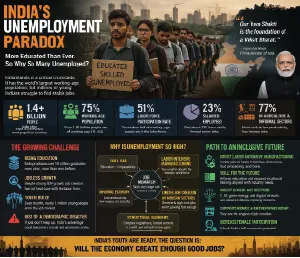 At the same time, India’s economic growth story, while impressive in headline figures, has not been sufficiently inclusive. High-growth sectors such as information technology and finance generate substantial wealth but employ a relatively small segment of the population. Meanwhile, labor-intensive industries that have historically absorbed large numbers of workers, such as textiles and manufacturing, have not expanded at the pace required to meet the surge in labor supply. Automation and technological advancements, while driving efficiency, have further complicated the employment landscape by reducing the demand for certain types of jobs.


Sara Danial is a Pakistan-based writer/editor and can be reached at sara.amj@hotmail.co.uk
Leave a Reply