



Meri saheli wo sath kheli,
wo mujh ko barson se jaanti hai.
 It took me years to understand that the Saheli in the Urdu verse was not someone else. She was me—the self that knows you the longest, judges you most honestly, and forgives you. That quiet, unflinching companion who has watched every negotiation you have made between who you are and who the world has asked you to be.
Zehra Nigah’s poetry has been my companion—mentor, mirror, and occasional adversary. It has comforted me in moments of stillness and unsettled me precisely when I thought I had found equilibrium. It has raised questions I was not prepared to answer and illuminated truths I was not ready to face. In that sense, it has done what only the finest literature does: it has refused to leave you where it found you.
For me, her Gul-e-chandni is perhaps the most quietly devastating image in her body of work. That moonlit glistening leaves of the tree as a metaphor for the interior life we guard most carefully, the reserves of secrets, regrets, and unfulfilled desires that we keep sealed because we sense, rightly, that releasing them might bring down the carefully constructed world around us. It is a transitory world, she reminds us, however solid it appears from within.
The range of her emotional universe is staggering. The cry of the Palestinian child ‘Ek Falasteeni Bache Ki Dua,’ the unbearable, liberating gratitude of a girl child spared a life of shackles ‘Mein Bach Gaye Ma,” the fragile, luminous romance of Sham Ka Pehla Tara “Jis Ne Hamein Hans Kar Dekha Tha Wo Pehla Dost Hamara Tha,’ the internal fracture of Tarasheedum - She moves between the geopolitical and the deeply personal without ever losing intimacy, and that is a rare and formidable gift.
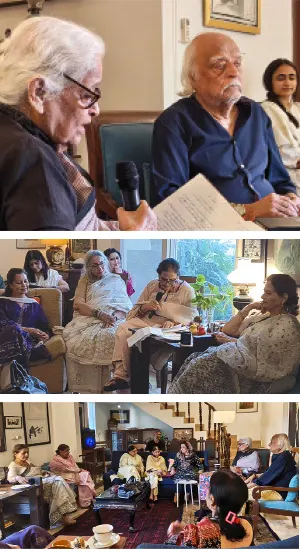
To sit with her recently, in a small and unhurried gathering, felt like a privilege of a particular kind. She shared new kalaam, work that carries the weight of this fractured moment in the world, the decline of collective humanity, the blurring of moral vision, and the particular selfishness of our age, the kind that is never without its own justification, that always presents itself as necessary, even noble. She holds that selfishness up to the light without polemic, and that restraint makes it all the more devastating. From the bombing of a girl’s school to a memorial for her youngest sister, Zubeda, she opened many doors.
The evening was made complete by the unexpected arrival of Anwar Maqsood, who moderated with the effortless grace of someone who has spent a lifetime understanding Zehra Nigah’s language and the people she has living in her poems. He added his own readings of her verses, and in doing so revealed new chambers in lines I thought I already knew.
It was, in the end, an evening that reminded me why poetry matters not as decoration or nostalgia, but as the only form of language still willing to tell us the truth about ourselves.

Based in Karachi, the writer is an educator, a corporate host, and regularly contributes to various publications. She can be reached at shaha.jamshed@gmail.com.
Leave a Reply