


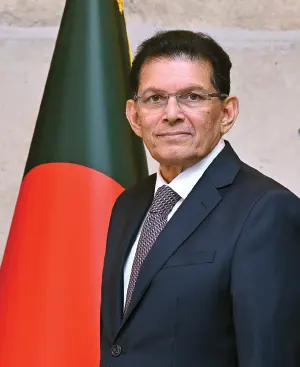
 Following the February 2026 election, the appointment of Dr. Khalilur Rahman as Bangladesh’s new foreign minister has been widely perceived in Dhaka’s diplomatic circles as an intentional recalibration of the country’s external relations.
Dr. Rahman is a career diplomat, economist, and former UN official who previously served as the National Security Advisor in Professor Muhammad Yunus’ interim government. His tenure was not devoid of controversy domestically and internationally, as he developed a reputation for being pro-United States.
As early as last year, the Bangladesh Nationalist Party, the current administration in Bangladesh, publicly questioned the motives behind Dr. Rahman’s appointment, even raising doubts about his citizenship.
Now that he is serving in the BNP government, it would not be illogical to ask whether this signals a shift in the strategic calculations of Bangladesh’s foreign policy moving forward. Most certainly, the appointment of Dr. Rahman as Foreign Minister under a BNP-led government represents a significant pivot. What this suggests is that the BNP leadership has made a pragmatic decision to retain and promote a technocrat with well-established diplomatic credentials and pro-Western leanings. The BNP has intentionally chosen not to appoint a person to the post based solely on partisan loyalty.
Bangladesh’s foreign policy under the BNP-led government is centered around the core philosophy of “Bangladesh First.” This principle, which is repeatedly emphasized by Prime Minister Tarique Rahman and Foreign Minister Dr. Khalilur Rahman, prioritizes national interests, sovereignty, mutual respect, and economic benefits above any country-specific favoritism or ideological alignments.
Some of the key broader indications of a strategic shift in Bangladesh’s forensic policy include:
Maintaining a healthy balance between regional and global ties
Bangladesh will be able to strengthen engagement with the United States. Dr. Rahman even defended a controversial reciprocal trade agreement signed under the interim government. Furthermore, strong multilateral outreach to the US, the EU, and regional players will be prioritized.
Continuation of the interim era
The interim government led by Professor Yunus emphasized an “independent” foreign policy, with Dr. Rahman playing a key role in shaping it. Some of the issues focused on were the repatriation of the Rohingyas, Bangladesh’s economic positioning after LDC (Least Developed Countries) graduation, and the enhancement of the armed forces’ competence.
The strategic decision to retain Dr. Rahman post-interim government era signals a powerful international message that the BNP is on board with the interim government’s foreign policy orientation while adapting it to its own priorities. Most importantly, the messaging of Bangladesh prioritizing a foreign policy that works for the country rather than tilting heavily towards its larger neighbor is crystal clear.
Political calculus
By appointing a non-traditional partisan like Dr. Rahman, sometimes referred to as a “technocrat minister,” the BNP is emphasizing competence and signaling stability, particularly given the 2024 upheaval that led to the student revolution, which brought about Sheikh Hasina’s ouster and the 2026 elections.
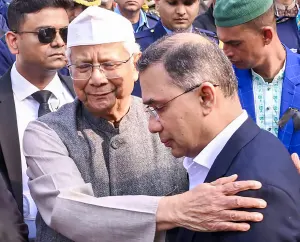 This is likely to stabilize ties with Western countries, although lingering criticism in some quarters remains about excessive US influence.


Based in Houston, United States, the writer is the executive director of a US-based human rights organization. She can be reached at scballand@thechrd.org
Leave a Reply