



 Fundamental democratic principles imply that men and women should have equal political participation. However, all over the world, women are still notably underrepresented in political decision-making. Female involvement in elections and political leadership is a crucial barometer of a nation’s democratic health. From a gender perspective, good governance requires the inclusion of women in leadership positions across all levels of the political sphere.
It is often mistakenly assumed that women’s political participation is particularly low in underdeveloped and developing countries. This is not true. South Asia has seen significant female leadership, notably in India, Pakistan, and Bangladesh. Bangladesh has been continuously ruled for decades by two female political figures: Khalid Zia and Sheikh Hasina Wajid. Wajid is the longest-serving head of government in Bangladesh’s history. She also holds the title of world’s longest-serving female head of government.
Bangladesh, however, also presents an astonishing gender paradox: Despite the presence of highly prominent female leaders, the overall political progress of women in the country still remains very low. Women accounted for just 3.67% of the total candidates who contested general elections in 2018. This year, the percentage marginally increased to 4.86%. Only 92 contestants out of 1891 were women.
Bangladesh’s government rendered it mandatory for all political party committees to meet one-third of women’s representation criteria. However, all parties have yet to comply, including the incumbent Awami League and its main rival, the Bangladesh Nationalist Party (BNP). Only one party, the Gana Front, meets this threshold. Awami League only has 18% women’s representation on its central committee.
Female participation in Bangladeshi politics has been increasing over the past few years. However, very few women can secure top positions within their parties.
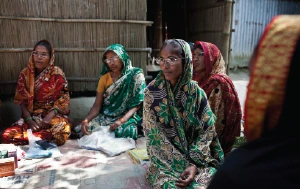
There is a gender barrier that, although diminished, continues to impede women’s participation in formal Bangladeshi politics. Women who enter this profession or actively participate in it must navigate several challenging spaces and contexts. Prevailing societal attitudes and traditional notions of femininity further weaken them. Meanwhile, women leaders also blame the lack of financial resources and socio-religious prejudices for their political regression. Bangladesh’s patriarchal society also shares responsibility.
There is a lack of awareness among Bangladeshi women about their legal rights. Additionally, traditional norms and values, a patriarchal society, and the scarcity of full-time female political activism have always hindered the greater participation of Bangladeshi women in the political process. Consequently, they have always been under-represented in political parties and within decision-making arenas. They carry lesser bargaining power within their communities. All these factors culminated in a least organized female electorate that succumbed to male subordination.


The writer is a freelancer and an investment banker based in Karachi. He can be reached at syedatifshamim@hotmail.com
Leave a Reply