


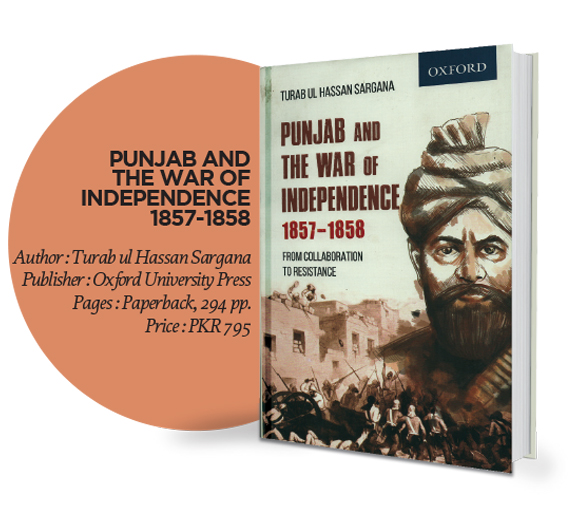
It is a misconception that many still think that the province of Punjab did not participate actively or significantly in the 1857-1858 War of Independence against the British. Bahauddin Zakariya professor, Turab ul Hassan Sargana takes it upon himself to rectify this prevalent oversight from an academic perspective. His recently published Oxford University Press book argues, convincingly for me at least, that far from being relatively passive or apathetic during what the British regard as a major mutiny against the Raj, Punjab was far more central to the Indian-driven quest for overthrowing colonial shackles than any historian (past or present) has given it credit for doing. Skeptical minds may roll their eyes and cynically note that given the selective nature of virtually all scholarship, perhaps Sargana simply states what he wishes to see, as observed for something that is provable. But the erudite and well-researched nature of his text will definitively belie the sentiments of such potential detractors.
The introduction outlines this thesis for the reader, and makes note of how intriguingly and, for some, alarmingly silent most academic books are on this subject. Sargana comments on several scholarly texts dealing with the events of 1857, but adds that most of them have been penned by non-indigenous authors. Even those that have been written by the latter are non-comprehensive as regards the topic. For instance, Sargana acknowledges that though Moin-ul-Haq’s otherwise comprehensive history of 630 pages on the war of independence does comment on Punjab’s role in it, only 47 pages are devoted to a discussion of the province! Credit should be given to Sargana for clarifying at this juncture in his book certain vital terms that matter to his later discussion, especially ‘purabiya’ — the term for native Hindustani soldiers employed by the British to help them with their imperialist ambitions, which naturally included the quelling of the 1857 uprising. I was impressed and fascinated by the point that Sargana has looked at writings other than history texts in order to buttress his conceptions. For example, he makes note of the poetic ‘varein’ in Punjabi poetry that, through the medium of folklore, shed light on that period of history.
The work is peppered admirably with sundry examples to underscore these tensions — no one can accuse Sargana of not doing his homework. For example, Sardar Jodh Singh Warraich of Ruriala, Gujranwala, received a handsome reward of a thousand rupees and an expensive watch for assisting Frederic Cooper in pursuing the freedom fighters of Mian Mir. On the other hand, towards the latter portion of his text, Sargana describes the uprising in Gugera under the heroic Ahmed Khan Kharral, who was instrumental in uniting a number of Punjabis against the British in spite of his relatively early death during the Gugera campaign. Sargana is careful to underscore briefly (but far from minor details) such as the implication that Maharaja Ranjit Singh’s wife Jindan regarded Kharral as a brother. While Kharral may have been undeniably elite, that did not lead to him unequivocally siding with his white lords and masters. Indeed, so spirited were the people of Gugera that even their women participated actively in these efforts—Sargana notes that they spread their skirts while on the roofs of buildings in order to shield their men who were holding firearms and looking for the best way to target the enemy. In terms of spirit, such women were no less driven than the Rani of Jhansi herself—a well-known, notable figure of the war of independence.
Sargana’s tables and statistics bring home the magnitude of how much these various rebellions shook the British, especially notable figureheads such as Lord Elphinstone. Thousands of people were labelled traitors, several shipped off to the Andaman Islands (the dreaded Kala Pani) and hundreds were publicly hanged as a deterrent to future uprisings. Due to the rulers of the Raj possessing superior weapons and having both collaborators and trained purabiyas at their disposal, the rebellions were eventually quenched. In giving us his detailed and remarkably nuanced appraisal, Sargana observes a vital element that may have internally sabotaged the rebellion in the Punjab. This was the inter-clan, internecine conflict between numerous warring clans such as the Khosas and Legharis, for example. In aggregate, Sargana does an enormous service to South Asian scholarship in bringing to the forefront of regional historical studies the role played in 1857 by what is now Pakistan’s most militarily dominant province and a prime reason for us holding our own against India. 
Leave a Reply