


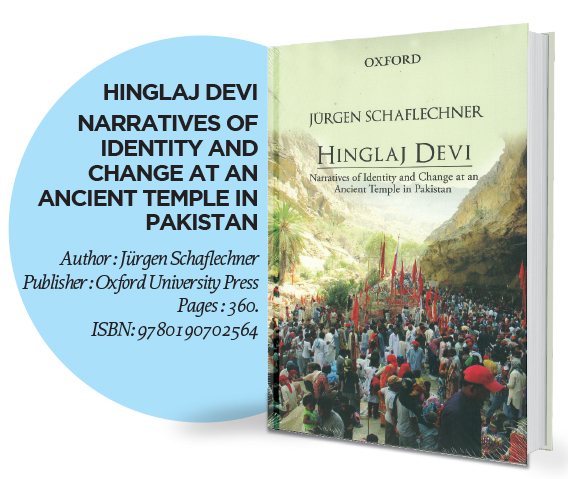
Jurgen Schaflechner’s book is a kaleidoscope of scholarly research and a delightful collection of stories of the Hindu religion’s past and present. It provides the reader with nuggets of history, analytical insight and information on the beliefs and practices of Hindus, the largest minority in the Islamic Republic, observed through the lens of one of the oldest Hindu worship sites in the subcontinent - Hinglaj, located close to the Hingol National Park in Balochistan.
Hinglaj is assumed to be the greatest of all “seats of power” in the world and to be self-generated by its devotees in Pakistan. It is also mentioned in various Sanskrit sources dating between the 10th and 14th centuries and is associated with the legend of the goddess Sati in the Mahabharata. These claims are discussed in detail by the author, citing various sources. The temple is described with the help of photographs and sketches and, although rather grainy, they offer a glimpse of the changing structure of the temple over time.
Analysing anthropological and ontological theories by other scholars, Schaflechner argues that many “truth-claims” about Hinglaj actually produce the shrine and its traditions, as opposed to merely providing a set of beliefs and opinions of people. In other words, the different ways in which worshippers travel to the site and the rites they use shape the totality of the shrine in a dynamic process. While no single claim can be shown to be either true or false, the Hindu identity at Hinglaj is linked to the struggle to make the claims to be heard, some dominating more than the others, depending upon the power wielded by the claimants. Schaflechner discusses the changes at Hinglaj after the construction of the Makran Coastal Highway (MCH) in 2001, the subsequent development at and around the shrine, the changes in the journey and the setting up of the temple committee, the Hinglaj Sheva Mandali (HSM) in 1986, managed by the Lohana community.
The scale of change at Hinglaj can be measured by the difference in number of pilgrims, from a few thousands annually in the 80s to more than 40,000 just for the three day mela in April every year since 2001. The journey that was highly demanding and took weeks only a few decades earlier is easy and the shrine accessible by different modes of transport plying on the MCH, resulting in changing the religious stops and even the reasons for the pilgrimage. Various actors operational at the shrine: the HSM, the Hindu devotees that come to worship there, Sindhi nationalists and provincial governments have all been attempting to produce an uncontested and unified history which Schaflechner calls “solidification of tradition” that is still moving and fluid.
Hinglaj is a key place of worship by all Hindu castes. It is linked with legends of the Khatris and Brahmakshatriyas, both of whose history is connected to Hindu mythology. The Charans, for whom it is mandatory to visit at least once are said to possess a special relationship with Hinglaj. The legend of Rama’s pilgrimage is presented in detail. The book describes differences in the perceptions of Hinglaj by Indian and Pakistani worshippers. Many Muslim readers would find the connection (that has now been wiped out) of Zikri Muslims, with the shrine especially interesting.
There has been a new wave of interest by writers and researchers and many diverse traditions have come forth after the construction of the MCH. Schaflechner describes how the HSM has attempted to unify the story of Hinglaj not only by inclusion of certain rituals and narratives, but also by exclusion, of, for example, the practice of bali which is now assumed to be a Muslim practice. The Lohana HSM, with the power and resources to perpetuate its vision, claims an ideal of “Hinduness” and what Hinglaj should mean to Hindus. At the other end of the spectrum is the Devipujak-Vagri community from Karachi that supports bali and views the HSM and its operations with scorn.
The book is interspersed with stories, case studies and personal accounts of pilgrims and travellers that make a fascinating read and provides a wide coverage of ideas and views. Schaflechner has conducted extensive field work and is careful about making assumptions. His analysis of Hindus in Pakistan is without bias and he has laid out a solid basis which other researchers can pick up from. This book is a rare and valuable addition to understanding of the Hindu identity of Pakistan.
Leave a Reply