



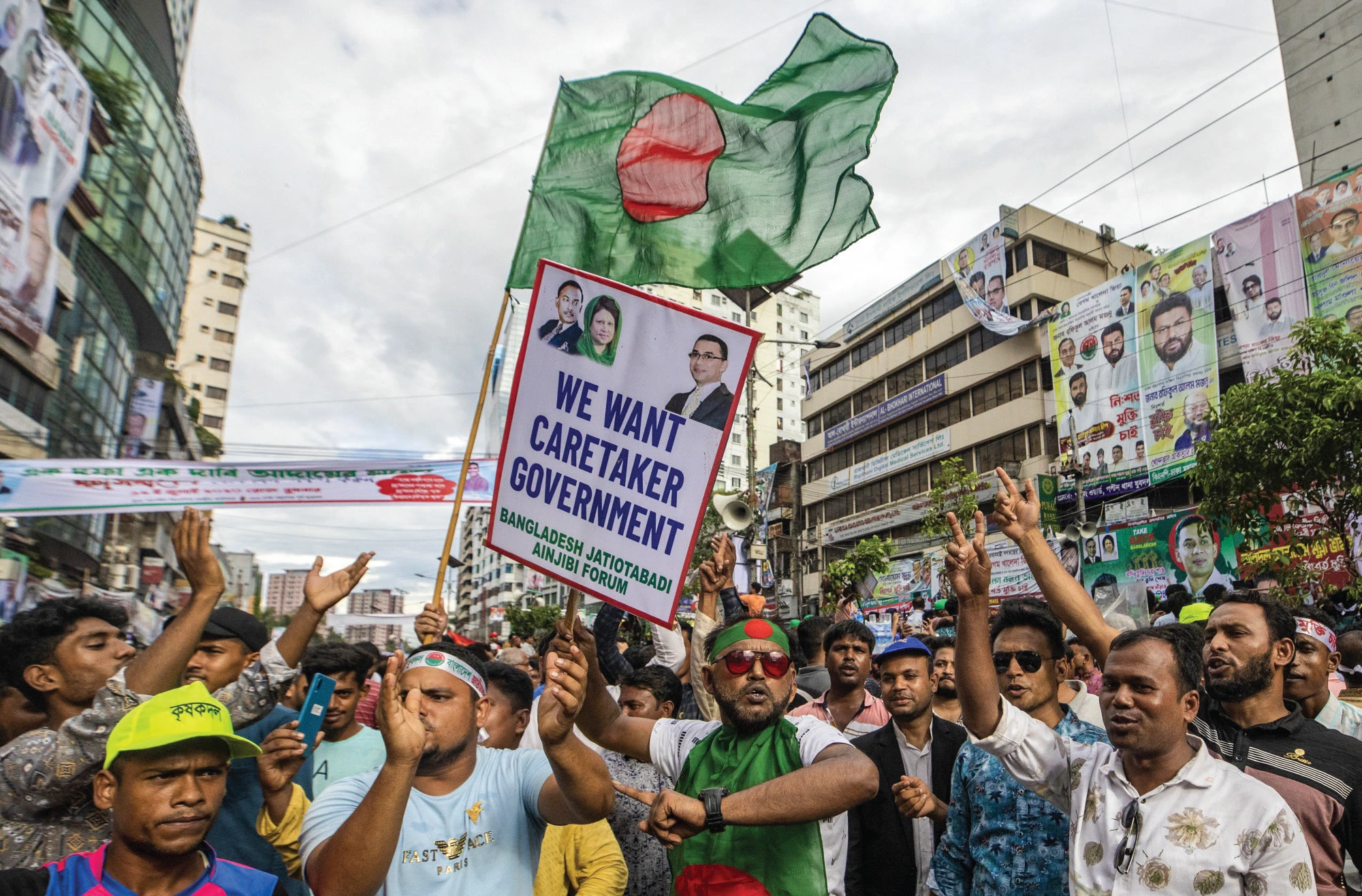
Indoctrination would have us believe that elections are the antidote to these non-democratic practices. However, the electoral process hasn’t always resulted in a democratic revival in Bangladesh. Elections have seldom remained free and fair and have often been characterized by regular rigging and the increased victimization of the opposition.
Political pundits have voiced fears that a similar fate will befall Bangladesh during the forthcoming general elections, scheduled for January 7, 2024. As expected, the polls have become controversial, and the country’s two major political parties have drawn the battle lines. The Awami League (AL), headed by the country’s premier, Sheikh Hasina Wajid, wants to assume public office for a fourth consecutive term. Reluctant to participate in an electoral process spearheaded by the ruling dispensation, the Bangladesh National Party (BNP) wants Hasina to resign. Over the last few weeks, numerous BNP leaders have been taken into custody following anti-government protests. If a news report published in The Guardian is anything to go by, over 10,000 opposition leaders and activists have been rounded up over two weeks. The BNP and its allies have also initiated a countrywide blockade on roads, railway lines, and waterways -- a move that could hamper economic stability in Bangladesh and the rest of South Asia.
At this critical juncture, the electoral process appears to be losing its legitimacy as voters believe they are no longer crucial stakeholders in determining the direction of Bangladesh’s democracy. National elections should be considered internal, consolidating the social contract between the state and the people. Unfortunately, modern-day South Asian democracies have become prisoners to a foreign agenda. As a result, the outcomes of major electoral processes are often motivated by geopolitical forces instead of the people’s will.
Over the last few months, the international community has made a concerted effort to encourage the Sheikh Hasina-led government to ensure that the January 2024 elections are carried out without any irregularities. In early November, the British High Commissioner urged BNP leaders to avoid violence and participate in the polls. The US ambassador also urged Hasina to initiate a meaningful dialogue with the BNP. Earlier this year, the Biden-led US administration introduced visa restrictions on government officials who attempt to thwart the electoral process.
It would be a fallacy to view these moves by international players as well-meaning efforts to infuse democratic values into an otherwise authoritarian political climate. On the contrary, these are calculated steps to create an environment of stability to fulfill their economic and geopolitical interests. The US is keen on ensuring democratic stability as its strategic interests are intricately linked with Dhaka. It is an open secret that the US wants to thwart China’s burgeoning influence in Bangladesh within energy and infrastructural development. Meanwhile, China views Bangladesh as a critical player in its Belt and Road Initiative (BRI) and has established ports along the Indian Ocean to solidify its position in the region. At the same time, strong bilateral ties with Bangladesh will allow China to dampen India’s growing influence in the region.


The writer is a journalist and author. He analyses international issues and can be reached at tahakehar2@gmail.com
Leave a Reply