



In dissecting the deepening Israel-Hamas conflict and its potential repercussions on the India-Europe economic corridor, a comprehensive analysis is essential. This entails a dispassionate exploration of the various dimensions at play, employing a reasoned and logical approach. To begin, unraveling the historical complexities underlying the Israel-Hamas conflict is crucial. Understanding the intricacies of historical grievances, territorial disputes, and the divergence of national narratives provides a nuanced perspective on the situation’s complexity in the Middle East.
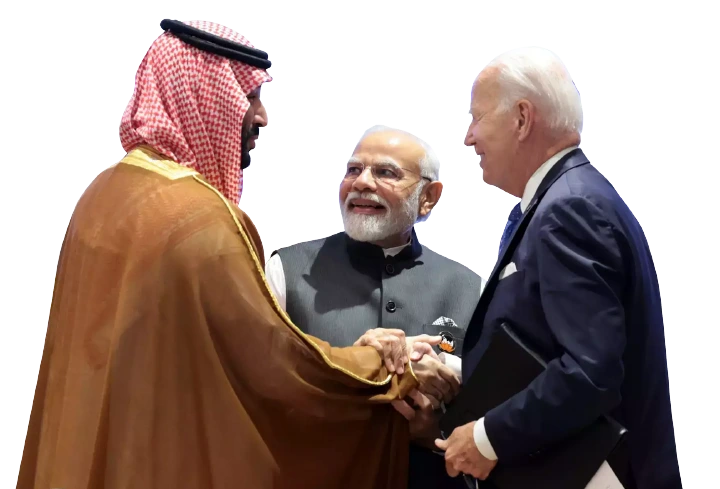
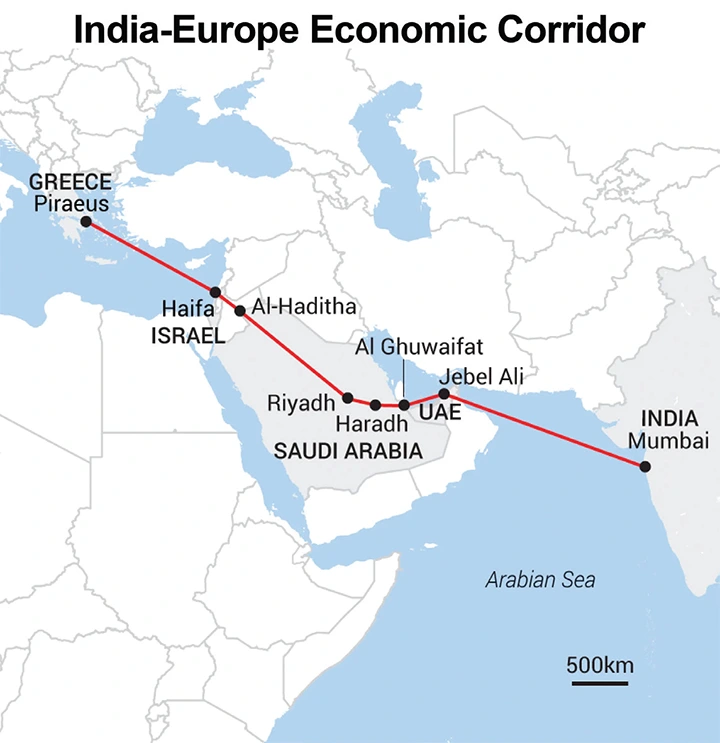
Announced at the Group 20 Summit held in India this year, the India-Middle East-Europe Economic Corridor, or IMEC, is seen as an alternative to China’s Belt and Road Initiative (BRI). The United States, the European Union, and Saudi Arabia back it. However, after the incessant strikes conducted by Israel in the aftermath of the October 7 attack, the possibility of a potential spillover into the economic realms poses a great risk for IMEC.
In recent months, the conflict has witnessed a surge in violence, with an increasing number of casualties and widespread destruction in the affected regions. Indian Prime Minister Narendra Modi has described IMEC as the “basis of world trade for hundreds of years to come.” These ground realities underscore the urgency of delving into the potential repercussions on the economic corridor connecting India and Europe.
Shifting the focus to the economic corridor connecting India and Europe, it becomes evident that an appreciation of the intricate web of global interdependencies is imperative. This corridor, symbolic of the modern era’s economic interconnectedness, intricately weaves trade and investment across continents. The delicate balance between economic interests and geopolitical stability necessitates careful consideration, as disruptions in one region may reverberate globally. In the tumultuous unfolding of the Israel-Hamas conflict, the repercussions extend beyond the immediate battleground. Israel’s retaliatory actions in the Gaza Strip, resulting in the tragic loss of thousands of civilian lives, have cast a shadow over diplomatic relations in the Middle East.
The corridors of power in Riyadh and Amman now tread cautiously on the prospect of rapprochement with Israel. Joost Hiltermann, Program Director, Middle East and North Africa at Crisis Group, cautions that any move towards Israeli-Saudi normalization will likely face delays. The Saudi public’s outrage at Israel’s assault on Gaza compels Saudi leadership to navigate this delicate terrain with utmost care. The people’s sentiment becomes a critical factor, demanding a nuanced and cautious approach to diplomatic initiatives as the repercussions of the conflict resonate through the geopolitical landscape. Moreover, further exploration of the potential impact of the escalating Israel-Hamas conflict on the India-Europe economic corridor reveals a cascade of intricacies. The Middle East’s strategic role in oil production implicates the energy supply chain, introducing fluctuations that could resonate through the corridor, affecting trade and economic activities.
Diplomacy emerges as a linchpin in navigating the complexities of global affairs. The responses of nations engaged in the economic corridor assume paramount importance. A nuanced approach, rooted in constructive dialogue and a commitment to addressing the root causes of conflicts, becomes imperative to safeguard the stability necessary for sustained economic growth.
 Ethical considerations assume a prominent role as the conflict unfolds. Scrutiny of the ethical dimensions of economic relationships takes center stage. Nations participating in the India-Europe economic corridor find themselves at a moral crossroads, prompting questions about the responsibility to leverage economic influence to promote peace and stability in conflict-ridden regions.


Salis Malik is a freelance journalist and columnist based in Islamabad. He can be reached on Facebook @salismalik7777
Leave a Reply