



Throughout history, the ruled have harboured grievances against their rulers, but the means of expressing those grievances have varied. Some have turned to literature, others to the arts, and still others to open resistance aimed at compelling rulers to acknowledge or redress injustices. A few, however, have resorted to self-abnegation in an altruistic attempt to give voice to the voiceless. Although not unique to India, this practice of protesting against oppressive policies and articulating the suffering of marginalised people has a distinctive place in Indian history.
Mahatma Gandhi transformed fasting from a personal discipline into a central instrument of political action. Between 1918 and 1948, he undertook numerous fasts to protest against colonial policies, communal violence and untouchability. His 1932 fast against separate electorates for the Depressed Classes culminated in the Poona Pact with B.R. Ambedkar. By putting his life at risk, Gandhi sought to compel those in power to address his demands and grievances. In doing so, he recast protest as an ethical act rather than merely a form of confrontation. Meanwhile, Jatindra Nath Das and Bhagat Singh resorted to hunger strikes in colonial prisons to demand better treatment for political prisoners.
After independence, hunger strikes evolved to address the demands of a democratic society. Potti Sriramulu’s 58-day fast in 1952, undertaken to demand a separate Telugu-speaking state, ended in his death. His death triggered widespread unrest and ultimately led to the creation of Andhra State in 1953, paving the way for the linguistic reorganisation of India’s states. Similarly, Irom Sharmila’s prolonged fast, which lasted from 2000 to 2016, against the Armed Forces (Special Powers) Act (AFSPA) in Manipur attracted international attention.
The anti-corruption fast undertaken by Anna Hazare at Delhi’s Ramlila Maidan in 2011 mobilised millions through extensive media coverage and increased pressure on the government to enact the Lokpal Bill. Medha Patkar’s and G.D. Agarwal’s fasts in campaigns concerning the Ganga, environmental protection and the rights of affected communities, along with more recent hunger strikes by farmers’ leaders, have kept the practice alive in struggles over land, livelihoods and ecological preservation.
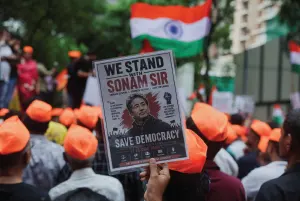
More recently, Ladakhi engineer, educator and climate activist Sonam Wangchuk has carried this legacy forward. Known for his innovations and educational reforms, which inspired aspects of the Indian film 3 Idiots (2009), Wangchuk undertook a climate fast in Leh in 2024, demanding the extension of Sixth Schedule protections to Ladakh and safeguards for its fragile Himalayan ecosystem. In 2026, he joined protests organised by the Cockroach Janata Party at Delhi’s Jantar Mantar and began an indefinite hunger strike, demanding accountability for examination irregularities, including the alleged NEET-UG paper leak, and the resignation of Union Education Minister Dharmendra Pradhan. He reportedly survived for weeks on salt water, lost considerable weight and was eventually hospitalised amid concerns about his deteriorating health. After 26 days, he ended his fast following negotiations, illustrating both the potential of hunger strikes to pressure those in power and the practical limits of the tactic.
 Second, hunger strikes exert pressure on those in power and the institutions that sustain them. Ordinary citizens and civil society groups often lack access to parliamentary majorities, influential media platforms and bureaucratic decision-making. A hunger strike raises the stakes and creates a sense of urgency. As the protester’s health deteriorates, media coverage intensifies, opposition leaders may rally to the cause, and the authorities face mounting public pressure. The possibility of a protester’s death can also threaten the ruling party’s political credibility.


The writer, who is based in Kandhkot in Sindh, is a passionate freelance journalist. He can be reached at alihassanb.34@gmail.com.
Leave a Reply