



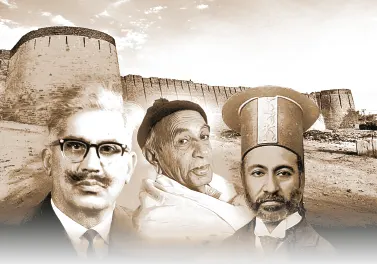
Pakistan owes its geography, creation, independence, geostrategic importance, sea and seaports, long coast, delta, culture and civilization, history and historic heritage, and continued nationhood to Sindh as the core land after Bengal’s secession. Balochistan serves as a buffer to protect Sindh and Pakistan.
History witnesses the fundamental role Bengal and Sindh, and their leaders, played in concretizing the dream of Pakistan. Our shortsighted leaders tried to distort the history of the movement for Pakistan, but the facts, being stubborn realities, resurface from underneath the layers of falsity. History was distorted, schoolbooks rewritten, and the speeches of Quaid Muhammad Ali Jinnah altered, but the facts remained unchanged in the pages of history.
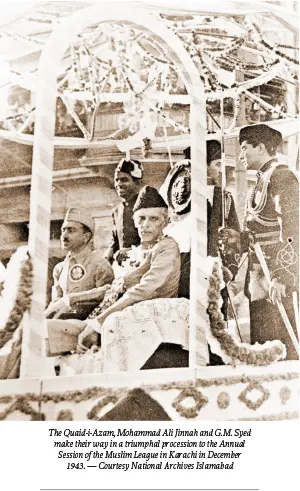
Pakistan was an abstract theory, a concept, and a dream. Bengal and Sindh took the lead in providing geography, territorial space and boundaries, and a heritage of history, culture, and civilization for this dreamland. Under the dynamic leadership of the Quaid, the All India Muslim League began its practical political odyssey from the despairing electoral defeat of 1937; and passed through the historic Pakistan Resolution of March 1940; the Direct Action of 1946; the electoral success in 1945 and 1946, acquiring the status of the sole representative of the Muslims of the Subcontinent, and finally reaching the milestone of the creation of two successive states in a short span of ten years. In this short but eventful journey, Bengal and Sindh played decisive roles. Punjab remained on the fence and joined this caravan only months before independence.
The country and the nation it sought appeared on the world map on August 14, 1947. The Quaid had staked his health, personal life, and comfort for the success of his struggle. He lived with us for hardly a year in his independent Pakistan. He did not have time to set his dreamland on a democratic path and transform his people, from diverse cultural, ethnic, and linguistic backgrounds, into a democratic, progressive, liberal, and modern nation. His successors miserably failed his country and his people, indulging in adventurism and futile experimentation with diverse political governance systems tailor-made to the ambitions of autocrats, authoritarians, dictators, military rulers, and even Martial Law administrators. This ugly practice has continued unabated. The Quaid did not achieve Pakistan for such adventures.
 The entire nation has apparently once again engaged in a futile discussion on how to address the governance challenge confronting the country. Patriots started feeling this challenge from the day the last military ruler, General Pervez Musharraf, was forced by the mainstream political leaders from the platform of the National Assembly to resign and go into exile or face impeachment. His autocratic rule of nine years, clothed in a sham democracy, did not elicit any protest from any quarter. Our shameless politicians even voted him to become President of this country in his military uniform. They were none other than Gujarat’s political dynasty, leading the king’s party.
The new subject spellbinding the nation was cleverly broached through Interior Minister Mohsin Naqvi, who not only condemned the existing system of governance but also sought to establish new administrative units by altering the geographical limits of the existing federal units. All this is meant to set up a new system of governance, or an altered version of an old system, tailor-made to the political ambitions of his political bosses and, most probably, clearly distinguishable from the long list of our past political and administrative governing structures, already tried and discarded.
The first Constituent Assembly, under the stewardship of Sindhi leader Zulfikar Ali Bhutto, adopted the 1973 Constitution after the tragic loss of most of the country to a coterie of generals under a Legal Framework Order promulgated by General Yahya Khan. Z. A. Bhutto was called to take over power when the extraordinary circumstances after the breakup of the country were spiraling out of control, with young officers rebelling against their seniors in almost all cantonments. Bhutto left no stone unturned in rehabilitating the truncated Pakistan.
 He raised the sagging morale of the nation and moved like a hurricane, grappling with the post-war issues, restoring the confidence of his people, reintegrating Pakistan into the international comity of nations as a viable and vibrant state, and even making it the leader of the Muslim world after the OIC Summit at Lahore in 1974. This was the rebirth of Pakistan, midwifed by a son of Sindh, Z.A. Bhutto. Only a leader with Bhutto’s political acumen could have saved and re-established the remaining smaller part of Pakistan as a viable country. He was meted out very disgraceful treatment after his overthrow in a military coup.


Based in Karachi, the author is a seasoned professional who previously served as a member of the Foreign Service of Pakistan and enjoyed a seven-year tenure as an Ambassador. Feel free to get in touch at brohialam7@gmail.com.
Leave a Reply