The ghost of One Unit continues to haunt Pakistan’s debates over provincial boundaries, while the legacy of the FATA merger remains contested. Any attempt to dismantle established political structures, however, carries the risk of deepening political instability and producing disastrous consequences that could endure for generations.
ByYousuf Sajjad | October 2026
Since Pakistan’s inception in August 1947, the country has once again been confronted with the controversial proposal to break up its existing four provinces into several smaller units. Similar attempts have been made in the past to dismantle Pakistan’s provinces and their identities. One notable example is the One Unit scheme of 1955, an administrative policy that merged all the provinces of present-day Pakistan into a single entity known as West Pakistan in order to counterbalance the Bengali majority in East Pakistan.
The creation of One Unit remains a potent symbol of humiliation for having completely disregarded the voices of the electorate. When it was carried out, it was a deliberate bid to reduce the political weight of the majority in East Pakistan.
In 1954, seven years after independence, Pakistan held its first free elections for the provincial assembly of East Bengal—the name of the province at independence that later became East Pakistan. As East Bengal had a clear Bengali majority, the election was contested by a coalition of Bengali parties known as the United Front. Spanning the political spectrum from left to right but anchored by Bengali nationalist parties, the United Front defeated the Muslim League, which had controlled the government since independence through favoured politicians.
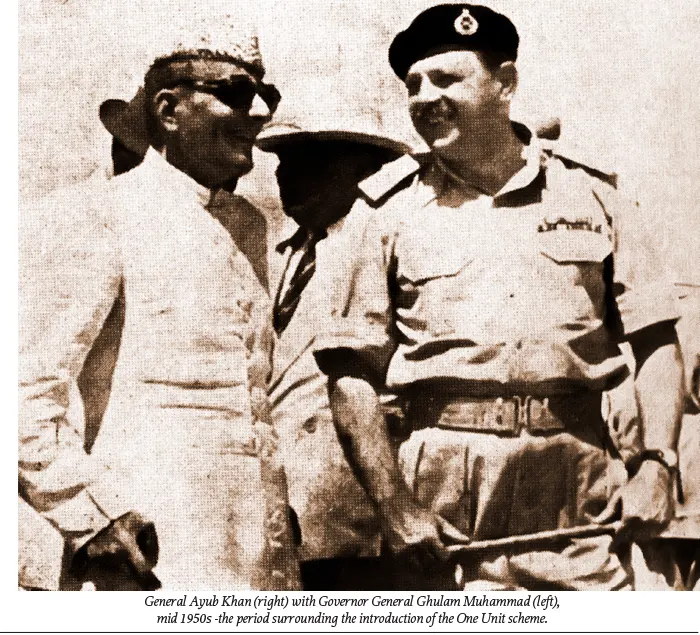
Seven years had allowed resentment to build against the poor management of the leadership the province inherited at independence. Public concerns centred on development, the needs of the people, and a growing cultural assertion of Bengali as the mother tongue. Meanwhile, the central government in Karachi viewed provincial leaderships with increasing suspicion as its own failures mounted, and it struggled to produce a constitution. Power in Karachi had come to rest with bureaucrats such as Governor-General Ghulam Muhammad, feudal landlords, and politicised military figures including General Ayub Khan.
Confronted with the United Front’s victory, the centre sent Iskander Mirza to Dhaka as Governor. Using extensive colonial-era powers, he dismissed the United Front government and ordered the arrest of several of its members. The move was widely regarded as arbitrary and anti-democratic, yet the United Front lacked the strength to resist, and there was little effective opposition at the federal level or in the other provinces.
The clique around Ghulam Muhammad and Iskander Mirza then revived an earlier plan to dissolve the western provinces and merge them into a single unit called West Pakistan. Merging the provinces would eliminate their separate assemblies—important arenas in which political figures could emerge outside the centre’s control—and create a western entity whose weight could counterbalance East Bengal’s majority. The proposal was blatantly anti-democratic, and its implementation was equally coercive.
Ghulam Muhammad and Mirza pressured and persecuted politicians across the western wing, removing recalcitrant chief ministers in Sindh and Punjab and replacing them with more pliant figures. The suppression of the United Front and the arrests in East Bengal created a climate of fear that made remaining provincial assemblies more susceptible to threats and inducements. Through this combination of coercion and political pressure, all the provinces and princely states outside East Bengal were dissolved, and West Pakistan was created as a single administrative unit. The consequences shaped some of the most defining moments in Pakistan’s history, including Ayub Khan’s military coup in 1958 and the eventual break-up of the country in 1971.
Those seeking to break up Pakistan’s existing provinces risk repeating a pattern associated with such controversial political figures as Ghulam Muhammad, whose actions reshaped the country’s political institutions, or with the Pakistani Taliban, whose agenda has challenged the existing order
After East Pakistan’s separation, the former eastern wing ceased to be relevant to debates over provincial boundaries. The provinces familiar today were restored in 1970 following the uprising against Ayub Khan, and One Unit was abolished. This left the Federally Administered Tribal Areas (FATA)—comprising Kurram, Bajaur, Khyber, Mohmand, Orakzai, North Waziristan and South Waziristan—as a distinct territory rather than a self-governing province.
Following the U.S.-led invasion of Afghanistan in 2001, militants including members of the Taliban and Al Qaeda crossed into FATA and established networks there. The Pakistan Army began operations in the area in 2002, with major campaigns in 2009 and 2014. In 2018, FATA was formally merged with Khyber Pakhtunkhwa under the 25th Constitutional Amendment. Although state administration has since been extended over the territory, the merged districts remain vulnerable to insurgency. Since the Afghan Taliban’s return to power in 2021, the area has continued to be a focal point for militant activity, with the Afghan Taliban accused of providing support and sanctuary to the Pakistani Taliban.
Why discuss the former FATA districts alongside One Unit? Because renewed talk of breaking up Pakistan’s provinces makes it relevant to recall that one long-standing demand attributed to the Pakistani Taliban since 2021 has been the separation of the merged districts from Khyber Pakhtunkhwa. Opponents of such a change argue that it could leave the area more vulnerable to militant influence and control.
Pakistan’s provinces predate the creation of the country itself. Their Muslim-majority territories were brought together to form Pakistan and encompass relatively coherent ethnic and linguistic identities. In this sense, the provinces have provided a stable political framework within which major ethnic groups can express and preserve their identities without necessarily destabilising the state. To dismantle these provinces or tamper with their constitutional structure—particularly to preserve the positions of ministers who have assumed responsibilities beyond their capacity—risks echoing the politics of Ghulam Muhammad and the assault on Pakistan’s early democratic institutions that helped set the country on a path towards instability and, ultimately, break-up.
The Constituent Assembly that Ghulam Muhammad dismissed in 1954 was preparing both to curtail the powers of the Governor-General and to complete Pakistan’s long-delayed constitution. Instead, he dismissed the Assembly and, together with Iskander Mirza, pursued One Unit and a constitutional order shaped by the ruling establishment rather than by elected representatives. Within a year, Ghulam Muhammad himself was removed by Mirza, and a few years later, Ayub Khan forced Mirza into exile, despite their joint role in Pakistan’s first military coup.
Those seeking to break up Pakistan’s existing provinces risk repeating a pattern associated with such controversial political figures as Ghulam Muhammad, whose actions reshaped the country’s political institutions, or with the Pakistani Taliban, whose agenda has challenged the existing order. Such actors may eventually pass from the scene, but the consequences of the changes they set in motion can endure long after they are gone. Dismantling established political structures risks setting the country on a path towards instability, with consequences that could prove disastrous for generations to come.






Leave a Reply