



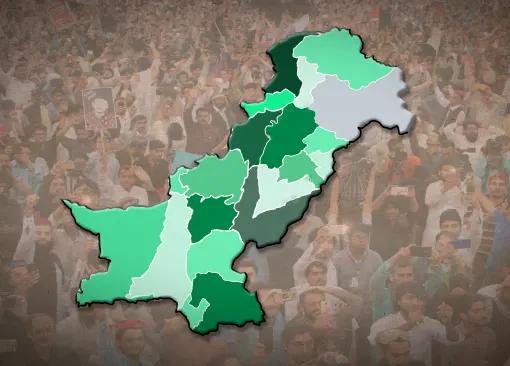
Why, in the almost 80 years since the inception of Pakistan, has the country, in the post-1971 era, had only four provinces despite significant disparities in power, population and demography? The debate over transforming Pakistan’s provincial map was revived by a recent statement from the federal interior minister, who argued that “the system has collapsed” and that the way forward was to create new administrative units.
Why, unlike India, which has 28 states and eight Union Territories, and Afghanistan, which has 34 provinces, does Pakistan, with a population of more than 250 million, have only four provinces? Gilgit-Baltistan (GB) and Azad Jammu and Kashmir (AJK) are not provinces of Pakistan, but are administered separately from the four provinces.
Currently, Pakistan has 32 administrative divisions across its four provinces. Recent proposals have called for these divisions to be transformed into empowered administrative units. Islamabad, the capital territory, is administered separately from the provinces. The Constitution of Pakistan provides a legal and constitutional procedure for creating new provinces or altering provincial boundaries. Under Article 239 (4), a constitutional amendment altering the limits of a province requires approval by the relevant provincial assembly with a two-thirds majority, in addition to the constitutionally prescribed two-thirds majorities in Parliament. The Constitution does not, however, provide for simply upgrading existing divisions into provinces or autonomous administrative units. Any such restructuring would therefore require an appropriate constitutional and legislative framework.
Since 2010, the debate over the creation of South Punjab, Bahawalpur and Hazara provinces has been repeatedly revived but has failed to reach a logical conclusion. During the PTI government, a separate civil secretariat was established in South Punjab to facilitate administration and development in the region. That arrangement was subsequently restructured by the PML-N government.
It is ironic that, instead of approaching the transformation of Pakistan’s provincial map through logic and reason, political power-brokers have often pursued narrow, parochial and contradictory approaches. The military establishment, which has at times appeared to favour the creation of administrative units rather than provinces on ethnic and linguistic grounds, has also faced criticism for lacking clarity and consistency on the issue. Meanwhile, questions of good governance, the rule of law, an effective justice system and the empowerment of local government receive insufficient attention from those advocating new administrative units or provinces.
Even if Pakistan’s four provinces were transformed into 32 administrative units, this alone would not resolve the country’s economic, political and governance problems if the underlying system remained corrupt and inefficient. Unless resources at the federal and provincial levels are used judiciously, and problems relating to the economy, governance, the rule of law, health, education and infrastructure are addressed, the creation of new administrative units or provinces is unlikely, by itself, to produce meaningful results.
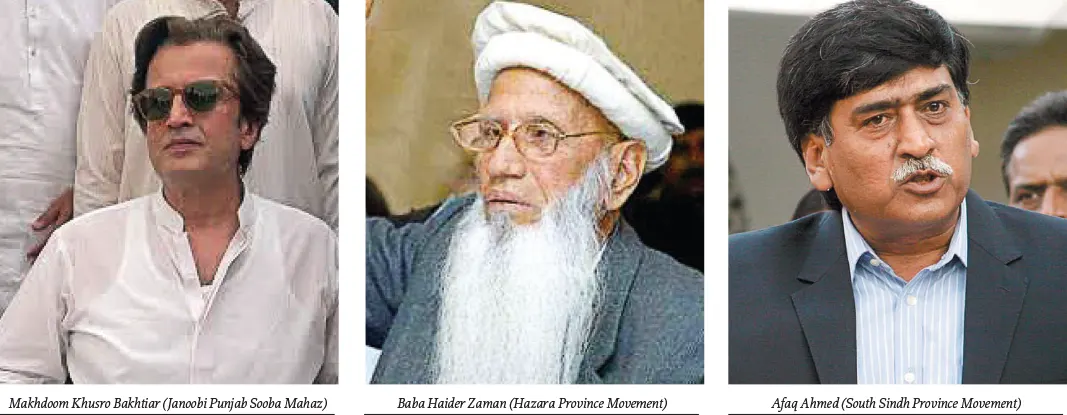
The lack of a coherent rationale behind the debate on new administrative units needs to be examined through critical analysis. In this regard, three major realities can be identified.
First, Pakistan’s weak research and reading culture, coupled with shortcomings in work ethics, often results in debates on major national issues being driven more by assertion than by evidence. Personal and group interests frequently take precedence over the national interest, while the so-called hybrid system, lacking sufficient political will, has been unable to take practical steps towards restructuring the provincial map.
When strategic thinking is absent, and a myopic approach dominates public discourse on major issues, the result is stagnation, as has happened with the debate over new provinces and administrative units. In the absence of meaningful, path-breaking research examining the costs, benefits and practical implications of creating new administrative units, those advocating such changes struggle to take the debate to its logical conclusion.
 When those who wield state power themselves lack clarity and vision, how can one expect a society burdened by economic hardship and restrictions on fundamental freedoms to take a considered position on creating new administrative units? As a result, the debate over changing Pakistan’s provincial map, which has continued for years, remains largely devoid of practical outcomes.
 These contrasting positions and the absence of a consistent national framework suggest that the debate over restructuring Pakistan’s provincial map is likely to remain unresolved unless political parties develop a broader consensus on the issue.

Based in Karachi, the writer is a Meritorious Professor of International Relations and former Dean of the Faculty of Social Sciences at the University of Karachi. He can be reached at amoonis@hotmail.com
Leave a Reply