


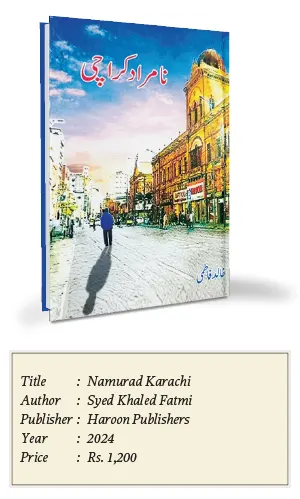
The book Namurad Karachi by Syed Khaled Fatmi, a veteran Urdu journalist, analyst, and writer, deserves high praise. Through his recollections and conversations with friends and fellow citizens reflecting on Karachi’s past, Fatmi poignantly captures the city’s pain and tragedy. Yet, beneath its portrayal of the city’s glorious past and its subsequent decline by design, the book reads less as an account of Karachi’s misfortunes alone than as a lament for Pakistan’s own steady fall from grace.
The author deserves credit for fearlessly chronicling Karachi’s tragic decline, largely at the hands of the establishment, which has pursued a Karachi-specific agenda of ‘divide, destroy, and dominate’ through both direct intervention and the use of proxies. At several points, he even names individuals and cites his sources. The systematic destruction, set in motion during Ayub Khan’s rule, was carried forward by the MQM, almost as though it were an act of charity.
From Karachi’s literary life and the excesses of its elite to the injustices of the quota system, startling accounts of wife-swapping among celebrated figures, and the tragedy of young men turning Kalashnikovs against their fellow citizens, Fatmi leaves no subject untouched. He explores prostitution and vice, recounts allegations of intelligence operatives embedded among beggars and at paan stalls, and describes the free flow of liquor and kebabs in officers’ clubs, alongside police raids on brothels. While the author’s presence at some of these scenes may not be surprising, his willingness to document such details so candidly is remarkable.
Had the author or any other outspoken individual published all this on social media, he might by now have met a fate similar to that of the slain journalist Arshad Sharif. The author also exposes certain personal weaknesses and unsavoury habits of some well-known figures. In my view, these details could have been omitted, as they have little to do with Karachi’s misfortunes.
The author highlights several hardships confronting the city, paying particular attention to the deplorable state of its hospitals and the predatory practices that prevail there. One can agree, to a certain extent, with his contention that, from the 1990s onward, Karachi was deliberately divided, allegedly through a calculated conspiracy, into two distinct groups along linguistic and religious lines in the aftermath of the MQM’s rise. The city’s subsequent fragmentation into multiple groups along these same lines lends further weight to his argument.
The author’s deepest sorrow appears to stem from the loss of the relatively liberal Karachi of the 1960s and 1970s—a city immersed in its own pleasures, where wine and revelry were readily accessible and where, in his eyes, the burqa worn by women today has become something of a fashion statement. Yet a closer look at the social backgrounds of the migrants who came to Pakistan at Partition presents a different picture. Many of these families came from conservative, family-oriented, and religious backgrounds in which the traditions of purdah and veiling were carefully observed. The author, it seems, views Namurad Karachi through a particular lens, one that reflects, more specifically, the outlook of Karachi’s elite.
Karachi is searching for its own culprits. For years, we have heard the lament that no one cares about the city. Yet, in these vivid, fact-based observations, Karachi’s people can clearly recognise the repulsive faces of those responsible for reducing it to its present state—individuals who, like vultures, have preyed upon the city, showed little concern for its welfare in the past, and appear no more willing to care for it even today.
In the author’s words, Karachi is Dubai, as well as the country’s largest goth, especially for those who migrate there from across the country.
Leave a Reply