


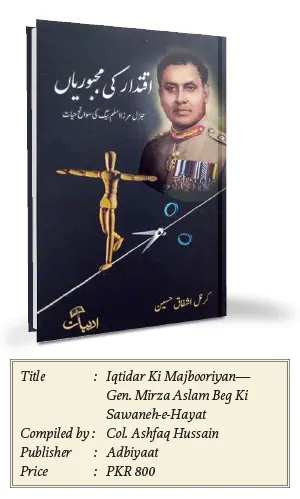
Compiled by Col. (retd.) Ashfaq Hussain, from extended conversations with General Mirza Aslam Beg, Pakistan’s former Chief of Army Staff, the book titled Iqtidar Ki Majbooriyan—Gen. Mirza Aslam Beg Ki Sawaneh-e-Hayat offers a personal account of an important period in the country’s political and military history. More than the story of a general who rose through the ranks to become army chief, it also explains the pressures, disagreements, and difficult choices he faced in uniform, particularly during his tenure at the helm of the Pakistan Army.
The title invites readers to look beyond familiar arguments about who held power and who exercised it.
Gen. Beg assumed command of the Pakistan Army in August 1988, following the death of Gen. Zia-ul-Haq in an air crash. It was an extraordinary moment. The president, the army chief and several senior military officers had been killed. The country was left facing uncertainty at a time when the Afghan war was drawing towards its conclusion, and Pakistan’s internal political arrangements were under strain.
For the incoming army chief, this was not a routine change of command. It was a test of judgement at a moment when the military held enormous influence over the state’s future direction. A decision to impose martial law, support a political arrangement, or allow elections to proceed would have shaped the country’s immediate future. Gen. Beg’s account of this transition is therefore central to understanding the book.
As the narrative presents it, he argued that the army could have taken direct control but chose not to impose martial law. The subsequent elections brought Benazir Bhutto to the prime minister’s office. This was a significant development in a country where the military had exercised direct political authority for long periods.
Yet the restoration of an elected government did not settle the question of civil-military relations. The prime minister had a popular mandate, while the army chief commanded an institution with its own professional outlook, security concerns, and established influence over national affairs. Both held authority, but their understanding of its limits was not necessarily the same.
This is where the title acquires a deeper meaning. An army chief may believe that he is protecting national interests by advising, restraining, or questioning an elected government. A prime minister, on the other hand, may regard the same conduct as interference in the constitutional domain of her government. The difficulty lies in deciding where professional military advice ends and political intervention begins. General Beg’s recollections provide an opportunity to examine this uneasy relationship from the perspective of the man who occupied the army’s highest office.
His relationship with Benazir Bhutto is particularly relevant. The two came from very different political backgrounds and had reasons to distrust each other. Nevertheless, published accounts of the book describe General Beg as acknowledging her commitment to Pakistan’s defence and nuclear programme. The book also brings the reader face to face with the military’s own world. The journey from the Pakistan Military Academy to the higher command is one of training, discipline, responsibility and the gradual widening of perspective.
General Beg’s discussion of the Afghan war and its aftermath is another important part of this account. The nuclear programme forms another important subject. The book’s treatment of General Zia-ul-Haq’s death is equally significant.
The book is best approached neither as a final verdict on Pakistan’s political history nor as a defence of one man’s record. It is a personal account that opens a window into the thinking of a former army chief during a difficult period. Its assertions invite comparison, its recollections deserve examination, and its unanswered questions provide ground for further research.
Leave a Reply