



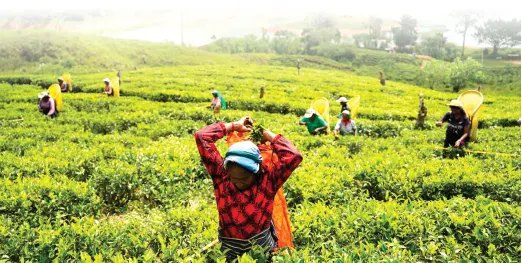
Sri Lanka’s tea industry is facing a growing crisis as the war involving Iran, the United States and Israel disrupts shipping routes, increases export costs and threatens the livelihoods of millions of people. What may seem like a distant geopolitical conflict has become a direct economic concern for the island nation, where tea is not merely a traditional beverage but also a major source of foreign exchange, employment and rural income.
According to an EconomyNext report published on 18 March 2026, Sri Lanka’s tea industry, valued at approximately US$1.5 billion, was experiencing severe logistical disruption, with exporters reporting that finished products were accumulating in warehouses because they could not be shipped. The crisis exposes the vulnerability of export-dependent economies to geopolitical instability and raises an important question: how can Sri Lanka protect its workers and businesses when international conflict threatens the foundations of its economy?
Sri Lanka is one of the world’s leading tea exporters, and Ceylon Tea enjoys an established international reputation. However, a substantial share of its exports has traditionally gone to the Middle East and North Africa, as well as to markets in Russia, the Commonwealth of Independent States, Europe and East Asia. According to industry representatives cited by EconomyNext, disruption across the Middle East and North Africa could affect 60–70 per cent of total tea exports, although this estimate describes potential exposure rather than confirmed losses of that magnitude.
The conflict has affected both the destinations for Sri Lankan tea and the routes used to reach international buyers. Disruptions around the Strait of Hormuz and the Red Sea, combined with difficulties at major transit hubs such as Dubai and Doha, have complicated established shipping arrangements. Vessels rerouted around the Cape of Good Hope face longer journeys, higher fuel consumption and delayed deliveries. The consequences extend beyond transportation. Exporters must contend with higher insurance premiums, emergency shipping surcharges and uncertainty over whether buyers will receive their orders. In some cases, war-risk insurance premiums have risen dramatically, while additional charges imposed by shipping companies are increasing the cost of transporting containers. These expenses threaten to make Sri Lankan tea less competitive in international markets.
The problem is particularly severe when exporters have already purchased, processed, and packaged tea but cannot deliver it. Warehouses fill up, working capital becomes tied up in unsold inventory, payments are delayed, and businesses face pressure to cut purchasing costs. Eventually, that pressure can travel backwards through the supply chain, affecting farmers and plantation workers. The economic consequences are not confined to exporters or financial markets. Sri Lanka’s tea industry supports approximately 2.4 million people, while nearly half of its Ceylon Tea exports, worth around US$680 million annually, have traditionally gone to Middle Eastern markets. These figures illustrate the industry’s scale, although the number of people supported includes livelihoods beyond direct plantation employment. For plantation workers and smallholder farmers, declining prices and uncertain demand can threaten already limited household budgets. Workers may earn less or face fewer employment opportunities, while smallholders may struggle to cover fertiliser, transport and other production costs. Families already facing rising food and energy prices have even less capacity to absorb these shocks.


The writer, based in Islamabad, holds a Master’s degree in Defence and Strategic Studies. He can be contacted at daniyaltalat2013@gmail.com.
Leave a Reply