



Ancient routes of the world brought prosperity to one part of the world, as colonisers plundered lands for resources to take back to their own countries, while depriving and enslaving indigenous populations. Present-day routes are being redrawn to recreate the grandeur of yore. Then there are the straits, and when it comes to these trade corridors, especially since the early part of this year, the Strait of Hormuz has become a major chokepoint, sending financial shockwaves across the world.
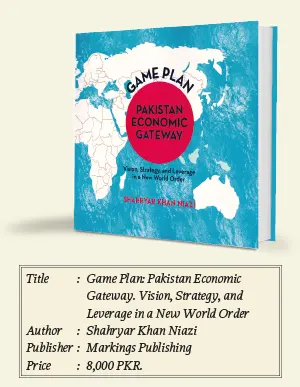
Shahryar Khan Niazi, the author of Game Plan: Pakistan Economic Gateway: Vision, Strategy, and Leverage in a New World Order, the book under review, puts the Game Plan into perspective through the lens of geography, while viewing it through the kaleidoscope of history and evolving geopolitics.
In 13 chapters, from ‘Euro-Atlantic: Blast from the Past’ to ‘The Re-emergence of the Pax Sinica’, the author takes the reader on a journey through ancient lands and new and prospective economic corridors. In the introduction to the book, the author writes that it ‘provides a roadmap for Pakistan to become a formidable power; however, governance and resourcing strategies will determine Pakistan’s success and position in the world order’.
The author is a strategist with more than two decades of experience working on Pakistan. His career includes a stint at the Foreign and Commonwealth Office, where he won the Secretary of State Award in 2010.
Through 33 maps across the book, the author highlights key themes that every policymaker, international affairs student, or anyone interested in how the world’s economic gateways work should consider exploring. The book offers a quick peek into maritime chokepoints and alternative means of circumventing them, allowing global trade and the movement of goods to continue without disrupting supply chains.
Drawing on history, Niazi writes that the ‘second Cold War has begun and is being played out in Eastern Europe, the Middle East, South Asia, and Southeast Asia’.
With a focus on Pakistan, he cautions the country against complacency, noting the complexity and lethality of the second Cold War. He writes: ‘Pakistan, with its fragile economy and looming security threat, will be far more vulnerable than it was during the first Cold War, and it cannot afford to be complacent. Pakistan must build a credible deterrence against asymmetric and conventional threats.’
In the chapter ‘Chagai: The Capital of Low-Carbon Battery Minerals’, the author discusses Chagai, ‘the ultimate treasure trove’, which is ‘rich in minerals and renewable resources while also functioning as a passageway to Europe and West, Central, and East Asia’.
For those who agree with Judy Martz that ‘Everything has to do with Geography’, this book is worth picking up to learn how existing and potential trade corridors can help shape history, and why ancient routes still matter, perhaps even more, in today’s world.
In the book, the author takes the reader on a journey through the oceans and land routes, helping policymakers assess why economic gateways across land and sea can make or break nations.
Leave a Reply