
Cover Story
Popularity vs. Power
Imran Khan may be the most popular leader, but it is hard to take on the power of the state

It has been a common phenomenon in Pakistan’s turbulent political history for power to alternate with prison. This has been true of almost every political leader who has reached the highest echelons of power. One elected prime minister was executed after being ousted in a military coup; both prime ministers and presidents have spent time behind bars. Former prime minister Imran Khan’s fate is no different. A former cricketing hero turned political leader, he rose to power on the strength of both the ballot and the support of the all-powerful security establishment.
For years, the establishment fed the public a narrative portraying a former cricketing hero as a saviour, while other political leaders were dismissed as corrupt and incompetent. But, true to our political culture, Khan too was removed halfway through his term — not through a military coup, but through a vote of no confidence, made possible by the withdrawal of the very forces that had helped him come to power. The astronomical surge in his popular support after he was ousted likewise stemmed from that same long-promoted narrative.
The causes of the anti-establishment backlash were equally rooted in the system that has long been manipulated to maintain the institution’s dominance. Besides his vitriolic rhetoric against his erstwhile patrons, Khan also alleged that the United States was orchestrating regime change. This helped whip up public sentiment and fuelled the protests. His growing popularity and frontal attack on the new military leadership brought the confrontation to a head.
His arrest on 9 May 2023 triggered violent attacks in Punjab and Khyber Pakhtunkhwa, targeting military installations. The military leadership was badly shaken by the unprecedented storming of the high-security zone in Lahore. The violence, followed by the removal of the local corps commander and scores of army officers, raised questions about whether they had been complicit in the events. These questions became more pertinent amid reports that family members of some serving and former generals were among those being investigated in connection with what the military spokesman described as the darkest chapter in Pakistan’s history.
Khan and his supporters appeared convinced that they had the backing of a section of the establishment. Some PTI social media operatives based abroad were predicting that the military would come out in Imran Khan’s support in the event of mass public protests.
That may have been why the former prime minister adopted an increasingly aggressive tone towards the top army leadership, even as he tried to assure the public that his allegiance lay with the security forces. He grossly miscalculated the authority of the top command as he waited for circumstances that could bring him back to power. The illusion of a revolution was never to be realised.
The establishment struck back with a ferocity not witnessed in the country’s recent history. Hundreds of PTI leaders and workers were convicted by military and anti-terrorism courts. Many are still languishing in prison without trial.
Despite securing bail from the courts on major charges, Khan has not been released by the government, which has instead brought new cases against him. The government’s high-handedness has further infuriated his supporters. Imran Khan’s call for change galvanised not only his party’s supporters but also others who were unhappy with the security apparatus’s growing influence.
His incarceration and the persecution of his party have failed to diminish its support. This was evident in the 8 February 2024 elections, when people turned out in large numbers to vote for little-known PTI-backed candidates, despite the party being deprived of its electoral symbol and denied the opportunity to campaign. Some analysts rightly described the outcome as a revolution through the ballot.
Yet widespread manipulation kept the party out of power, and a government of questionable legitimacy was installed. All this has further strengthened Khan’s support base. His confrontational politics and personalised campaign against the military leadership have also fuelled growing polarisation in the country. The treatment meted out to him and his party’s leaders, along with the growing involvement of state institutions in politics, has contributed to the ongoing unrest.
Khyber Pakhtunkhwa is sitting on a powder keg, and the removal from power of an elected government that enjoys an overwhelming majority in the provincial assembly and broad popular support could ignite it in a way the state would struggle to contain
The security establishment’s increasing involvement not only in the country’s politics but also in all spheres of the state has deepened the country’s crisis. As the confrontation escalates, Khan has now been declared a national security threat by the very forces that propelled him to power only a few years ago.
Branding political leaders as traitors and national security threats is nothing new in this country; the practice has long been part of the political power game. Hardly any leading political figure, even one who has held the highest state office, has escaped this humiliation. The latest addition to the list is the incarcerated former prime minister Imran Khan, whom the military has described as a “security threat” with a “delusional mindset”. Such labelling of a man who, not long ago, held the country’s highest political office and still leads its largest opposition party is disconcerting. Yet it has only strengthened Khan’s support.
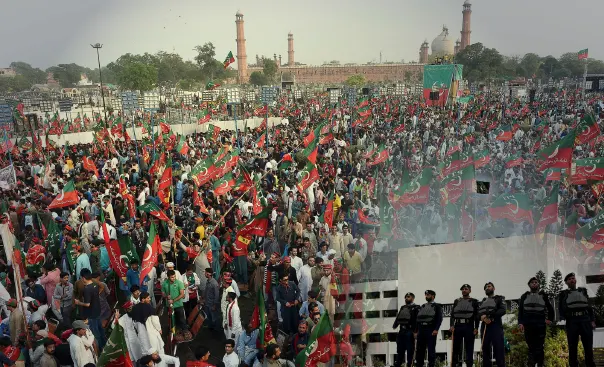
Notwithstanding some of his flawed populist rhetoric, the incarcerated former prime minister is undoubtedly the country’s most powerful political leader. Perhaps no other political leader in the country’s history has enjoyed such widespread support across class divides. Behind bars, Imran Khan remains the most powerful political figure challenging a military-dominated hybrid system of rule. It is a fight between popularity and power. It is now more than three years since he was imprisoned. He has been convicted in several cases and faces trial in dozens of others, yet he is not prepared to surrender.
Now in his late seventies and in deteriorating health, he remains steadfast. Neither Imran Khan nor his party is revolutionary or driven by any ideology. His populist slogans may have galvanised the public, but his party is in tatters and rudderless. Relentless state persecution has forced many to leave the party. The government’s latest move to remove the PTI-led government in Khyber Pakhtunkhwa has dealt a serious blow to the party. The reckless move came after the PTI threatened to storm Islamabad in protest against the denial of medical treatment. Khan has been barred from meeting family members and even his lawyers, despite a high court order. This has further inflamed an already combustible situation in the highly sensitive province.
The province is sitting on a powder keg, and the removal from power of an elected government that enjoys an overwhelming majority in the provincial assembly and broad popular support could ignite it in a way the state would struggle to contain. Imran Khan may be the most popular leader, but it is hard to take on the power of the state.
The writer, based in Islamabad, is a veteran journalist, author and television analyst. He can be reached at zhussain100@yahoo.com.


Leave a Reply