
Malé
Muizzu, the Mediator?
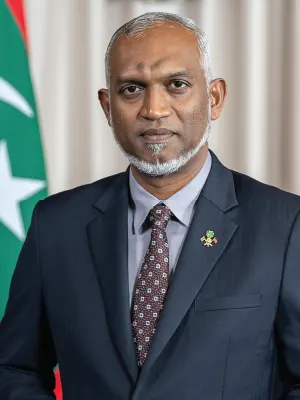
Maldivian President Mohamed Muizzu has called for the revival of the South Asian Association for Regional Cooperation (SAARC), offering the Maldives’ services as a mediator to help facilitate dialogue among member states

For more than a decade, the South Asian Association for Regional Cooperation (SAARC) has existed in a curious state: neither formally dead nor meaningfully alive. Its institutional structure remains in place, its charter survives, and the idea of regional cooperation is still invoked from time to time. Yet the political momentum that once gave SAARC relevance has largely disappeared. The last summit was held in Kathmandu in 2014, while the summit planned for Islamabad in 2016 was postponed after a sharp deterioration in India-Pakistan relations.
Into this prolonged silence has stepped the Maldives. President Mohamed Muizzu has called for the revival of SAARC and offered the Maldives as a possible facilitator in bringing member states back to the table. His intervention matters not because the Maldives has the political weight to resolve South Asia’s most difficult disputes, but because it raises a more fundamental question: should the future of regional cooperation remain hostage to tensions between India and Pakistan? That question lies at the heart of SAARC’s present crisis.
India and Pakistan have always shaped the political temperature of South Asia. Their disputes over security, terrorism, Kashmir and bilateral relations have repeatedly affected regional diplomacy. Over time, SAARC has become so vulnerable to these tensions that the institution has been unable to sustain summit-level engagement. This has created the impression that no meaningful regional process can move forward unless relations between the two largest member states improve. But that assumption deserves to be challenged.
South Asia is one of the least integrated regions in the world. Intra-regional trade remains low despite geographical proximity, cultural linkages and a combined population of nearly two billion people. Cross-border connectivity is weak. Energy cooperation remains limited. Public-health coordination is fragmented. Climate vulnerability is growing, while floods, heatwaves, water stress and food insecurity increasingly affect more than one country at a time. These are regional problems whether political relations are good or bad.
The Maldives has particular reasons to make this point. As a small island state, it faces severe environmental vulnerabilities, including the long-term risks associated with sea-level rise and changing climate patterns. For such a country, regional cooperation is not an abstract diplomatic preference. It is directly connected to food security, disaster response, marine sustainability, the energy transition, and economic resilience.
Other smaller South Asian states also have strong incentives to support a functioning regional institution. Nepal, Bhutan, Sri Lanka, and the Maldives do not benefit when every regional mechanism becomes suspended because of disputes between India and Pakistan. Regional forums give smaller states a space to discuss their concerns collectively, rather than only through unequal bilateral relationships. This is why the Maldives’ call deserves serious consideration.
The more difficult question, however, is what “reviving SAARC” should actually mean. If revival simply means another summit, another group photograph and another declaration full of familiar language, the exercise may achieve little. Symbolism has its place, but a ceremonial summit cannot by itself repair years of institutional stagnation. The deeper problem is not the absence of meetings alone. It is the organisation’s inability to function when political tensions rise.
President Mohamed Muizzu’s intervention matters not because the Maldives has the political weight to resolve South Asia’s most difficult disputes, but because it raises a more fundamental question: Should the future of regional cooperation remain hostage to tensions between India and Pakistan?
A more practical approach would be to distinguish between political SAARC and functional SAARC. Political SAARC will always remain vulnerable to bilateral disputes. Functional SAARC, by contrast, could focus on areas in which cooperation is possible even when political relations are strained.
Climate adaptation should be one such area. South Asia faces common environmental pressures, and scientific data, early-warning systems and disaster-management protocols could be shared more systematically. Renewable energy is another field in which regional cooperation could produce real benefits. Public-health coordination, disease surveillance, higher education, scientific exchange, food security, water management and trade facilitation are also areas where progress need not wait for complete political reconciliation.
This does not mean ignoring India-Pakistan tensions. Nor does it mean pretending that security disputes are unimportant. It simply means refusing to allow every other form of cooperation to be paralyzed by them.
SAARC was never designed primarily as a conflict-resolution mechanism. Its purpose was to promote social, economic and technical cooperation. Yet over the years, bilateral political disputes have come to dominate the institution so completely that its original purpose has been weakened. The danger now is not necessarily formal collapse. The greater danger is irrelevance.
Regional cooperation does not stop simply because SAARC is inactive. Countries find other channels. They turn to bilateral arrangements, sub-regional groupings and wider Asian forums. If this continues, SAARC may remain alive on paper while becoming increasingly unimportant in practice. That would be an unfortunate outcome because South Asia still lacks a genuinely inclusive regional platform in which all member states can participate.
The Maldives cannot single-handedly overcome India-Pakistan hostility. Nor should anyone expect it to. But its intervention can perform an important political and intellectual function. It can shift the debate away from the question of whether India and Pakistan can first resolve all their disputes and towards a more realistic question: can South Asian countries cooperate in selected areas even while major political disagreements remain unresolved? The answer, at least in principle, should be yes.
Regionalism is not always built through dramatic breakthroughs. More often, it grows through repeated, practical cooperation. Universities can create joint academic programmes. Scientists can share research. Public-health agencies can coordinate emergency responses. Energy experts can work on regional networks. Trade officials can simplify procedures where possible. Climate experts can exchange data and planning strategies. None of these measures would solve the region’s major political disputes. But they could prevent those disputes from consuming every other possibility of cooperation. That may be the most realistic path forward.
The future of SAARC should not depend entirely on recreating the political atmosphere of the past. South Asia has changed. Its challenges have changed. Climate stress, demographic pressure, economic inequality, technological disruption and public-health threats have all become more urgent. The institution must therefore adapt as well.
The Maldives has reopened a conversation that the region had allowed to fade. Whether that conversation leads to another symbolic summit or to a more functional form of cooperation will depend on how seriously member states are willing to rethink the purpose of SAARC.
The real question is no longer whether SAARC can return to what it once was. The more important question is whether South Asia can imagine what SAARC needs to become now. 
Based in Karachi, the writer holds a PhD from CTH, Sweden, and serves as Professor and Chairman of the Physics Department at the University of Karachi. He can be reached at iulfat@uok.edu.pk.


Leave a Reply