



What the Mecca Joint Defence Agreement actually is
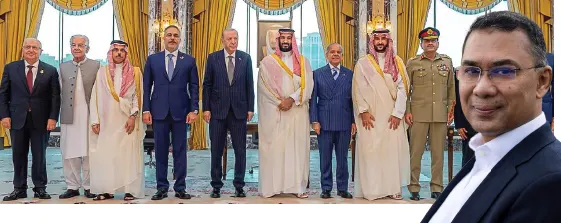
On 7 August 2026, Saudi Crown Prince Mohammed bin Salman, Turkish President Recep Tayyip Erdoğan and Pakistani Prime Minister Shehbaz Sharif signed the agreement at Al-Safa Palace in Makkah. The public joint statement says an armed attack on any one of the three “shall be regarded as an attack against them all”, and that the parties will expand defence cooperation across the board. Officials have compared the clause to NATO’s Article 5. The full legal text has not been released. Its duration, withdrawal provisions, geographic scope, what constitutes an “armed attack”, and how a response would be decided remain unpublished.
It builds on the August 2025 Saudi–Pakistan Strategic Mutual Defence Agreement. A Strategic Political and Defence Committee has since met; a secretariat is to be based in Saudi Arabia, with Pakistan providing the first secretary-general for three years. Turkish officials have said the pact is defensive, is not aimed at Iran or any third country, and is open to other states that share its principles. Erdoğan has framed it as a framework that need not remain a trio.
The combination on paper is formidable: the world’s largest oil exporter, NATO’s second-largest standing army, and the only nuclear-armed Muslim-majority state. Combined active personnel are often cited at around 1.4 million. What is missing is the architecture that turns a political declaration into a war plan—joint command, integrated planning and a defined area of application. Until those exist, the deterrent value remains ambiguous: an adversary cannot be sure that the others will stay out. That is useful for Riyadh, Ankara and Islamabad. It is a different proposition for a state being asked to join before the fine print exists.
The unnamed adversary is the point. The pact was signed amid US–Iran fighting, Ansarallah’s pressure on Gulf shipping and energy sites, and a wider sense that the old US security umbrella is no longer automatic. Officials insist it is not a “Sunni NATO” or an anti-Iran coalition. Naming no enemy keeps the door open and the obligation elastic.
Bangladesh’s debate: interest without a signature
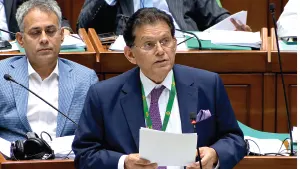
Bangladesh has neither formally applied nor received a published invitation. Officials have refused to rule out joining. State Minister Humayun Kabir framed it as a “Bangladesh First” calculation of national interest and expressed a positive view of an economic or defence framework with Saudi Arabia, Türkiye and Pakistan. Foreign Minister Khalilur Rahman told Parliament that Dhaka would consider an invitation positively. A foreign-ministry source told Reuters that Saudi Arabia had extended an informal invitation; Kabir has also said that the leadership, including Prime Minister Tarique Rahman, was being invited to participate. Later comments stressed “no risk” and that one security arrangement would not bar others. There is still no Cabinet-level decision, nor has any public invitation been released.
The political context matters. The Tarique Rahman government, in office since early 2026 after the fall of the Awami League, is marking its distance from the previous India-first tilt. Relations with Pakistan have been thawing, with flights, military contacts and trade all expanding. Türkiye is a defence-industry and political partner. Saudi Arabia is at the core of Bangladesh’s labour-export model and accounts for a large share of remittances. Association with a Makkah-centred Islamic security framework also carries domestic symbolic weight in a country that is overwhelmingly Sunni. Egypt was reportedly another early signal of interest; Cairo’s caution about unconditional obligations provides a useful comparison.
India’s response has been watchful and restrained: New Delhi says it is following developments in West Asia. That understatement should not be read as indifference. Bangladesh’s land border with India exceeds 4,000 km; most overland connectivity runs through Indian territory. Indian commentary has already begun to treat a Dhaka–Islamabad security link as a potential eastern-flank problem, even though the pact does not publicly grant basing or transit rights. The military scenarios are the least plausible part of that anxiety. Border friction, transit, trade and Myanmar-related leverage are the more plausible ones.
What Bangladesh would actually gain
The pull is mostly non-military.
Labour and remittances: A large share of Bangladeshi migrants and roughly half of remittances are tied to the GCC. Alignment could provide a bargaining chip for worker protections.
Energy and finance: Bangladesh’s LNG and oil-import chain has already been hit by disruption caused by the Gulf war, including Qatar’s force majeure declaration and the risk surrounding the Strait of Hormuz. Saudi Arabia’s weight in Islamic trade finance and crude supply is real; deferred-payment oil facilities and cheaper Islamic finance are concrete asks that do not require an Article 5 clause.
 Defence industry and training: Türkiye sells equipment and provides training; Saudi Arabia already cooperates on exercises and maritime security. Dhaka has joined a Saudi-led Red Sea/Gulf of Aden maritime grouping. Those tracks can deepen without collective defence.


Based in Houston, United States, the writer is the executive director of a US-based human rights organization. She can be reached at scballand@thechrd.org
Leave a Reply