



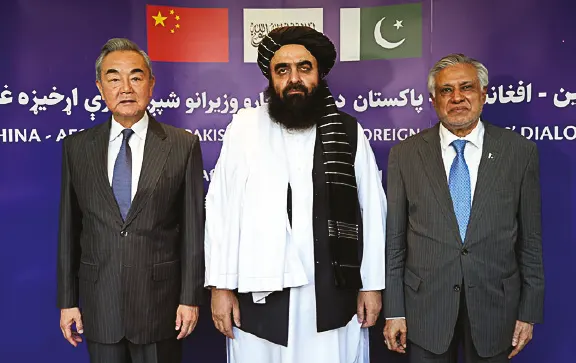
Efforts to restore dialogue between Islamabad and Kabul seem to be gaining momentum, with China pushing to revive the Urumqi process and the Afghan ambassador’s appearance at Pakistan’s National Defence University (NDU) signalling cautious re-engagement. Yet Pakistan’s Foreign Office insists that talks can progress only with “verifiable, written assurances” from the Taliban against cross-border terrorism—a demand the Taliban government does not appear ready to concede.
On the face of it, the mutual trust required to rebuild the relationship seems to be beyond repair. The relationship has reached its present stage because maximalist and adversarial attitudes are suppressing opportunities for mutually beneficial cooperation and obscuring substantial shared interests. The challenge, therefore, is not simply an Afghanistan–Pakistan dispute; it is a failure to convert deep interdependence into positive diplomatic leverage.
Both countries have an interest in expanding trade and transit, settling the refugee issue, improving border connectivity, and developing energy and economic cooperation. Yet neither side appears prepared to address the hostility that imposes costs on both. Perhaps, in their respective calculations, these costs remain bearable. If so, no meaningful progress can be achieved unless that assumption changes and both countries begin to recognise that their economic and strategic interdependence could provide the foundation for a carefully sequenced diplomatic reset.
The difficulty is that security perceptions increasingly dominate the relationship, causing each side to interpret the other’s actions primarily through the lens of threat. This is precisely where diplomacy becomes important—and critically relevant. But the methodology has to be measured and nuanced.
In such circumstances, seeking a grand settlement at the outset may prove counterproductive. The immediate diplomatic objective should be to prevent further deterioration. Only then can the two sides begin to recover areas of common interest. Pakistan has travelled down this road several times. At present, however, it does not appear ready to compartmentalise the relationship and deal with its different dimensions separately. Consequently, disputes over the TTP, BLA and border incidents continue to undermine cooperation in the economic and strategic domains.
Pakistan’s leadership has repeatedly defined its red lines and identified what it considers non-negotiable. Its diplomats therefore have limited room to manoeuvre. Any concession could be perceived domestically as politically costly or as a sign of weakness.
In theory, a useful approach could be a deliberate strategic pause in public statements without a pause in diplomacy. Such a policy would require patience, restraint and a careful avoidance of any appearance of capitulation. This may be a more realistic diplomatic ambition in the Pakistan–Afghanistan quagmire.
In diplomacy, cooperation can create the confidence required to address disagreements. Essentially, diplomacy brings expectations down from the desirable to the possible. It is also inherently sequential and therefore often slow in producing results. Sometimes diplomacy produces an immediate result precisely because the groundwork has already been laid. At other times, attempting to force an immediate settlement can destroy the possibility of a durable solution. What appears from the outside to be a delay may actually be an essential part of negotiation.


The writer, based in Rawalpindi, is a former ambassador and can be contacted at mian.sana@gmail.com.
Leave a Reply