


An electoral roll is the dullest document in a democracy—until your name disappears from it. Then it becomes something else: a question about citizenship, political belonging, and the ability to exercise a basic democratic right.
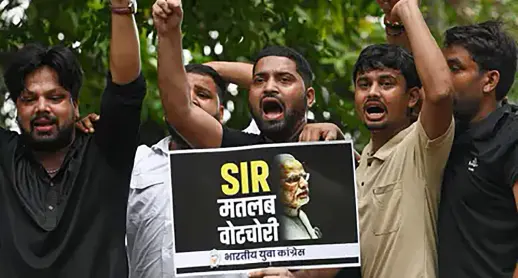
That is why India’s Special Intensive Revision (SIR) of electoral rolls has become far more than an administrative exercise. What began in Bihar in June 2025 as an attempt to clean up voter lists has since expanded across much of the country and produced a political and institutional controversy that shows little sign of fading. The Election Commission says it is identifying dead, duplicate, permanently shifted, and otherwise untraceable voters. Its critics argue that the process risks excluding genuine voters on a scale that demands much greater scrutiny.
Both propositions can be true at the same time.
Revising an electoral roll is not wrong. Voters die, change addresses, and sometimes remain registered long after they can no longer be traced. A serious election authority should remove such entries. The real question is what happens to the legitimate voter who gets caught in the same net.
According to figures released by the Election Commission this month, 13.39 crore electors have been placed in the categories of absent, shifted, dead or duplicate during the nationwide SIR exercise. The Commission says this does not mean that 13.39 crore legitimate voters have been permanently disenfranchised. Its classification covers 95.4 crore electors reviewed during the exercise and includes 6.30 crore people classified as permanently shifted, 3.01 crore as absent or untraceable, 2.80 crore as deceased and 1.02 crore as duplicates.
But distinction does matter. Calling all 13.39 crore cases “deleted voters” suggests that the state has permanently deprived 13.39 crore people of their vote. The official data does not establish that.
The Election Commission itself has now ordered a special drive in 20 states and Union Territories where the SIR has been completed to enroll voters who were “left out” of the rolls. That decision is significant. It acknowledges that, whatever the original reason for exclusion, some people still need a practical route back onto the electoral register.
The controversy becomes clearer when viewed through individual cases.
The Indian Express recently reported the case of 72-year-old Samsul Alam and his daughter, Sabia Khatun, in Bolpur. Both had previously been voters, but their names were removed during the SIR process. The family produced educational certificates and other documents, and the matter eventually reached a tribunal. The report said the family had not received notice of the deletion, and the Calcutta High Court later ordered reconsideration of Alam’s case.
The point is not that one case proves a nationwide pattern. It does not.
The point is that a supposedly technical exercise can have a very human consequence. For an elderly voter, being required to reconstruct a documentary trail stretching back decades is not a minor administrative inconvenience.
Other cases reported in newspapers illustrate similar problems. These are reported individual cases, not independently established evidence of a nationwide campaign to disenfranchise voters. That distinction is important.
But individual cases still matter because they expose what national statistics can obscure: the burden created when the electoral system places the responsibility for resolving a data problem on the voter.
The documentation issue has been one of the most contentious aspects of the exercise. In Bihar, the Supreme Court eventually directed the Election Commission to accept the Aadhaar card as an identity document for the SIR process, while making clear that Aadhaar alone does not establish citizenship.


The writer, based in Karachi, is a freelance contributor and investment banker. He can be reached at syedatifshamim@hotmail.com.
Leave a Reply