



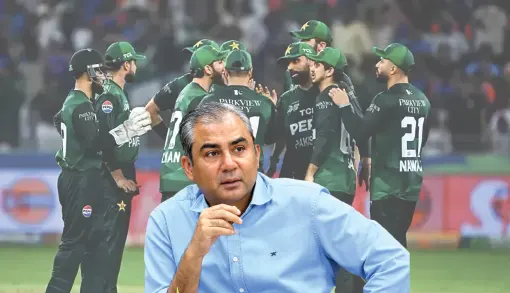
Few global sports ecosystems embody the tragic disparity between organic talent and institutional ineptitude as starkly as Pakistani cricket. In Lahore, Karachi, and Peshawar, street corners and dusty grounds pulse with an inexhaustible reservoir of natural athletic talent. Raw pace, instinctive strokeplay, and unmatched fan fervour remain the bedrock of the country’s national identity. Yet, on the global stage, the men’s national team consistently finds itself trapped in a cycle of chaos, performance slumps, and administrative upheaval.
Following a disastrous Test series performance in England, the Pakistan Cricket Board (PCB) defaulted to its historic playbook: reactionary purges. Mass sackings of coaching staff, the abrupt exclusion of seven squad veterans mid-tour, and the launch of a high-profile disciplinary probe into opener Imam-ul-Haq and fellow player Mohammad Rizwan were framed as a standard of accountability. To seasoned observers of Pakistani sport, however, these measures were recognisable for what they truly were: a performative diversion engineered to mask systemic governance failure at the very apex of the board.
At the centre of the current crisis stands PCB Chairman Mohsin Naqvi. Appointed to lead the board in early 2024, Naqvi’s tenure reflects a broader administrative framework that has long characterised Pakistani cricket. Rather than a career sports administrator or commercial executive, Naqvi brings a background as a prominent media figure and government official, continuing a legacy of placing high-level public figures at the helm of the national board.
Crucially, Naqvi’s role as head of the PCB is not his sole responsibility. He simultaneously serves as Pakistan’s Federal Minister of Interior and Narcotics Control, one of the most demanding security portfolios in the country, and has frequently been deployed on high-level diplomatic missions across the Middle East. Balancing internal security, counter-terrorism oversight, and foreign diplomacy with the long-term modernisation strategy of a multi-billion-rupee sports enterprise presents an immense institutional challenge.
When results on the field falter, an overburdened board leadership inevitably finds itself constrained by immediate crisis management. Dropping senior players, altering central contracts, temporary confiscation of team devices, and holding high-profile press conferences promising “major surgery” serve to address immediate public concern. However, these urgent measures leave the underlying administrative structure unchanged, substituting short-term operational interventions for sustainable, long-term governance.
This dynamic is not an isolated chapter; it reflects a long-standing governance architecture where administrative turns closely mirror broader public developments. Under the board’s constitutional framework, the Prime Minister serves as the ex officio Patron-in-Chief of the PCB. In practice, this high-level connection has historically meant that broader shifts in national governance often ripple into the PCB, occasionally prompting sudden administrative turnarounds and policy recalibrations.
Over the past two decades, changes in national leadership have frequently coincided with restructuring at the PCB. This pattern reached a notable phase during the 2013–2014 period, when shifts in public administration led to a protracted legal and administrative transition between Najam Sethi and Zaka Ashraf. The repeated exchanges of leadership during that era highlighted how institutional uncertainty can delay core strategic decisions.
A similar administrative transition unfolded in late 2022. Following a change in government, the board’s leadership transitioned from former national captain Ramiz Raja to an interim management committee led by Najam Sethi. The incoming administration subsequently re-evaluated several ongoing projects, including the Junior League and aspects of the domestic first-class set-up, favouring a return to a departmental competition model. Within a year, further administrative adjustments led to another leadership rotation, illustrating how long-term technical programmes can become intertwined with broader institutional changes.


Based in Gilgit-Baltistan, the writer is a development practitioner and can be reached at shakeelahmedshah@yahoo.com
Leave a Reply