


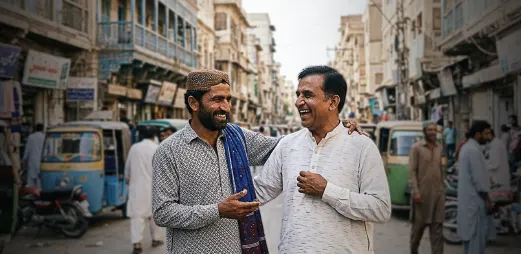
The province of Sindh represents one of the world’s oldest civilisations. The archaeological discovery of an ancient city whispers to every visitor of the splendour of the Indus civilisation, which once flourished on the banks of the Sindhu, marked by high standards of living, civility, hygiene, cleanliness, art, and culture. Modern Sindh has been a multi-religious, multi-linguistic and multi-ethnic nation for centuries. This unique feature has made it the chosen destination of travellers, wanderers, migrants, poets, scholars, mystics, traders, and explorers. Sindh embraced them as its sons.
The Talpur rulers lost Sindh’s independence to superior British forces because of the treachery of Seth Neomal Hotchand, who provided strategic intelligence, financial backing, and logistics to General Napier before the consequential battle of 1843. The British knew the resilience of the Sindhis and attached Sindh to the Bombay Presidency. They demonstrated a hostile and discriminatory policy towards Sindh. Sindhis launched a well-sustained movement for its separation from Bombay. This was realised in 1936.
Pakistan emerged as an independent state on 14 August 1947. It faced two immediate challenges: consolidation of the Federation, and the settlement of refugees. Bengal and Sindh were in the vanguard of the Pakistan Movement. Punjab opted to join Pakistan at the last moment. Former NWFP consented to join the Federation in a disputed referendum. Balochistan was declared an independent country in June 1947 as a result of the standstill agreement signed on 5 June 1947. Later, it was annexed into Pakistan by force in April 1948.
The challenge of refugees was also daunting for the new country. There were millions of displaced persons pouring into Punjab and Sindh. The government of Sindh handed over its offices, secretariat, buildings and vehicles to the central government with logistical and financial backing. The influx of refugees was mounting, putting exhausting pressure on the administrative machinery caught between a dual command.
Karachi in 1947 was a city of slightly over 400,000 citizens. It had no infrastructural capacity to sustain an enormous influx of population. The provincial government wanted to spread refugees all over Sindh. The central government wanted concentration of refugees in Karachi despite a shortage of resources. Some historians are of the view that Liaquat Ali Khan was planning to create an electoral constituency for himself in the metropolis.
The local administration was listening more to the central authorities than to the provincial chief executive, ignoring the violent protests of the refugees vandalising the properties of Hindus. This compelled the Chief Minister, Muhammad Ayub Khuhro, to visit the affected areas personally to assuage the fear of the Hindus, assuring them of protection. His government was later dismissed.
The dismissal of Khuhro’s administration deepened the sense of fear and vulnerability of the Hindu population. They resorted to a panicky exodus from Sindh, depriving it of an educated, trading and teaching class of population, and a large number of public servants. The population of the city increased to over 1.2 million within a few years. The settlement of the refugees in other towns was smoother, causing no serious administrative problem.
Liaquat Ali Khan was appointed as the Prime Minister after the decline of Raja Sahib of Mahmudabad to head the central government. Liaquat Ali Khan was overly concerned with the political, economic, and social advantages of the refugees. His obsession with the refugees at the cost of the indigenous population resulted in unpleasant consequences, including the concentration of refugees in Karachi, unbalancing the population of the city, unlawful occupation of the properties of Hindus, en masse recruitment of refugees in the public service, fixing separate quotas of government jobs for Karachi and refugees, conversion of Sindhi schools into Urdu schools, and the takeover and renaming of the Sindh University as Karachi University.


Based in Karachi, the author is a seasoned professional who previously served as a member of the Foreign Service of Pakistan and enjoyed a seven-year tenure as an Ambassador. Feel free to get in touch at brohialam7@gmail.com.
Leave a Reply