For Kathmandu, the challenge after the devastating floods is not choosing between India and China, but ensuring that Nepal is never forced to choose between its neighbours simply because a single road has been washed away
ByPD Dr. Pushpa R. Joshi | October 2026
No country has the luxury of choosing its neighbours, and Nepal is no exception. With its landlocked geography, Nepal has always depended on its two giant neighbours—India and China—for economic connectivity. With open borders to the south, Nepal relies heavily on India for transit, trade, fuel and access to global markets. Although physical connectivity through the northern border is limited by the formidable mountains, Nepal also seeks to expand trade relations and connectivity with China. This strategy has often been described as diversification—not replacing India with China, but ensuring that Nepal is not excessively dependent on any single external corridor.
Nepal has always sought to maintain a balanced relationship with its immediate neighbours. Nepal was an important transit point for trade between the pre-independence Indian States and Tibet for centuries. Even during the British occupation of the South Asian subcontinent, Nepal provided an important trade route connecting Tibet with the rest of South Asia. Over time, Nepal’s northern corridor was upgraded with roads, bridges and settlements. Despite this, the southern Indian border has always been the dominant trade route for Nepal, especially for importing daily necessities, including fuel, household items and third-country consignments. It accounts for about 60% of Nepal’s total foreign trade. In fact, the Nepal–India Treaty of Transit has assured Nepal access to the ports of Kolkata/Haldia and Visakhapatnam for third-country trade.
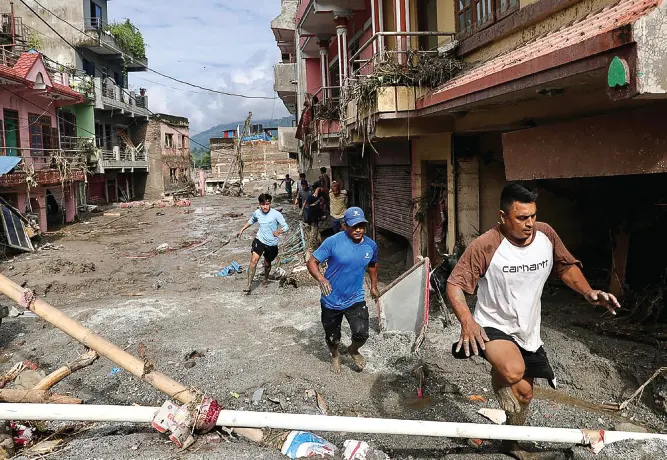
Despite accounting for a smaller fraction of foreign trade, the Nepal–Tibet border is an important link connecting Nepal with China through three trade points—Tatopani, Rasuwagadhi and Korala. The recent unprecedented flooding of the Bhote Koshi River devastated Rasuwagadhi’s border facilities, customs infrastructure, road sections and the surrounding trading settlement of Timure. The destruction came after the same corridor had already suffered a major flood in 2025, due to which the Rasuwagadhi border was operating below capacity. In addition, the other two trade points are also not fully operational—Tatopani has been affected by landslides, while Korala handles only limited cargo.
The Rasuwagadhi trade point is particularly important because it offers the most practical northern route from Kathmandu towards China’s Gyirong port. But this corridor has always been vulnerable. Not long ago, trade through this border was disrupted for months after the bridge connecting Nepal and Tibet was swept away by floods. Operations finally resumed in January 2026, restoring trade, but the underlying infrastructure remained inadequate.
With the recent devastation of the Rasuwagadhi trade point, it has been reported that traders have suffered losses running into billions of rupees, with hundreds of containers and festival-season merchandise swept away by the floods. As Nepal’s largest Hindu festivals—Dashain and Tihar—approach, demand for clothing, electronics, food and consumer goods rises sharply. A large proportion of such festive goods is imported from China. Hence, the recent trade disruption has immediate consequences for businesses, consumers and government revenue.
Nepal’s attempt to diversify its trade has always confronted an uncomfortable reality: connectivity is not simply a diplomatic decision; it is a geographical one. India’s extensive road and rail networks provide Nepal with comparatively accessible routes to seaports and international markets. By contrast, the northern routes to China cross some of the world’s most difficult terrain. The roads approach the Himalayan frontier through steep valleys that are highly susceptible to landslides, floods, earthquakes and extreme weather.
Before the latest disaster, transporting goods through the northern corridor was already expensive and unpredictable. Now, with the closure of the Rasuwagadhi border, rerouting cargo through alternative routes is likely to increase transport costs. The flood has therefore highlighted an important distinction between having an alternative and having a reliable alternative.
The immediate economic consequence of the disaster is likely to be increased Nepalese reliance on southern routes. With the Rasuwagadhi crossing destroyed by the flood and China closing the Tatopani border amid concerns over continuing landslides, the high-altitude Korala crossing has been left as the principal remaining overland trade option with China. Yet Korala has limited infrastructure and is itself exposed to harsh climatic and geographical conditions. Hence, overland connectivity with China is likely to be severely constrained for many months.
Kathmandu’s longstanding strategy has not been about choosing Beijing over New Delhi—or New Delhi over Beijing. It has been about expanding its room for manoeuvre. Nepal’s vulnerability arises precisely because neither side currently offers a completely interchangeable alternative. The disaster could therefore reinforce the argument for greater southern connectivity, including more efficient links to Indian ports and transit networks. At the same time, abandoning the northern corridor would undermine the very purpose of diversification.
The more useful lesson from the floods may be that Nepal’s foreign economic policy needs to move beyond “balancing” towards “resilience”. Nepal should not view connectivity with China merely as a geopolitical counterweight to India. Nor should it regard Indian connectivity simply as an unavoidable dependence. Both are essential components of a broader national strategy. Hence, Nepal should prioritise building redundancy into its trade system: multiple functioning border points, alternative road corridors, stronger bridges, climate-resilient customs facilities, emergency logistics arrangements and better integration between road, rail and dry-port infrastructure.
The Himalayas will remain where they are. Rivers will continue to change their course, glaciers will continue to retreat, and extreme weather will increasingly test infrastructure. Amid all these adversities, Nepal cannot change its geography. It should therefore make it a top priority to strengthen the resilience of the infrastructure built upon it. The challenge after the devastating floods is, therefore, not choosing between India and China, but ensuring that Nepal does not have to choose between its neighbours simply because one road has been washed away.
Based in Germany, the writer is a senior scientist and independent opinion maker. He regularly contributes political commentaries and analyses on current affairs to leading English dailies published from Nepal. He can be reached at pushpa.joshi@gmail.com






Leave a Reply