


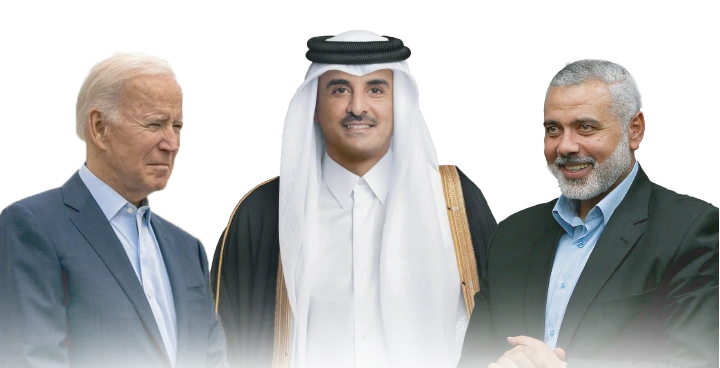
Qatar has a history of playing a mediatory role in the Hamas-Israel conflict and between the United States and Hamas. It was Qatar, which, upon the request of America, agreed to open lines of communication with Hamas and played a vital role in arranging a ceasefire between Israel and Hamas in 2014, 2021, and 2022. In 2023, more than a month-long armed conflict between Hamas and Israel over Gaza is problematic because, unlike in the past, Qatar tried unsuccessfully for a ceasefire but is hopeful for a breakthrough.
The dilemma and paradoxical position of Qatar vis-à-vis Israel, Hamas, and the United States reflects the art of diplomacy on the part of Doha. In the past, Qatar had a soft corner for the Islamist regime of Egyptian President Mohammad Morsi and was a source of financial help to Cairo. Unlike other GCC countries, which took anti-Hamas and anti-Iran positions, Qatar pursued a policy of constructive engagement, sometimes to the detriment of Washington and Arab monarchs.
One needs to understand the dynamics of Qatari diplomacy in the Middle East. On the one hand, Qatar has strong relations with the United States, but on the other hand, it has regular ties with Iran and has provided space for Hamas to operate from Doha. The top leadership of Hamas, consisting of Ismail Haniyeh, Moussa Abu Marzuk, and Khaled Mashal, is residing in Qatar and is allowed to have meetings and strategic planning against Israel. And, of course, Qatar’s permission to Hamas to operate from Doha is with the connivance of the United States, and America would like to use its Arab ally in conflict with Iran, Hamas, and Israel. It is assumed that the U.S. also has a military presence in Qatar and, at the same time, also agrees to facilitation by Doha in the Hamas-Israeli armed conflict.
What is the source of understanding between Qatari and American diplomacy, and how is Doha acting as a go-between Hamas and Israel in connivance with America? How did Qatar survive the blockade by Saudi Arabia and the diplomatic boycott of Riyadh, the U.A.E, Bahrain, and Egypt? What prompted the four Arab states to normalize their relations with Doha? Why do Israel, America, and anti-Hamas Arab states tolerate an independent approach of Qatari Emir Sheikh Tamim bin Hamad al Thani?
Qatar’s sound economy, its modern infrastructure, and the enlightened approach of Qatari rulers tend to provide enough confidence to Doha to act as an icon of diplomacy in the Middle East. Qatar hosted the Football World Cup in November-December 2022, proving Doha’s respectable and credible position in global affairs. With a population of 2.8 million and rich in oil and gas reserves, it has a GDP of U.S. $268 billion, per capita income of $66,335, and foreign exchange reserves of $43 billion. With a population of only 2.8 million, of which foreigners account for a large percentage, Qatar is a developed state with modern infrastructure and a good quality of life.
When Qatar faced a blockade of fellow GCC members and Egypt, it managed to survive by getting food and other items from Turkey and Iran. It was realized by the Saudi-led countries like the U.A.E, Bahrain, and Egypt, which had broken off diplomatic relations and enforced a blockade of Qatar, that they had failed to achieve their objective. Qatar has not relegated to their demands, like closing the Al-Jazeera TV channel and terminating relations with Iran and Hamas; they decided to reverse their measures. It means the Qatari leadership is dynamic, strong, visionary, and intelligent and doesn’t come under external pressure.
Now, coming to the U.S.-Qatar ties and America’s readiness to accept Doha’s role in mediation with Iran and the ceasefire in Gaza, one can analyze it from three angles. First, the U.S. realizes the fact that the role of Qatar in mediating with Iran and ending the Hamas-Israel war is substantial. Qatar is playing its cards well because it has housed the top leadership of Hamas. Through them, it is negotiating with America and Israel on the release of hostages and arranging a ceasefire in Gaza. But, in diplomacy, the concerned parties must be flexible and not intransigent in their positions. For that matter, Qatar is trying to prevail over both Hamas and Israel for the release of hostages and a long-term ceasefire in Gaza.
 One would recall that it was Qatar that had mediated between the United States and Afghan Taliban, leading to the Doha Accords’ signing in April 2020. Qatar also allowed the Afghan Taliban, in connivance with the United States, to open its office in Doha. This means Qatar has the required skills in diplomacy and mediation. Notably, as far as mediation is concerned, it can only render positive results if the involved parties in negotiations trust the mediator because of its neutral position. For that matter, Qatar proved that it was and is a good mediator and earned the trust and goodwill of the parties concerned in negotiations. Second, Qatar, having access to Iran and Hamas, is thought to be in a strategic position for facilitating American mending of fences with Iran. Will Qatar succeed in persuading Israel and Hamas to adopt a flexible stance on the conflict in Gaza, where since October 7, more than 14000 people have been killed, including 1400 Israelis, and the rest are Palestinians, including those residing in the occupied West Bank?


The writer is Meritorious Professor of International Relations and former Dean Faculty of Social Sciences, University of Karachi. He can be reached at moonis.ahmar59@gmail.com
Leave a Reply