



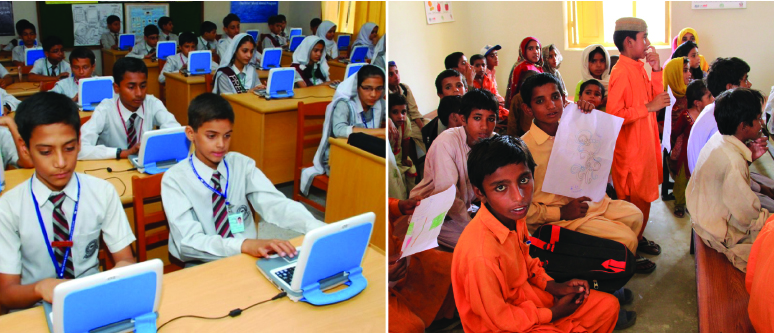
There is no denying that disparities persist often as a result of serious policy-level discrimination and neglect of economically disadvantaged and vulnerable communities. It also goes without saying that poor allocation of education funds is responsible for dismal performance of schools and higher education institutions. Under such circumstances, the government’s assertion that bringing uniformity in the education system would help alleviate the perils of poverty would not be fair, given the fact that the education sector, along with the health sector, is among the least prioritized areas for the government to allocate sufficient funds. At the federal level, education gets an average share of around 2.5% or less of the GDP and, at the provincial level, a lion’s share of the funds is generally exhausted in mere maintenance of staff and other operational activities, whereas no improvement is seen in further development of infrastructure, improving quality of standards for teachers and students, content generation and increase in enrollments.
The Federal Ministry for Education and Professional Training has identified at least four parallel education systems, which it holds responsible for creating education apartheid. These systems are formal public schools, formal private high-end schools (following the Cambridge or IB curriculum), formal private schools (following the curriculum prescribed by local boards) and Deeni Madaris, or religious seminaries. Before we delve into a conversation on the streams of education present in Pakistan, let us first look into why parallel systems of education exist. Where communities and societies are segmented by their socio-economic situations, different preferences are bound to take place. It all boils down to what parents want for their children who are too young to decide for themselves. Poor parents are often more prone to send their children to Madaris in place of a public school, because there they are offered free lodging and food. This preference may not necessarily be for religious teachings. At the same time, there are some affluent families that prefer to send their children to religious schools for specific religious teaching. Then there are also families that prefer to send their children to low-budget private schools as they lack confidence in state-run schools, just like affluent or rich families send their children to English medium private schools because they find the general quality of public schools sub-standard. And then, there are those students who graduate or drop-out of secondary schools to get into vocational institutions to get required mechanical skills as per the labour market needs.


The writer is a peace educator and an opinion writer based in Lahore. She is also a co-founder of the Centre for Peace Dialogues. She can be reached at zeeba.hashmi@gmail.com |
|
Cover Story
|
|
News Buzz
|
Leave a Reply |
Update |
Very well written Zeeba Hashmi. I second you in this thought that SNC will destroy the diversity. Maleeha Lodhi in her book, Pakistan beyond the crisis state, states that Diversity is the strength. Furthermore, she states that It is because of the diversity in Pakistan, the chances of its disintegration is minimum. So by implementing SNC, the academic standards of our educational system will get worse.