



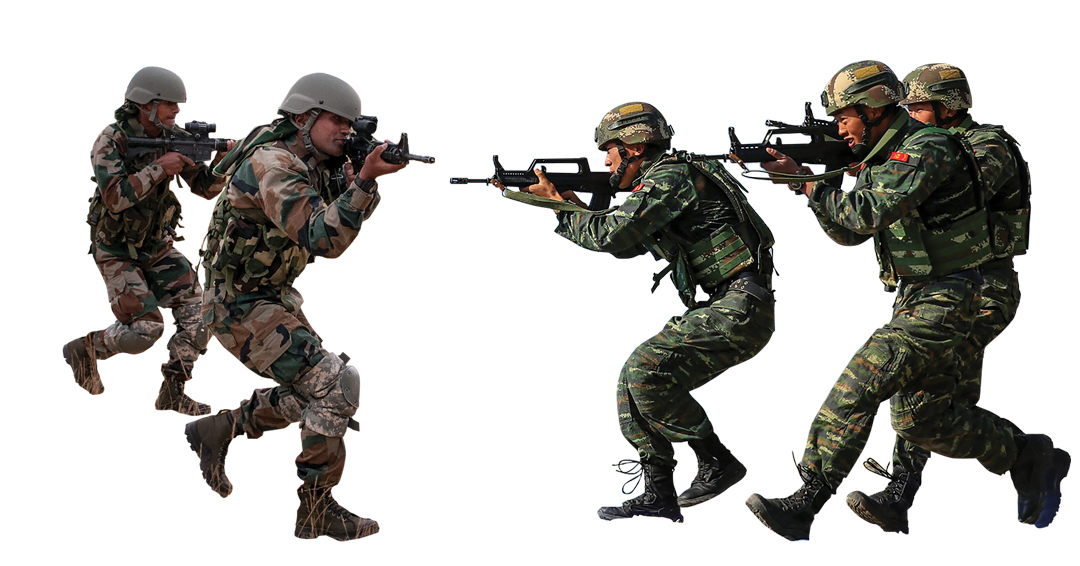
The reason why China attacked Ladakh in India during May-June 2020 has been under debate. These include: India’s map of the Union Territory of Ladakh which includes Aksai Chin under China’s illegal occupation; India’s closeness to America, and China fearing India may capture Aksai Chin though China keenly observed the neglect of the military in India. Aksai Chin was never part of China. India only had a border with Tibet, not China. In the 7th century, Tibet’s empire spanned high heartland and deserts of the north-west from the borders of Uzbekistan to Central China, from halfway across Xinjiang, an area larger than the Chinese heartland. In 763, the Tibetan army even captured the then Chinese capital Chang-an (today’s Xian).
At the 1914 Shimla Convention, representatives of China, Tibet and British India agreed to the McMohan-MaCartney Line as the border between Tibet and British India. But after China’s communist takeover, expansionist plans were aired by Mao Zhedong, saying, “Tibet is the palm of China and Ladakh, Nepal, Sikkim, Bhutan and NEFA (Arunachal Pradesh) are its fingers.” China then annexed Tibet, Inner Mongolia and Xinjiang. Mao’s thoughts were echoed by Deng Xiaoping under whom Xi Jinping (now president of China) was the first secretary in the defence ministry when China invaded Vietnam in 1979 to ‘teach Vietnam a lesson’ but received a bloody nose.
The postulation that India’s map of Ladakh triggered the recent Chinese aggression is not entirely true because Ladakh was always in China’s crosshair. China aimed to join hands with Pakistan along the Shyok River, reviving the old silk route joining Gilgit-Baltistan to Yarkand in China through the Karakoram Pass, capturing the Siachen Glacier in the process. This is a major freshwater source. China kept slicing off Indian territories over the years. The PLA made a 19-km intrusion in Depsang (Ladakh) in 2013, staying put for three weeks. In 2014, the PLA exercised an invasion on a land model of Ladakh inside China. The 2020 invasion in Ladakh with two dvisions was a follow up of such an exercise, taking India completely by surprise.
Indian intelligence failed to read signs of the aggression, as also the intent of China and Xi Jinping despite the dedicated China Study Group (CSG). India was engaging China economically as the rest of the world but forgot it has a 3,448 km unresolved border with China which has a superior border infrastructure on the opposite side. This contrasted China’s Science of Strategy 2013 that said, “We cannot count on luck and must keep a foothold at the foundation of having ample war preparations and powerful military capabilities of our own rather than hold the assessment that the enemy will not come, intervene or strike”. Presently India is engaged in a flurry of defence procurements but is building hard power which will take time and cost more.


The author is a veteran lieutenant general of the Indian Army. His views are personal. He can be reached at prakashkatoch7 |
|
Cover Story
|
|
News Buzz
|
Update |
Leave a Reply