



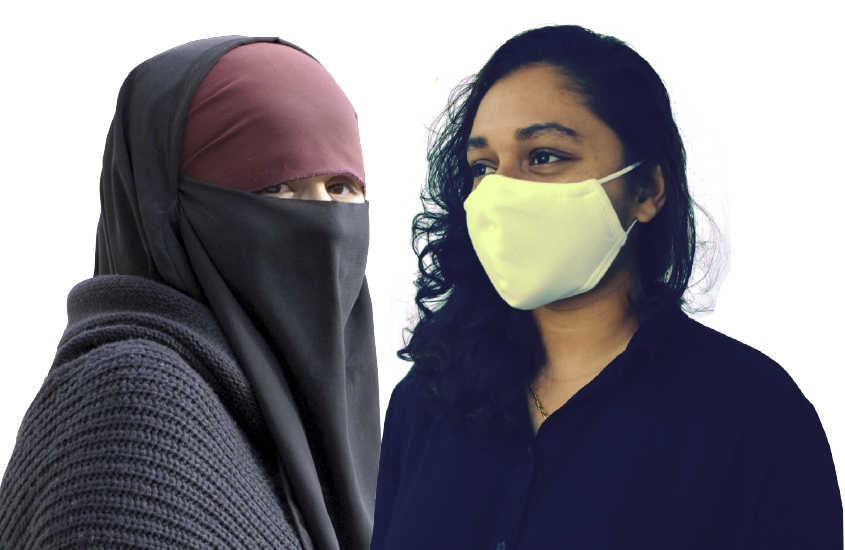
 Even in the new millennium, certain parts of the globe are reluctant to allow Muslim women to cover their faces. The rationale behind the veil ban is ensuring safety of others, retaliating to security threats, hurdles in identifying terrorists and discouraging those dreadful elements who mostly claim to be linked with Muslim communities. Indeed the advancement in technology has offered us facilities like closed-circuit television (CCTV) and face veils appear to negate the facility. Look into the ironical shift of happenings in 2020, when covering the face with masks has been made compulsory to ensure safety for mankind. Whether masks or no masks, the apparent purpose is to guarantee security.However, the matter has been taken to another level and is cooked-up as religious discrimination.
What is the idea of the veil and what denies the right of wearing a veil? Hijab is part of a woman’s dress and is particularly associated with Muslim women. Most Islamic legal systems explain such clothing as covering everything excluding the face and hands up to the wrists, whereas some believe that the Quran itself does not order that women wear hijab. So hijab is not a problem to any country but burqa and niqab are. Burqa is an encasing outer garment that covers the body and the face of women and niqab is also a garment that covers the face. The burqa and other types of face veils have been testified since pre-Islamic times. Many Jews, Christians, and women of other faiths considered covering their faces as a symbol of piety. Jains in India take it to the next level and cover their faces regardless of gender.
Many Islamic scholars do not regard covering the face as a religious requirement. However, some scholars, particularly those belonging to the Salafi school of thought, view face veils as obligatory for women, particularly in the presence of non-related males. In early Islamic jurisprudence, when the veil was discussed beyond prayer requirements, it was generally considered an issue of social status and physical safety, rather than one of religious nature. Later, during the medieval period, Islamic jurists began to give more consideration to the idea of “awrah” (intimate parts) and the question of whether women should cover their faces.


The writer is a columnist and broadcast journalist. He teaches at UVAS Business School in Lahore and can be reached at mali.hamza@yahoo.com |
|
Cover Story
|
|
Special Editorial Feature
|
Region
|
|
News Buzz
|
Update |
Leave a Reply