



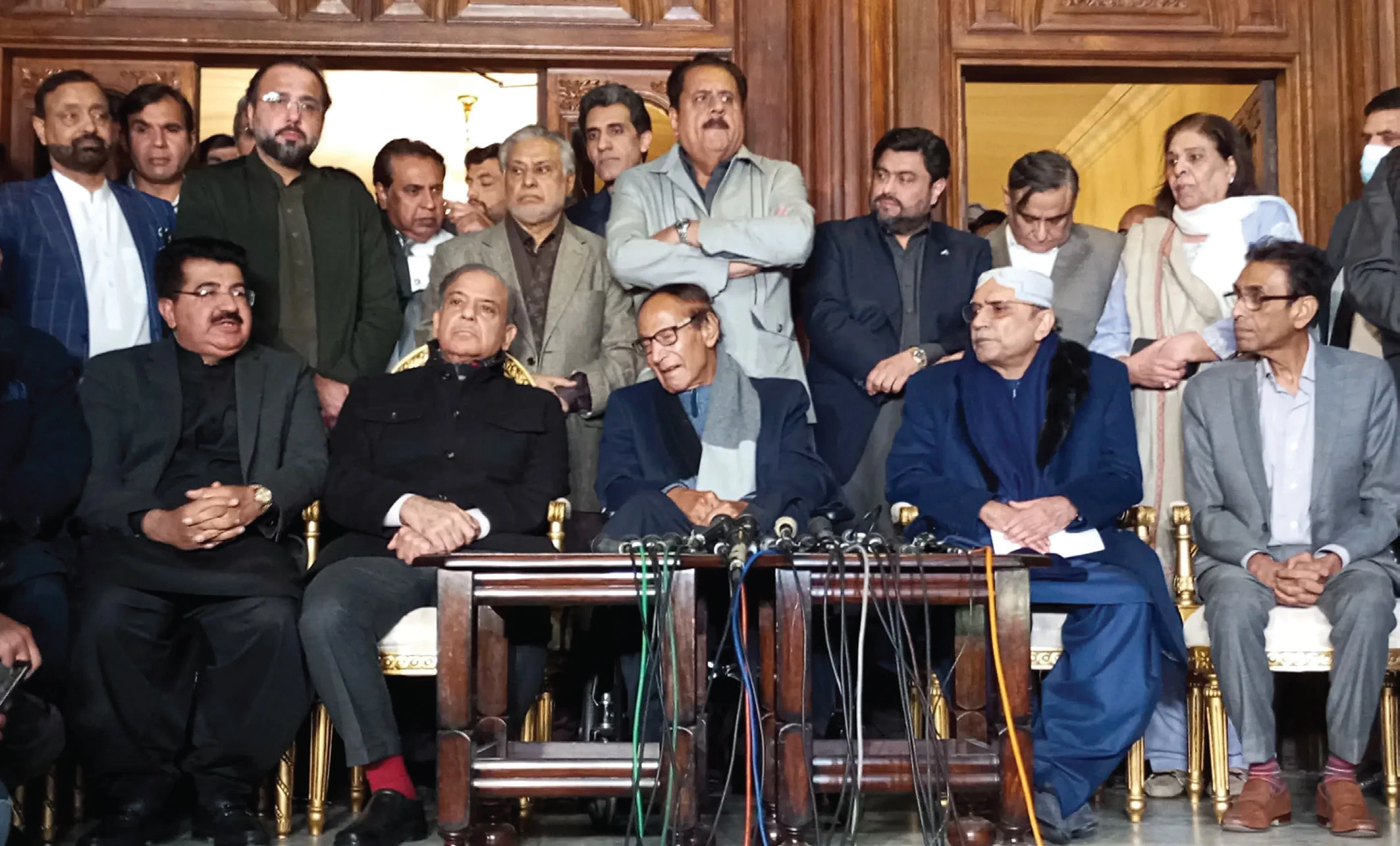
The 2024 General Elections in Pakistan resulted in an unprecedented outcome. This was a vote against the dynastic parties’ status quo and the dominance of its old guard. On the day of the election, 44% of the electorate was under 35 years, and they seemingly voted for the Pakistan Tehreek-e-Insaf (PTI).
Despite the election day surprise, Pakistan got a government that looks very much like the one that came in after former prime minister Imran Khan’s ouster in the form of PDM. In February 2024, the second and third-largest parties in the parliament, the Pakistan Muslim League (PML-N) and Pakistan People’s Party (PPP) joined hands again to form a coalition government and formed PDM 2.0. The members of Parliament took their oaths of office on February 29. Surprisingly, Nawaz Sharif is out of the fold, and his brother Shahbaz Sharif took the oath and became the 24th Prime Minister of Pakistan in March 2024.
However, this arrangement raises several questions: Can the PML-N and the PPP coalition, referred to as PDM 2.0, deliver durable democracy? Will the PML-N overcome its political differences with the PPP, or will they leave behind their internal rivalries and focus on the security issues Pakistan is facing today? Another important question that begs attention is if the PML-N and the PPP try to overcome their issues, how will they pass bills where they have to face strong opposition? Can the PDM 2.0 bring some degree of political stability and, hence, economic stability in Pakistan?
If we reflect on the issues Pakistan faces today, the top on the list is a precarious economic situation. Inflation is backbreaking, and the rupee’s value has fallen sharply. The Express Tribune reported that Pakistan’s foreign reserves have dropped to a precariously low level of less than USD 8.27 billion, likely due to foreign debt repayment. However, the IMF’s (International Monetary Fund) upward revision of Pakistan’s foreign exchange reserves to USD 9.1 billion by June 2024 suggests a continued gradual growth momentum. But will it happen that easily? What will the status of IMF conditions be, and what will its effect be on the general public?
Pakistan is rippling with societal polarization after the election outcome. This is becoming another serious issue for PDM 2.0 to deal with. Public sentiments do not match the election outcome; they feel betrayed and have lost trust in the government institutions. In this environment, even if PDM 2.0 tries its best to overcome the differences with the people of Pakistan, their mandate will always come between their relationships. Hence, it becomes difficult to overcome.
There is mounting insecurity on the western border, TTP attacks are getting stronger in the tribal regions, and Balochistan is becoming a hub of new waves of terrorism. At this point, Pakistan’s first preference will be to strike kinetically at TTP targets within its borders, but that will be limited by TTP movement across the border into Afghanistan. That movement is what leaves Pakistan with the difficult-to-resolve TTP issue and complicates things beyond the military operation it launched against the group in 2014. Still, the Pakistani Taliban, at this point, is not the biggest threat Pakistan faces, given the country’s major political and economic challenges – but left unchecked, it could morph into a significant crisis.


The writer is associated with the National University of Sciences and Technology, Islamabad as an Assistant Professor at Department of Government and Public Policy. She can be reached at farahnaz@s3h.nust.edu.pk
Leave a Reply