

Lahore
Great Expectations
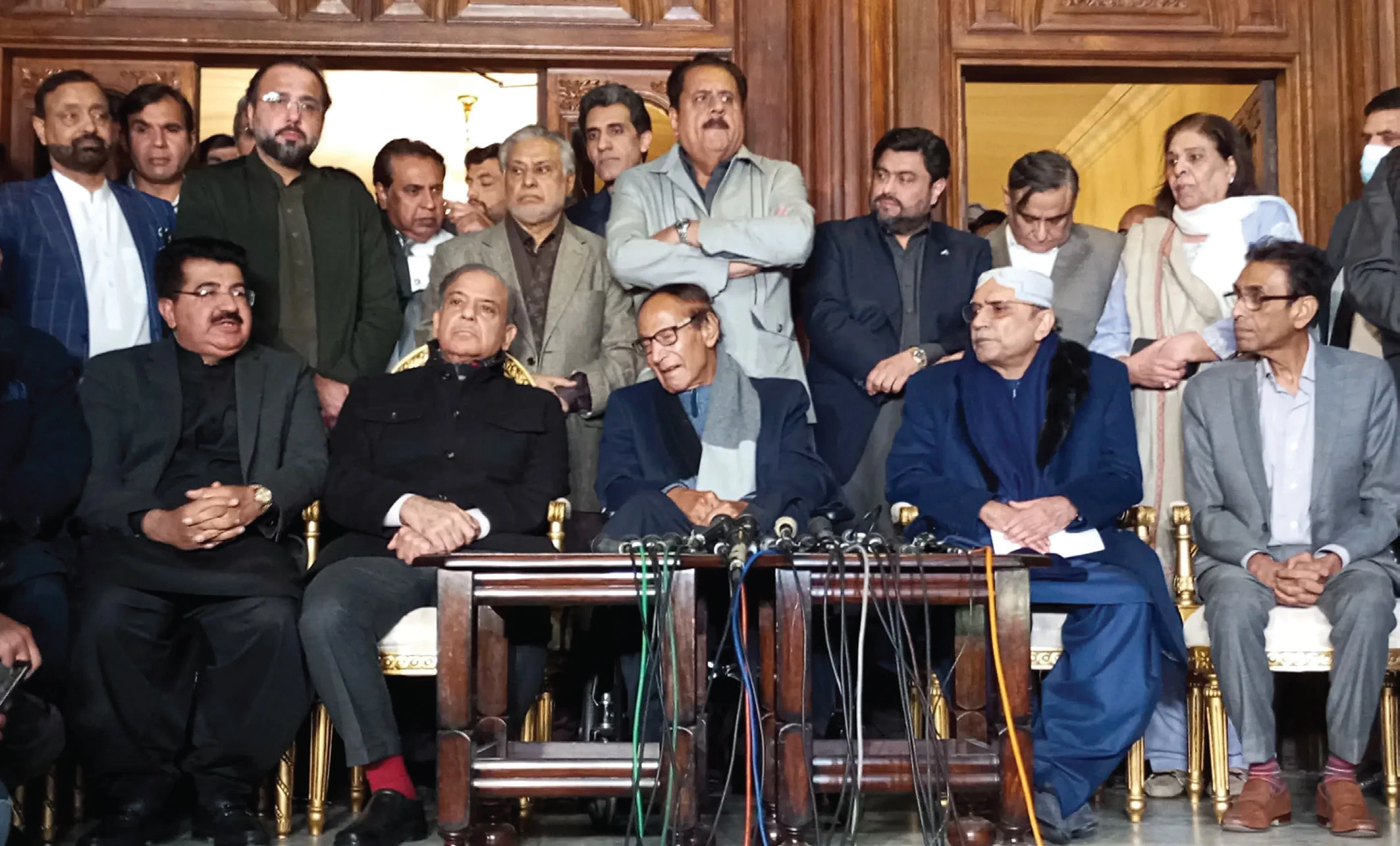
Led by Prime Minister Shehbaz Sharif, the new coalition government may be too weak to find the necessary solutions and run its political show.

The 2024 General Elections in Pakistan resulted in an unprecedented outcome. This was a vote against the dynastic parties’ status quo and the dominance of its old guard. On the day of the election, 44% of the electorate was under 35 years, and they seemingly voted for the Pakistan Tehreek-e-Insaf (PTI).
Despite the election day surprise, Pakistan got a government that looks very much like the one that came in after former prime minister Imran Khan’s ouster in the form of PDM. In February 2024, the second and third-largest parties in the parliament, the Pakistan Muslim League (PML-N) and Pakistan People’s Party (PPP) joined hands again to form a coalition government and formed PDM 2.0. The members of Parliament took their oaths of office on February 29. Surprisingly, Nawaz Sharif is out of the fold, and his brother Shahbaz Sharif took the oath and became the 24th Prime Minister of Pakistan in March 2024.
However, this arrangement raises several questions: Can the PML-N and the PPP coalition, referred to as PDM 2.0, deliver durable democracy? Will the PML-N overcome its political differences with the PPP, or will they leave behind their internal rivalries and focus on the security issues Pakistan is facing today? Another important question that begs attention is if the PML-N and the PPP try to overcome their issues, how will they pass bills where they have to face strong opposition? Can the PDM 2.0 bring some degree of political stability and, hence, economic stability in Pakistan?
If we reflect on the issues Pakistan faces today, the top on the list is a precarious economic situation. Inflation is backbreaking, and the rupee’s value has fallen sharply. The Express Tribune reported that Pakistan’s foreign reserves have dropped to a precariously low level of less than USD 8.27 billion, likely due to foreign debt repayment. However, the IMF’s (International Monetary Fund) upward revision of Pakistan’s foreign exchange reserves to USD 9.1 billion by June 2024 suggests a continued gradual growth momentum. But will it happen that easily? What will the status of IMF conditions be, and what will its effect be on the general public?
Pakistan is rippling with societal polarization after the election outcome. This is becoming another serious issue for PDM 2.0 to deal with. Public sentiments do not match the election outcome; they feel betrayed and have lost trust in the government institutions. In this environment, even if PDM 2.0 tries its best to overcome the differences with the people of Pakistan, their mandate will always come between their relationships. Hence, it becomes difficult to overcome.
There is mounting insecurity on the western border, TTP attacks are getting stronger in the tribal regions, and Balochistan is becoming a hub of new waves of terrorism. At this point, Pakistan’s first preference will be to strike kinetically at TTP targets within its borders, but that will be limited by TTP movement across the border into Afghanistan. That movement is what leaves Pakistan with the difficult-to-resolve TTP issue and complicates things beyond the military operation it launched against the group in 2014. Still, the Pakistani Taliban, at this point, is not the biggest threat Pakistan faces, given the country’s major political and economic challenges – but left unchecked, it could morph into a significant crisis.
To deal with cross-border terrorism, if the goal is to build broader public support for a potential new major counter-terrorism operation, that may be tough given that this new government is unlikely to be popular among the masses. Since the PTI has formed its government in KPK with an overwhelming majority while BAP, PTI, ANP, and HDP have formed a coalition government in Balochistan - it will be difficult for the federal government to interfere in their internal affairs. Thus, the problem will keep multiplying and may be hard to resolve.
There is mounting insecurity on the western border, TTP attacks are getting stronger in the tribal regions, and Balochistan is becoming a hub of new waves of terrorism.
Pakistan’s relations with neighbouring countries are also becoming challenging. Pak-Iran security relations are now being discussed openly. While India poses severe water security issues to Pakistan, India plans to divert the Ravi River waters, which will significantly impact Pakistan’s agriculture sector. On top of that, efforts have been put in place to negatively affect the Kabul River flow and divert its water, too. This will lead Pakistan to a severe water crisis. Pakistan’s relations with China are also questioned based on the delay in the CPEC completion plan and the security of the Chinese working in Pakistan. The longer this project drags, the more it negatively affects Pakistan-China relations. The cherry on top, Pak-US relations are also not in high spirits. The more Pakistan tries to get closer to the US, the more the US administration becomes unsatisfied with the Pakistani side, and the mantras of “do more” still exist in the 21st century.
Pakistan’s 2024 election result has added political instability to a nation already dealing with an economic crisis and rising militancy. The new coalition government may be too weak to find the necessary solutions and run its political show. This new coalition government will likely be unstable, given that disagreements might emerge between the PML-N and the PPP on various issues.
Due to uncertain economic conditions, the coalition government will be compelled to make unpopular choices to qualify for a new IMF loan. This coalition will not have sufficient political space to implement reforms and will institute just enough austerity measures to meet the IMF’s obligations for a new loan. It remains an open question how it will manage the parliament in which the Opposition’s members will constitute a significant bloc. If the PDM 2.0 ignored election manipulation, the cost of inaction could be street mobilization.
A new anti-government movement led by the PTI, Maulana Fazal Rehman, and Mahmood Khan Achakzai, encouraged by its electoral performance but enraged by what it believes to be massive rigging that prevented it from securing a majority will affect PDM-2 badly to perform. Problems are multifold, and expectations are too high - it looks like this will be one of the toughest governments for the PML-N because, other than President Asif Ali Zardari, there is not a single ministry allocated to the PPP yet. Therefore, the entire blame will come on the PML-N for not serving the nation well and taking the country out of crisis!![]()

The writer is associated with the National University of Sciences and Technology, Islamabad as an Assistant Professor at Department of Government and Public Policy. She can be reached at farahnaz@s3h.nust.edu.pk
Pakistan urges Afghanistan to address terrorism as ‘shared concern’
New Team at PBA
Pakistan seeks investment, not loans: PM
Pakistan, China to form WG on 5 new economic corridors
ChatGPT sees a surge in website traffic as schools reopen
US diplomat visits Napa
Sarah Ahmad wins prestigious award
Pakistan eyes $300m by selling Panda Bonds
Tunnel becomes the latest flashpoint in India-China border tensions
India’s ‘Silicon Valley’ is running out of water
New Delhi summons US diplomat over Kejriwal’s arrest remarks
World’s super rich attend pre-wedding bash of Mukesh Ambani’s son
Shahid Afridi and Mushtaq Ahmed Demand Censorship
Biden, Netanyahu hold first call in over a month
Telenor Pakistan launches female sales trainee program
NBP’s Annual Corporate Briefing
Sailor martyred in operation against Indian fishermen


Leave a Reply