


Special Editorial Feature
The Unreported
Musharraf-Clinton Dialogue
As reproduced from his notes and recall by Senator (r) Javed Jabbar.
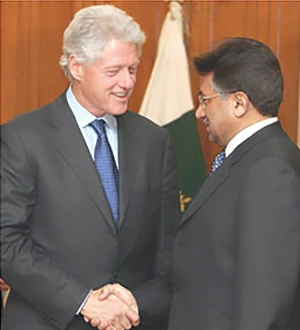
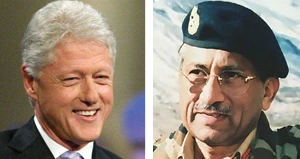 In the forenoon of 25th March 2000, Pervez Musharraf and the Cabinet welcomed President Bill Clinton and his entourage at the CE’s Secretariat in Islamabad. As I shook hands with the man from the White House, two thoughts occurred even as one noted his robust, still youthful face and the eyes with a veil of humour in them. One thought was about Clinton’s extraordinary capacity to not only survive the Monica Lewinsky scandal but to actually achieve a gain in his poll ratings even during and after the live telecast of his virtual interrogation conducted by the prosecutor about the scandal — marked by his almost hilarious yet effective evasion of defining a particular “sexual” encounter. Only a few weeks earlier in February 2000 the Senate had rejected the attempt to impeach him — another remarkable indicator of his capacity for weathering severe political storms. The other thought was that, though belatedly done, here was an American President who had enough respect for Muslim lives to order the bombing of Serbia in order to prevent further massacres in Bosnia and Kosovo.
I also could not help noticing that as the brief welcome formalities and handshakes proceeded, no cameras recorded the scene as previously agreed.
There were three phases of the President’s visit of which I was a part. The first phase was a restricted dialogue. The second phase was a larger scale interaction with the whole Cabinet seated at a conference table. The third phase was at a lunch in the Aiwan-e-Sadr hosted by President Rafiq Tarrar who, in many ways, was the opposite of his guest in several respects.
It was good to be included by Pervez Musharraf in the first phase. This comprised a candid dialogue in which both Heads of Government were accompanied by six aides and officials. The Pakistan six included: Foreign Minister Abdus Sattar, Finance Minister Shaukat Aziz, Foreign Secretary Inam ul Haque, Ambassador to USA Maleeha Lodhi, Lt. General Ghulam Ahmed, COS to CE and myself. The Americans comprised: Secretary of State Madeline Albright, National Security Adviser Sandy Berger, Chief of Staff John Podesta, Ambassador Bill Milam and one other member of the Clinton team.
The schedule had allotted about 35 minutes for this first phase. In the event, it went over 85 minutes, concluding with a one-on-one session of about 20 minutes in which Pervez Musharraf and Bill Clinton were alone after all others had left the room.
Both during the 120-minute restricted group dialogue and in the 20 minutes one-on-one session — when only the two Heads of Government were in the closed room and all the rest were outside — it was notable that Madeline Albright and at least 2 of her colleagues seemed concerned at the sessions going beyond the allotted time, with the one-on-one session being an unexpected last-minute addition. When the restricted group dialogue’s duration had become about 45 minutes, i.e. 10 minutes more than allotted, I saw Albright slipping a small chit to Clinton who read it. And if it was a reminder that it was “Time up”, he carried on regardless. As indeed, two more such chits were also ignored when they came from Sandy Berger and John Podesta. But those chits may well have been about talking points that Clinton needed to be reminded of — even though the body language of the chit-passers indicated they were not comfortable about going into so much extra time.
I was the only member of the Pakistan group who made notes. Neither Pervez Musharraf nor anyone else asked me to do so. I almost reflexively began to scribble on a pad the words spoken by the host and his chief guest. Fortunately, that pad has remained with me, along with 4 other pads of notes from many more that have been lost over the past 20 years.
Before I reproduce the notes, brief remarks about the ambience.
 We were a total of 14 people in the room (7 from each side including the two Heads), seated in chairs facing each other. Pervez Musharraf was seated to the left of his colleagues as were Bill Clinton’s colleagues seated to his left.
As Pervez Musharraf began his welcome remarks and continued for the next four or five minutes, followed by Bill Clinton’s initial comments, there was clearly evident a certain stiffness on both sides, an under-current of mild yet palpable discomfort. Where Pervez Musharraf had commenced his remarks with a degree of tentativeness, he soon developed a self-assured manner. But gradually, after about the first 20 minutes, I saw an unmistakably more relaxed demeanour in both leaders. Smiles were exchanged. There were chuckles. Heads nodded. Even when prickly subjects were covered, a cordiality grew into a faint yet tangible warmth. As the tenor improved it was distracting yet amusing to note that Bill Clinton’s aides were not as increasingly empathetic as their leader seemed to be. The obvious question in their minds must have been: “An American President should not become so amicable and relaxed with a military dictator — even if there are no cameras to record this scene.”
 The second phase is covered in the subsequent chapter.For the third phase, we proceeded to the lunch hosted by the President of Pakistan. I was seated at a side table close to the large main table at which the two Presidents, the Chief Executive, the Chief Justice of Pakistan, Irshad Hasan Khan, the Foreign Minister and Madeline Albright and others were seated. Among the five persons with me was Sandy Berger. During our formal exchanges over lunch, there were mostly only pleasantries. But he did note with interest and appreciation the fact that our Government practiced an open, progressive approach to media and to freedom of expression as also to freedom of information.
There was a brief and amusing distraction. Bill Clinton excused himself because he needed to use the washroom. Within a few seconds of his leaving the head table and his walking to the facility adjacent to the banquet hall, Chief Justice Irshad Hasan Khan also excused himself and followed the American President. There were some spontaneous smiles at the charming coincidence of natural needs felt by the US President and the Head of Pakistan’s Judiciary. One remains uninformed to this date as to the content of the manly banter that may have been exchanged by the two distinguished gentlemen while simultaneously using the washroom!
They resumed their seats at the head table. From my own seat, the joviality and pleasantness of the exchanges taking place at the head table indicated that Bill Clinton was actually enjoying the company, the cuisine and his visit to Islamabad.
Thereafter, he left the Presidency to make his live address to the nation and to meet with a group of citizens invited by the Embassy before his departure from Chaklala airfield. Over the next 18 months, until 9/11 happened, Pakistan-US relations improved slowly and not always satisfactorily.
Now, placed below for the first time in print are the words spoken by Pervez Musharraf and Bill Clinton in the restricted, closed- door dialogue whose content has not previously been reported or reproduced. Where I was unable to write down every single word exactly as spoken, be it a simple “the” or an “a”, or a phrase in its entirety, I have taken the liberty of completing the sentences as they should read for purposes of coherence alone, without any change of their intended — as perceived by me — meaning.
The words below are accurate about the total dialogue. But the text as written by me is not meant to be a word-to-word, absolutely comprehensive record. Some phrases and sentences may well have been missed. But none of those possibly missed words or phrases were inherently different from the statements and words noted by me at that time.
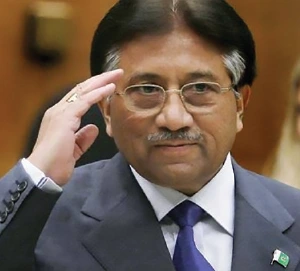
The closed-door, restricted dialogue began with Chief Executive Pervez Musharraf welcoming President Bill Clinton and his colleagues. He said he was grateful for the decision by the President to visit Islamabad, even if this was a very brief visit.
Chief Executive Pervez Musharraf: Our Government and the country are at a critical stage just about six months since I took responsibility. A comprehensive process of institutional reform with special stress on improving governance is being formulated and implemented. The last thing that we want is de-stabilization. Pakistan has suffered the most due to the conditions in Afghanistan since December 1979, while India’s repression in Kashmir continues unabated because the people will not accept Indian rule. We want peace in the region, peace with our neighbours.
We see in you Mr President a hope for the promotion of peace. You have been a benefactor for people who have suffered great blood-shed due to the conflicts in the former Yugoslavia and you helped the victims in Bosnia and Kosovo to be protected from violence. You have also made laudable efforts to redress the problems between Palestine and Israel. We appreciate your efforts to bridge the increasing gap between the West and Muslims. We thank you for sending out Eid cards from the White House! You are clearly someone who is trying to understand Muslims, our concerns and our aspirations.
From Pakistan’s viewpoint, the basic source of tension is Kashmir. There is hostile rhetoric and frequent belligerence from India. We have gathered information that India is attempting to escalate tensions across the LoC and we particularly appreciate your call for restraint. We guarantee such restraint. But based on the information that we have, you may need to do more than only call for restraint.
We agree in to to with you on the need to ensure non-proliferation of nuclear weapons and on combating terrorism. We look forward to your valued views.
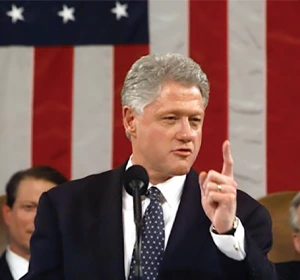
President Bill Clinton: I welcome what you have said. I wanted to come very badly to Islamabad for several reasons. Firstly, to honour our old friendship from the very beginning. During the Cold War, and then with the Soviet invasion of Afghanistan, your country’s participation in the peace-keeping missions in the United Nations, and our cooperation for control of narcotics, specially in the past two decades are laudable.
Secondly, people who know you well like General Zinni says he respects you highly even though our two countries have certain differences. Thirdly, the peoples of our two countries have warm and friendly relations.
Fourth: I am worried about where we are going in the region in terms of India, Pakistan and Kashmir.
While I was listening to your remarks, I thought of how countries can tangle with each other just as children play games. All I say is: as a friend of both countries, neither should play games. I have only 8 months to go before I end my term in office and I want to use every day and all my efforts to promote peace.
One of the reasons I went to India is that we have had estranged relations with them. Despite other aspects, there are friendly relations between the Indian people and the American people. I listened carefully to what they had to say, I made notes and I also conveyed to them my concerns.
The course that you are on may not be able to prevent deepening the crisis. For example, developing and then testing nuclear weapons. I frankly told India that their policy is wrong.
A lot of things that nations do on assumptions increase dangers rather than diminish them. There is a very real danger of proliferation of nuclear weapons. There is simply too much money being spent on them. I have worked with Russia to reduce the number of nuclear weapons and to prevent export of dangerous fissile material, specially by preventing non-State actors from obtaining access. We are very worried.
I have read all about your tenure since you took charge. You have brought a lot of stability compared to the past. You made a reference to your plans to hold local government elections in a few months. For us, it is important to have a time-table for full democracy. It takes a long time to build stable, enduring democratic institutions.
If you were a candidate, General, you could be elected!
In the Americas, except for Cuba, every other country is a democracy.
It is vital for us to know when exactly you will hold elections.
Pakistan is an important large Muslim country with a very significant geo-political position.
About Kashmir, I would like to say a few things. I have spent considerable time studying the history of Kashmir. As you are aware, the father of Secretary of State Madeline Albright who is here with us, was a very astute observer of Kashmir. (Author’s note: Her father, Josef Korbel served as a Member of the UN-appointed Commission on Kashmir onward of May 1948). I have talked to the Pakistani-American community. I am familiar with the related documents and pertinent facts.
The last most relevant document was the Lahore Declaration when the Indian Prime Minister visited Lahore in February last year. Yet, soon after that, your forces crossed the LoC. Nawaz Sharif came and asked me to mediate. I refused to do so till Pakistani forces withdrew. It is unfortunate that that episode became the reason for his downfall.
Nothing can be done until both sides respect the LoC, end the violence and resume dialogue. I do not think the Indians will just give up Kashmir. To them it is not the only issue in the world. I cannot force a dialogue but I can be a force for dialogue.
The Lahore process, or some version of it, should be revived. My talking with the Indians and with you will be empty of meaning if there is no evidence of progress.
The Indian Prime Minister Vajpayee is a smart man. When he went to Lahore, he understood what he was doing. I went to different parts of India: Hyderabad, Rajasthan, for example. They did not talk about Kashmir.
You have to find some way to create a comprehensive process. If Kashmir is the only issue for you, then we are headed for disaster. Your nuclear deterrent is not enough to stop a war.
We will not intervene. I feel strongly about the dangers in this region.
 Based on my trip to India, and now that I am meeting with you, I say that if you take certain steps, then I could work with India. You gave an example of my efforts in the Middle East. Well, I am prepared make an effort here as well. In the Middle East, President Assad of Syria and others trust me from several years of working together. But Assad knows that in a crunch, the US will stand by Israel, and Arafat also knows this.
Some people think the US will throw its weight around. They refer to Bosnia, Serbia, our efforts for the independence of East Timor where they were trying to run people out. But in Kashmir they are not running people out of Kashmir.
In the context of the US and India, and the world at large, the nuclear issue is a huge issue for me. When I leave office I want to have prepared the world for a new era.
20 years from now, we may have groups like the one led by Osama bin Laden possessing nuclear and chemical weapons. Just their possession will be a big psychological blow to the world.
There is no military solution to the Kashmir dispute.
I would like to work for a peaceful settlement but there have to be conditions. I know your scepticism about India’s sincerity but you will hopefully allow for they also possibly being keen to move towards peace. Their view of the future is not dumb. They also look at the US as an example of a model of what can be achieved. India and Pakistan have an enormous variety of ethnic groups, between 80 to 100.
The two of your countries have so much potential that if you were to resolve your disputes, you two could roar past China.
Sometimes, the Pakistani-American talent that benefits the USA comes back home to you! Your Finance Minister Shaukat Aziz is one example.
But if the only definition of the Pakistan-India relationship is Kashmir, and only nuclear weapons, then you are going to squander the great opportunity.
Even friends in Congress, in my own Democratic Party or in the Republican Party, want to help your two countries to achieve peace.
There are one or two other things I would like to say.
I am grateful for the cooperation of Pakistan in the efforts to combat terrorism. Previous governments of Pakistan have extended help. You delivered Ramzi to us who was responsible for the explosions at the World Trade Centre and other measures you took for which we are grateful.
We have real problems with the Taliban, and not just because of Osama bin Laden. Their policies about women are unacceptable. And look at Pakistan, you have a fine lady Ambassador in our country (in acknowledging the presence of Ambassador Maleeha Lodhi). The contrasting attitude of the Taliban to women is barbaric. You should use your influence to promote talks between Mulla Umar and the Northern Alliance.
We hope that there are changes in Iran where you could also help but your hands may be tied. We need to talk about this frankly. There have been kidnappings of Americans by jihadis in Kashmir in 1995. Then there was the hijacking of the plane to Kandahar in December last year and Masood Azhar was released from Indian custody to return to Pakistan. An American citizen kidnapped in Kashmir in 1995 — his body was never found. The Indians think that Masood Azhar may know. It may seem like a little thing, talking about a single human being’s body and locating it but if this is done, it will send a big message to the USA.
Every country has its own justice system. I do not know all the facts about the case in which Nawaz Sharif has been convicted and I don’t know what your plans are about the verdict but I hope that justice is done and that he stays alive.
In the last 30 years, all major leaders in South Asia have died violent deaths. I know that there were children on-board the aircraft on which you were travelling and that his actions threatened the safety of the plane and the children….
Chief Executive Pervez Musharraf interrupted: There were also American children on-board.
President Bill Clinton: Yes, I believe so. But if Nawaz Sharif is executed, the cost will not match the benefits. I am being totally honest.
I want to re-establish our relationship.
There are two positions on which we need clarity and commitment. If we can make progress on non-proliferation in the nuclear field, that will mark real progress.
But I don’t like to talk only about the negatives. We would like to help you. There is the whole field of science and technology. We could restore military-to-military contacts. There is the financial sector where we could support you.
I want to make something good happen before I leave the Presidency. For any positive action you take, I would like to reciprocate, in fact aggressively so!
 I don’t know what will happen in the November elections. But I would like to be a good participant and do whatever I can to improve our relationship before then.
Chief Executive Pervez Musharraf: I will take up the easier issues first. The Nawaz Sharif case is coming to an end soon. I assure you that the Court is totally independent. I have not been following every detail. But I will keep your advice in mind. I am not a vindictive man.
About Kargil: everything was happening with the full knowledge of Nawaz Sharif. We must have discussed it about a dozen times. There were also three meetings of the Defence Committee of the Cabinet which he presided over and in which we discussed Kargil comprehensively. Every point was debated. Not even once was there a difference of opinion. But he is now going to say about Kargil that his downfall was due to Kargil. I never had any intention of removing Nawaz Sharif from his office. As you know, I was returning home, I was in an aircraft and there was no contact with my fellow Generals in Rawalpindi or in Karachi.
President Bill Clinton: Yes I am aware of those circumstances….
Chief Executive Pervez Musharraf: I gave Nawaz Sharif all my support. The Army, the Armed Forces themselves gave all possible help to his Government to implement its policies. He had a problem with WAPDA. I authorized full support from the Army. He wanted to set up anti-terrorism courts and there too we provided full support.
But what he did while I was up in the air was unprecedented and unacceptable to the Army. There was no difference of opinion with him. I go to Sri Lanka and while I am returning, he makes a strange decision.
The only time we disagreed was probably in the case concerning the Editor of the weekly Friday Times, Najam Sethi. Nawaz Sharif wanted him to be tried by a military Court for something Sethi said in New Delhi or wrote about in his journal. I disagreed with him.
Now let me go ahead to other matters. In the nuclear weapons field: there will never be proliferation from our side. I guarantee it. You must remember that it was India which initiated nuclear weapons into South Asia. We had no choice. We had to react. We maintain our capacity for purposes of deterrence alone. But India is not doing the same.
We don’t want them to bully us, to treat us at their whim.
If our security can be guaranteed, we do not need nuclear weapons.
Our conventional capacity is already declining, partly because of sanctions enforced by the USA.
We will always be a responsible state and will never threaten peace and stability.
With regard to the restoration of democracy, my Government and the Armed Forces are absolutely committed to the restoration of elected institutions.
Please note the fact that we have real Press freedom in Pakistan. I hope you read some of our newspapers. A lot of what they publish can be quite painful. Is not it something you also feel when you read your own newspapers?! But as long as they criticize me as an individual, I do not mind. It is only when they make the wrong presumptions about our policies and our Government and our Armed Forces is when I find it hurtful.
The essence of democracy is responsibility and authentic participation of the people.
If I were to give a very precise time-frame at this stage in March 2000 for every step that has to be taken, it can generate a negative momentum. Certain elements start marking time. They begin to disrupt the process and the distances between the milestones.
When I took over, the nation was really suffering from a bad economy, from nepotism and mis-governance. Already, in less than six months, we have begun to take corrective measures and the results are becoming apparent.
This does not mean that I will stay forever. I can’t do it. But just to set the right direction, I have to be there. I have absolutely no intention to stay too long. I prefer to quit while I am on top, not when I am going down.
I know my people, I respect their rights and their expectations. We will restore democracy beginning at the grassroots with the Local Government elections, then the Provincial and the Federal levels. I assure you we will do it fast, very fast.
There are two most important issues. On Kashmir, you tell me that India wants dialogue. I will meet anyone anywhere in the world to conduct dialogue on Kashmir. You need to acknowledge the nature of the dispute itself. This is a struggle for fundamental rights. Kashmir is a human rights issue, involving every one and not just Kashmiris or Pakistanis. Unfortunately, some have labelled freedom fighters as terrorists.
One of the Kashmiri-Americans named Katwari came to see me from the USA. He manages a group that has studied the Kashmir dispute for several years. Our Government is not sponsoring it. There are other Track II initiatives along with Katwari’s which have formulated some possible options that could be discussed during the dialogue process.
Our Government is not sponsoring violence in Indian-occupied Kashmir. The people of Kashmir themselves will give money for Kashmir. The issue of our controlling them is wrongly evaluated. Yes, we must control the violence but this has to be from both sides, not just Pakistan.
I appreciate your sincerity. But I can’t do it entirely at my own initiative, and if so, at what cost to the country?
We need to remember that even as we are talking, the death toll in Kashmir at the hands of Indian repression now exceeds over 70,000 killed. We receive reports every day of atrocities being committed against women and young people. We have refugees who have escaped more suffering. There is daily firing on the LoC. Every second or third day, innocent civilians targetted by indiscriminate Indian shelling are being killed. We are obliged to reciprocate, to retaliate.
De-escalation by both sides can start simultaneously. If they reduce tension, we will immediately do the same and we can both eliminate the firing. We are prepared to operate a hot-line between Commanders at the Battalion level to reduce the chances of mis-understanding. We will use our influence on the freedom struggle to avoid violence.
But Indians have not even accepted that Kashmir is a problem, despite the fact that we have fought wars on Kashmir.
We have started negotiations in the past and with reference to the Lahore process which you mentioned, I want to say that I was part of the internal preparatory process in which the draft text of the Lahore Declaration was discussed and prepared. I raised the issue at that time about the need to refer to the reality of Kashmir and the Lahore Declaration then did include a small reference to it.
Governments have been doing tight-rope walking in the past. There is a duality, a dichotomy between word and deed, between principle and practice. Say something to the people but do something else.
What else is the problem? Why don’t we look forward? We are the worst sufferers here in Pakistan with the problems in Kashmir and the spill-over from Afghanistan for the past ten years and more.
On Afghanistan in particular, the fall-out is terrible and we want to address the issue urgently. With regard to the allegation that we provide sanctuaries for terrorists — I will go to any extent to prevent that from happening because ultimately it is Pakistan that has to pay the price. I received assurances from Mulla Rabbani that they will certainly deal fairly with women’s rights, with freedom of media and so on.
I will try my best with regard to Osama bin Laden but I have my limitations. He represents a complexity of factors.
We remain wholly committed to peace in Afghanistan. In our situation, I cannot risk national security by alienating Pukhtoons. The Taliban are Pukhtoon and they live on both sides of the border, there are strong family and tribal ties between them.
If the leadership of the Taliban can be changed, we have no problem. But the Taliban are strongly entrenched. If they split, there will be pockets of resistance leading to many years of war. Our aim should be to moderate them, to engage them. They have very specific customs and ways of thought. Let me cite a seemingly minor and yet significant example. In 1996 when our Chief of General Staff and the DG-ISI met some of the leaders in Afghanistan and they served food and had their meals while sitting on the ground, the Taliban found it awkward and difficult to shift from the ground to chairs and sofas!
The Taliban do not recognize the simple use of force alone. They understand the power of money, but not force alone ! We have to help them re-build their country. I request you to also contribute support. I will not let you down nor the people of Afghanistan but will help moderate them. Yet I cannot take personal responsibility nor can Pakistan alone be held responsible.
The cultivation of opium and the use of drug money fuels their funding and we have done our utmost to reduce the cultivation of opium in the areas under their control but you need to remember that it is the only source of sustenance for them.
President Bill Clinton: If you want to change the nuclear dimension with India, why don’t you sign the CTBT (Comprehensive Test Ban Treaty)?
I would like our Foreign Minister to conduct a dialogue with you, and with others.
President Bill Clinton: Perhaps you could use our problem to your advantage ! We have a divided Senate. The Republicans want more (nuclear) bombs! They are crazy. If you want to turn the tables on the Indians, you can do so. If you were to simply sign the CTBT but not ratify it, you would gain the upper hand.
Chief Executive Pervez Musharraf: My present focus is inward: our economy, our debt burden. If I get involved in a contentious issue, it will get people out on the streets.
President Bill Clinton: If India signed the CTBT, would it still be contentious?
Chief Executive Pervez Musharraf: That may change the situation.
President Bill Clinton: From your viewpoint, is there a solution to Kashmir that does not involve separation of Kashmir from India?
Chief Executive Pervez Musharraf: There are a number of possible solutions. We will not be rigid. A middle line, somewhere between the Indian position and our position perhaps?
President Bill Clinton: In respect of human rights, with the help of organizations that deal with human rights, it will be easier to achieve objectives for their protection. An increased use of Track II?
Chief Executive Pervez Musharraf: Yes, if we start the dialogue.
President Bill Clinton: You mentioned some CBMs (Confidence-building Measures) which are encouraging.
Chief Executive Pervez Musharraf: There is a basic issue that has to be addressed: the wishes of the people of Kashmir and their rights.
President Bill Clinton: Every nation with a multi-ethnic group has a fear of secessionist tendencies. Kosovo is one of the results. Putin reminded me of the US civil war.
Let me go back: somehow, we have to have conditions that end the current tensions marked by pitched battles between State forces and others.
Chief Executive Pervez Musharraf: The Indian media have created such a hype that it has become difficult for them to withdraw when there is so much whipped-up hysteria. They have blown up the issue of conditionalities to be imposed on Pakistan before dialogue.
President Bill Clinton: If you reaffirm respect for the LoC and prevent outside support for militant groups, then….
Chief Executive Pervez Musharraf: They always say, we should go first!
President Bill Clinton: You can state your position clearly and perhaps make a symbolic gesture.
Chief Executive Pervez Musharraf: Let them allow the United Nations’ Military Observers’ Group to monitor the LoC, let international human rights’ bodies visit and monitor the conditions in Indian-occupied Kashmir. We will certainly try to moderate the freedom fighters.
President Bill Clinton: I might be able to get them to talk to you. They don’t trust you. Instead of starting with a long list of terms and conditions, perhaps there should be a short, doable list of CBMs.
Please remember that no country ever parts with its territory. They understand that if difficulties can be resolved, there can be benefits for both countries. Kashmir can drag both of you down, to much darker conditions in the future and you and they and we must remember the larger reality.
PM Vajpayee comes from the Hindu nationalist Party. He has reached a crucial point in his life where he probably genuinely wants to leave a legacy.
I agree that you must manage your economic problems which are a top priority.
You may be right about the Taliban, and about how you could and do exercise some moderation on them. There is the separate issue about Osama bin Laden. You know what he has tried to do, to kill Americans and to damage us. He operates through a network. Americans tend to project the danger from him as a major threat. Can we buy Osama bin Laden?!
Chief Executive Pervez Musharraf: I can’t say for sure, but I will try !
President Bill Clinton: Osama bin Laden murdered 200 to 300 people in Africa.
Chief Executive Pervez Musharraf: Can we have solid evidence of his involvement? The Taliban say we don’t have the evidence to prove that Osama bin Laden was responsible.
President Bill Clinton: I will think about that. I want it conveyed that I opposed unilateral action against the Taliban on the OBL issue.
Chief Executive Pervez Musharraf: On the other side, about Kargil and Kashmir, we held a DCC meeting two days before we came to you in DC. The Air Chief and the Naval Chief were also present. It was Nawaz Sharif who took the final decision to tell the Mujahideen to go forward or to withdraw from Kargil. We backed him.
President Bill Clinton: Shall we go in for the larger territory, not just Kargil?
Chief Executive Pervez Musharraf: Kashmir is not Indian territory. Kashmir is a disputed territory.
We will be flexible. I can’t give you any more assurance. We are all for a peaceful solution.
President Bill Clinton: We will need a lot of creativity and compromise.
Chief Executive Pervez Musharraf: No one can doubt the intentions of a US President!
President Bill Clinton: 50 years ago, Truman said something insightful about the wisdom of the people!
The President and the Chief Executive agreed to conclude the closed-door dialogue at this point which had already gone well beyond its originally-scheduled duration.
The two leaders agreed to conduct a one-on-one dialogue and said they would take only about 10 minutes. All other persons present exited the room. As we waited outside, and over 15 minutes had passed, it was once again amusing to note the looks being exchanged between Secretary of State Albright and Sandy Berger conveying concern at this unscheduled exclusive exchange between the two leaders. It was only about 20 minutes later that the President and the Chief Executive emerged, both of them looking quite relaxed and amiable.

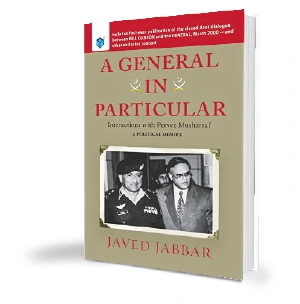
But sadly Pervez Musharraf’s autobiography is so concerned with the immediacy of conditions just before, during and after 2001 and his then-new friendship with President George Bush that he devotes no attention or space whatsoever to the significant and revealing encounter with President Bill Clinton.
In sharp contrast, the American President makes several references in his own autobiography to his visit to Islamabad and takes two paragraphs, quoted below, to recall his meeting with the military ruler of Pakistan.
On page 903 of My Life, President Bill Clinton wrote: “In my meetings with Musharraf, I saw why he had emerged from the complex, often violent culture of Pakistani politics. He was clearly intelligent, strong, and sophisticated. If he chose to pursue a peaceful, progressive path, I thought he had a fair chance to succeed, but I told him I thought terrorism would eventually destroy Pakistan from within if he didn’t move against it.
In sharp contrast, the American President makes several references in his own autobiography to his visit to Islamabad and takes two paragraphs, to recall his meeting with the military ruler of Pakistan.
Musharraf said he didn’t believe Sharif would be executed, but he was noncommittal on the other issues. I knew he was still trying to solidify his position and was in a tough spot. Sharif subsequently was released into exile in Jeddah, Saudi Arabia. When Musharrafbegan serious cooperation with the United States in the war against terror after September 11, 2001, it remained a risky course for him.
In 2003, he survived two assassination attempts within days of each other.”
Though Pervez Muharraf’s memoir runs to only about 335 pages while Clinton’s autobiography. is spread over 957 pages, the contrasting attention- or the lack of it in one case! -given by each leader to their sole official meeting is a revealing indicator of the interest in history, and in respect for the other as differendy recalled-or not, as in one case! –by the two leaders.
Raza Rabbani calls for declaring 2023 ‘Year of Constitution’
GO Installs RO Plant
Cowasjee Institute to be made psychiatry university
PM approves outsourcing management of three key airports
Film on forced conversion bags international award
Veteran Journalist Mudassir Mirza passes away
NBP Awarded (GDEIB) Awards in four categories
Emirates Group returns to profit
American TV journalist Barbara Walters dies at 93
Faysal shifts to ‘Islamic only’ banking
Chapter 19 comprises the first-ever publication anywhere of the closed-door dialogue between President Bill Clinton and Chief Executive General Pervez Musharraf which took place on 25th March 2000 in Islamabad at which the author was also present. As a perusal of the text reveals, the candid dialogue between an elected American President and an unelected Pakistani military ruler covered a wide and vital range of internal, bilateral, regional and global issues that marked the advent of the 21st century. Aptly described by General Ehsan Ul Haq, former Chairman, Joint Chiefs of Staff Committee and former DG. ISI in his Foreword, the whole book represents “a treasured record of historical value and a significant contribution.”