


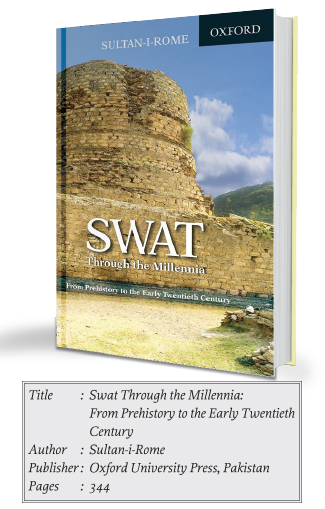
 Mainstream discourse is dominated by seemingly clichéd representations of the Swat Valley as a picturesque holiday destination. With its sprawling meadows, majestic forests and azure lakes, the valley is often billed as the ‘Switzerland of Pakistan’. Over the last decade or more, Swat has entered the public imagination as the breeding ground for militancy.
Since 2007, the region has become the site for armed efforts to suppress the influence of the Tehreek-e-Taliban. The violent memories of Operation Rah-e-Haq and Rah-e-Raast have been exacerbated by another turbulent event: the assassination attempt on Malala Yousafzai. As a result, the valley is often portrayed in the modern context as a study in contradictions - a beautiful yet broken place that is plagued by strife.
However, Sultan-i-Rome’s Swat Through the Millennia doesn’t foray deeply into the contradictions associated with contemporary representations of Swat. On the contrary, the emphasis of the book remains on appreciating the tumultuous sweeps of the region’s history that seldom receive critical attention.
In his introductory note, the author categorically states that efforts to understand the complex strands of Swat’s history before it became a princely state have often been undermined. Narrating his own experience of working on a PhD dissertation about the region, Sultan-i-Rome illustrates how experts have propagated the flawed notion that the pre-state history of Swat ought to be “abridged”. The author challenges this form of academic erasure by venturing into hitherto uncharted terrain and embarking on course-correction. According to the author, Swat’s modern history can only be effectively understood through an intimate awareness about the region’s pre-state past.
The book has been published many years after Sultan-i-Rome’s 2008 treatise, titled Swat State (1915-1969): From Genesis to Merger, which examines the institutional framework in the princely state of Swat. Even so, the author’s latest offering could have served as a worthy prequel to his earlier book and should arguably be read before it. This will enable readers to understand the logical progression of events that altered the region’s social and political landscape.
One of the major attributes of Swat Through the Millennia is that it doesn’t abandon the conventions of chronology. The history of the region unspools sequentially through a series of crisp, tightly wrought chapters.
The initial chapters examine Swat’s etymology and ancient political geography, and make effective use of archaeological research to present unique observations on the region’s prehistoric and proto-historic periods. Another chapter evaluates the secondary sources that turn an intimate gaze into the invasion of Swat by Alexander of Macedonia. The growing dominance of the Mauryans, the pre-Yusufzai Muslim period and the social evolution spurred by the Yusufzai occupation are portrayed in immaculate detail. The implications of Mughal rule on the valley have been analyzed in depth while Khushal Khan Khattak and Sayyid Ahmad Baraevi’s visits to Swat feature as prominent themes in the book. In addition, Sultan-i-Rome explores Swat’s role during the British rule in India and the machinations that eventually led to the creation of the Swat State.
Sultan-i-Rome’s linear account documents the intricacies of Swat’s pre-state history in an uncomplicated manner. It is, therefore, a useful historical text for students or inquisitive readers who are eager to learn about bygone eras. However, it would be wrong to assume that Swat Through the Millennia merely presents a simplistic analysis as the book relies heavily on extensive primary and secondary research. This can be evidenced from formidable bibliographies at the end of each chapter.
Fuelled by refreshing insights on a subject that rarely gains scholarly attention, Sultan-i-Rome’s historical account seeks to deepen our understanding of a misunderstood region. Swat Through the Millennia celebrates the valley’s diverse past and can be perceived as a subtle lament of the region’s gradual corrosion at the hands of miscreants. 
Leave a Reply