



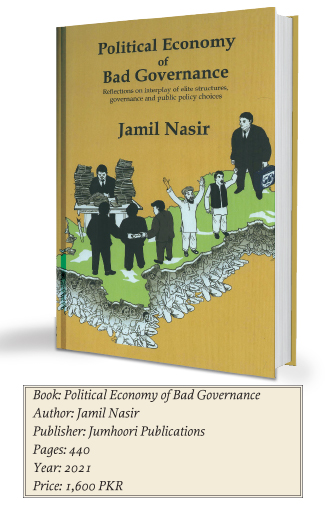
 Political Economy of Bad Governance: Reflections on interplay of elite structures, governance and public policy choices by Jamil Nasir is a well written, concise collection of essays produced for various leading newspapers and journals. Jamil Nasir is a Columbia alumnus and a Chevening Fellow on ‘Economic Governance and Reforms’. His experience ranges from working as a Collector of Customs and Chief (Trade & Tariff) at the Federal Bureau of Revenue, Islamabad. He holds a Master’s degree from Columbia in Economic Policy Management. In essence, Jamil Nasir has several years of experience not only working as a civil servant in Pakistan, implementing the various policies and developing first-hand knowledge on the opportunities and pitfalls of such policies. He also has experience working as a consultant at the World Bank. The book provides us an opportunity to tap into the vast pool of knowledge that Jamil Nasir has accumulated over two and a half decades.
The book is divided into eight sub-themes: namely democracy, political economy, rural political economy, governance, corruption, education, trade and taxation. The sub-theme on democracy explores the link between democracy and various socio-economic and political issues that a country may face. The sub-theme on political economy focuses on the interplay of politics and economy such the relationship between rent-seeking activities and the conflicts of interest in governance. Important issues include the IMF conditionalities, the strategies promoted by the World Bank, and poor understanding of major conflicts faced by developing countries. The third sub-theme focuses on the rural political economy, emphasizing on the poor understanding of the needs of the agricultural and non-agricultural economy in the rural areas. The fifth sub-theme involves governance as it links to the challenges in human development. The sixth sub-theme moves on to education, which considers issues related to the sharp divide between the rich and poor in their access to education. The seventh sub-theme focuses on trade, with a focus on issues related to WTO, trade with India and challenges associated with non-tariff barriers. The last sub-theme focuses on taxation, explaining how an effective taxation system can be developed based on the principles of accountability, transparency and democracy.
My favourite sub-themes are education and trade. Considering the discussion on education, the author does an excellent comparison on the access to education between the haves and have-nots. The divide is not only between rural and urban areas but within urban areas as richer strata have access to much better quality than their poorer counterparts. The state patronizes elite education as is obvious with the difference in quality of education offered by schools catering to the upper economic strata. The author also recommends designing appropriate incentives so that there is economic value in ensuring that children obtain education. These can include linking pay of school administrators with enrollment rates in a particular area.
Considering the topics covering trade, the author focuses on WTO and trade liberalization, capacity building in trade, and the opportunities and challenges associated with the GSP Plus status by the EU. The author discusses the international political economy at play at the WTO and its impact on Pakistan and how capacity building is critical to realizing trade potential. Finally, the author asks how Pakistan can benefit from preferential treatment awarded under the GSP Plus status?
Although, the volume is an excellent read and contains vast information from various academic sources to prove the notions brought forward in the articles, the structure of the book in the current format is not exactly reader-friendly. There is a lot of repetition involved as articles overlap topics. The author could have discussed a sub-theme as a whole rather than in the form of different articles. This would have avoided repetition across different articles while ensuring that the reader gets most out of the book. Overall, though, the author has done a commendable job in providing much-needed critical knowledge in the field of political economy in Pakistan.
Leave a Reply