The response of civil society and the criminal justice system aims to deter
such heinous crimes as rape. The victims, however, continue to suffer.
ByWajahat Ali Malik | November 2020
Every country in the world is suffering from rape offences against women, children and even adult boys. In Pakistan, the numbers of cases are increasing regardless of several efforts at the government and non-government levels to control them. This increase creates a general sense of insecurity.
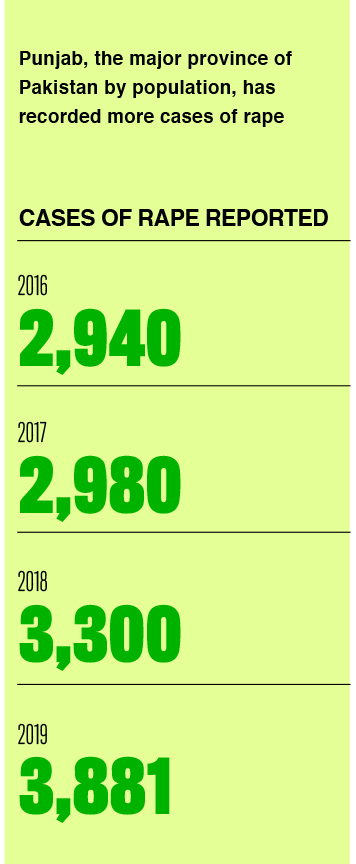
Punjab, the major province of Pakistan by population, has recorded more cases of rape than any other province. In 2016, some 2,940 cases of rape were reported there, 2,980 in 2017, 3,300 in 2018 and 3,881 in 2019. These figures show that the number of rape cases have been increasing every year. Moreover, this is the data of only one province, and is only a tip of the iceberg, because most such cases are either not reported due to social taboos or are negotiated at family level. However, in other provinces, an increase in reporting of rape cases and arrest of perpetrators has been noted.
The increase in reporting of rape cases does not actually mean that incidences have been increasing every year, but rather that the reporting criteria have been improved every year. Due to more awareness in society, rape survivors and their families now feel less reluctant in reporting cases which were previously kept under wraps due to the stigma attached.
Legislation exists in Pakistan to investigate rape offences through forensic methods in the form of DNA technology, for which the legislature must be given due appreciation though its implementation is severely hampered. Irrespective of all the positive legislation, by 2019 there was still a continuing increase in the rate of rape crimes. Some basic causes led to this increase were:
(a) Forensic investigation methods such as use of DNA technology and other latest scientific means for use as evidence in rape cases were not fully exercised by the criminal justice system. Due to the weak evidence against perpetrators, they were acquitted and continued their offences.
(b) The police, prosecution and judiciary are not fully aware about use of forensic investigation methods in the form of collection, preservation and analysis of DNA evidence in cases of rape. A delay in DNA testing or a badly handled DNA sample, or one that has been tampered with, misleads investigations and hinders the process of identification and conviction of the real perpetrators. Access to justice is not served both for the victims, rape survivors and perpetrators.
(c) The conviction rate for rape offences is very low and culprits are not awarded due punishment due to the sluggish criminal justice system and the various loopholes in it. There is not much deterrence against sexual abuse in society, which ultimately leads to the increase in cases.
(d) Family structure and norms in most ethnic groups in Pakistan are established in such a way that after being raped, the individuals or their family members try to hide the incident because of the expected dishonour and stigma.
(e) Lack of awareness of the after-effects of rape on the part of the community lead to an increase in cases.
(f) Sex education is often avoided or is not considered necessary, especially for minors; this has also led to an increase in sexual abuse incidents.
(g) Most individuals and their kin are not aware of the legal procedures that need to be followed after a rape incident.
(h) Many incidents in the rural areas are not registered, which is the main cause of increase in the number of habitual rapists. A classic example is that of Zainab in Kasur, where the habitual rapist was not caught until he raped his eighth victim, Zainab. His DNA sample matched seven other unsolved cases.
A classic example is that of Zainab in Kasur, where the habitual rapist was not caught until he raped his eighth victim.
One important preventive measure that government must take is to build and maintain a DNA database of offenders at the national level. Technologically advanced states such as the USA and the UK make use of DNA databases. They include in their DNA databases samples from crime scenes and from convicts. The UK even keeps in its database DNA samples of suspects from unsolved crimes.
Statistics show that many offenders are likely to be habitual offenders and so it would be easier to identify and convict the suspects of rape crimes, if their names would be placed in DNA database on the basis of their previous involvement in crimes. It is also argued that an offender who knows that his DNA is on the government’s database will be deterred from committing future crimes. The murder and rape of six-year-old Zainab further illustrated the need for establishment of a DNA database, because the culprit Imran Ali was convicted for raping and murdering of Zainab through DNA technology.
As of September of 2020, Pakistan had found itself narrowing its grip on rape cases once again with the recent rape of a mother in front of her children on the Lahore-Sialkot motorway. This even led the Prime Minister to suggest that perhaps the best way to tackle the problem was the castration or public hanging of the perpetrators.
The rape rampage is in tribal areas, mostly in Balochistan because non-political men give attention. The issue of rape is increasing day by day. Is it the responsibility of the government alone to control overall criminals and make strong efforts?






Advocate Wajahat has a keen eye on social issues in South Asia. I find his writings very meaningful and educative.
The rape rampage is in tribal areas, mostly in Balochistan because non-political men give attention. The issue of rape is increasing day by day. Is it the responsibility of the government alone to control overall criminals and make strong efforts?