Islamabad
One More Chance
Pakistan now finds another opportunity to redefine its character and realign amidst evolving regional and global politics.

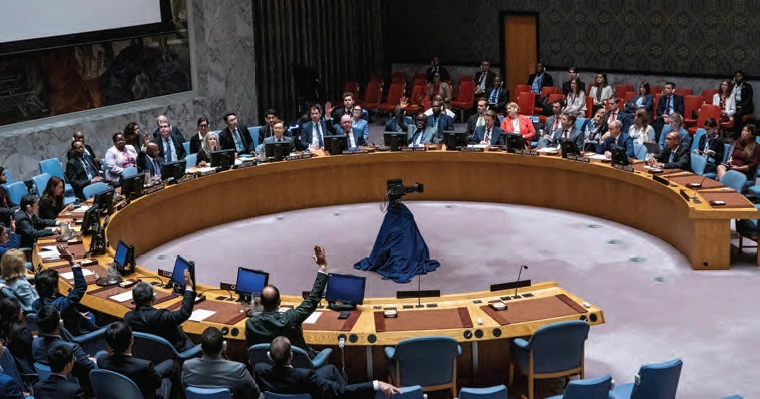
Pakistan’s election to the United Nations Security Council (UNSC) as a non-permanent member for the term 2025-2026, with a substantial majority, represents a notable achievement for the country. It needed 124 votes, constituting a two-thirds majority in the General Assembly, to secure its seat representing the Asia-Pacific region on the UNSC. Out of 193 UN member states, 190 participated in the ballot. Pakistan received 182 votes, significantly surpassing the required threshold, with five abstentions and three votes against.
This victory marks Pakistan’s eighth term in the UNSC. It served in 1952-53, 1968-69, 1976-77, 1983-84, 1993-94, 2003-04 and 2012-13. Only a few countries have had the honor of being elected so frequently. Beyond diplomatic accolades, this victory signals Pakistan’s emergence from diplomatic isolation and presents it with a chance to reshape its trajectory amidst evolving global politics.
Of late, Pakistan has found itself largely isolated diplomatically, facing international scrutiny for its perceived role in fostering extremism and terrorism. The country’s strategic importance as a nuclear power has been accompanied by global apprehensions regarding the security and management of its nuclear weapons, fueling discussions on non-proliferation and disarmament. Moreover, Pakistan’s historical alignment with various global powers and regional dynamics has sometimes characterized it as a client state, dependent on external support for economic and military aid. Pakistan found itself less aligned with this new orientation as the US-led West redirected its attention from South Asia to the Indo-Pacific region to counter China.
In this strategic shift, India emerged as a favored partner for the Western nations, and Pakistan lost its clout. The country’s looming economic crisis also tarnished its reputation. In this context, securing 182 votes out of 190 in an international body is not an ordinary development. Notably, the presence of ambassadors from the five permanent UNSC members—China, the United States, Russia, France, and Britain in a celebratory reception which was hosted by Pakistan’s Ambassador to the UN, Munir Akram, and attended by nearly a hundred ambassadors and UN officials from diverse regions, demonstrates recognition and engagement from major global powers towards Pakistan. It is essential to examine the factors contributing to this change.
The ongoing conflict in Ukraine has significantly reshaped global geopolitics, heightened tensions, and prompted international actors to reconsider their strategies, fostering new alliances and straining existing relationships. Nations worldwide are reassessing their security policies and partnerships in response to the ongoing war, underscoring its profound impact on the international order.
From a Western standpoint, under Russian President Vladimir Putin’s ideological guidance, Russia’s deepening partnership with China has introduced further complexity into global geopolitics amid ongoing transformations. This crisis, coupled with the West’s failure to exert pressure on Israel regarding its actions in Gaza, has raised significant doubts about the integrity of the rules-based international order. Within this framework, Western powers seek alignment with countries supporting their global influence and control ambitions.
Pakistan now stands at another critical juncture of opportunity. It can leverage this momentum with proactive measures and international cooperation to address its domestic challenges.
In South Asian politics, India has not positioned itself as a nation that aligns with Western agendas. It perceives itself as a participant in global power competition rather than an ally. Its defiance of sanctions on Russia, assertive stance in the region, and strategic maneuvers during the current crisis have unsettled the US and the West, leading them to seek allies more aligned with their interests. In contrast, Pakistan has positioned itself closer to Western interests by maintaining neutrality in the Ukraine crisis, supporting Western positions on the Taliban in Afghanistan, and offering strategic assistance in critical areas.
Smaller countries in the region are already anxious about the intensifying Great Power competition, grappling with political instability and economic unpredictability. Their recourse lies in turning to middle powers, which can offer stability amidst the rapidly evolving norms of global interactions influenced by technological advancements and non-military challenges such as climate change. These nations perceive middle powers as pivotal in bridging the divide between major powers and smaller states, promoting cooperation and mutual understanding. Pakistan indicates its aspiration to become that influential power, which has led to a noticeable easing of the international stance towards the country.
Pakistan now stands at another critical juncture of opportunity. It can leverage this momentum with proactive measures and international cooperation to address its domestic challenges. It has missed numerous chances to position itself as a beacon of development and a middle power that influences global politics.
Various reasons contribute to this situation. Historically, Pakistan’s government has not pursued a path of comprehensive national development but prioritized a privileged few’s interests. Consequently, despite being the fifth most populous nation, 33rd largest in land area, 24th largest economy by GDP (PPP), 46th largest by nominal GDP, a nuclear power, and possessing the sixth largest army globally, Pakistan finds itself on the brink of economic collapse. Globally, we rank poorly in all human development indices and have garnered a negative reputation. Had the previous opportunities been utilized for national progress, Pakistan would be a robust middle power, fostering internal and external peace today.
Fortunately, Pakistan now finds another opportunity to redefine its character and realign amidst evolving regional and global politics. While ambitious, this goal is achievable with three prerequisites: resolving internal security challenges, pursuing effective border conflict management, and implementing a people-centric economic recovery strategy. The international community stands ready to support these efforts and hopes for Pakistan’s success. The question remains: are we prepared to seize this opportunity? The focus now should be on leveraging this opportunity to foster national development, strengthen regional stability, and contribute meaningfully to global affairs.![]()
The writer is an Assistant Professor at the Department of International Relations, University of Karachi.
Gunvor to Acquire Total Pakistan
The Bank of Punjab Hosts Professor Stefan Dercon
Former Indian batsman dies at 71
Indus Motor Company Extends its partnership with Arshad Nadeem
Residents of Venice welcome new tourist limits
Trump questions Kamala’s identity
Nestlé for Healthier Kids (N4HK) Room Inaugurated
Konnect by HBL Crowns Valorant Champions
Charity Dinner raises funds for vulnerable segments


Leave a Reply