

Guwahati
Don’t You Dare!
Several factors would likely influence the decision to lift the ban on government employees participating in Rashtriya Swayamsevak Sangh (RSS) activities.

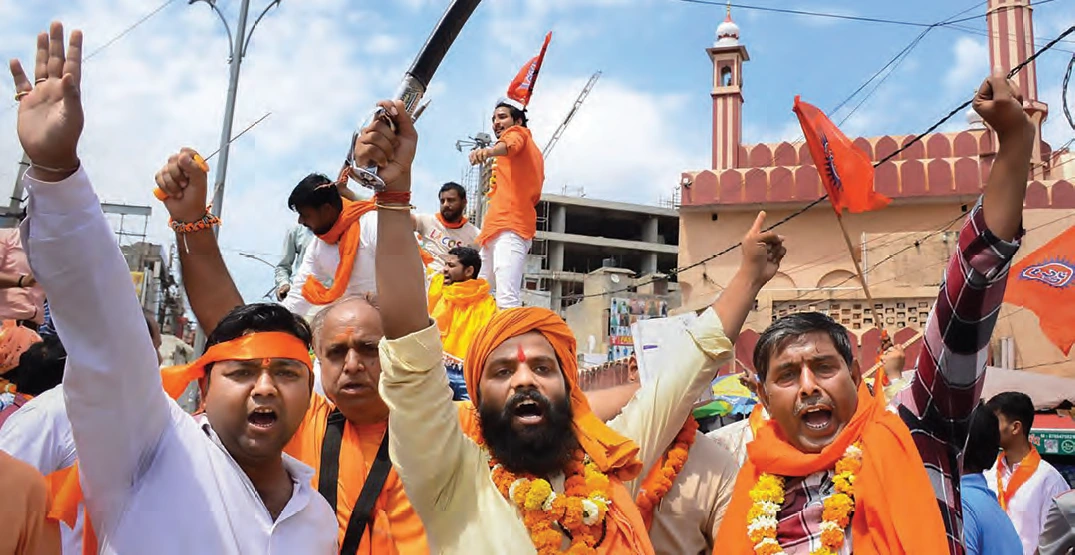
The Rashtriya Swayamsevak Sangh (RSS), a right-wing, Hindu nationalist volunteer organization in India, has faced bans by the Indian government several times in its history. These bans were imposed due to allegations of involvement in activities deemed harmful or prejudicial to public order and security. From the beginning, the bans on the RSS have been highly controversial and have often been viewed through the lens of India’s complex political and communal landscape.
Critics argue that the bans were politically motivated, while supporters contend they were necessary to maintain public order and national security. The RSS remains a significant and influential organization in India, with strong ties to the present ruling Bharatiya Janata Party (BJP). Banning a party’s political wing is a significant and complex action, often undertaken by governments to address issues of public order, national security, or constitutional principles. It can have far-reaching implications for democratic processes and political stability.
Usually, the ban on any political wing led to the causes. Governments may ban the political wing of a party if it is deemed to threaten national security, such as involvement in terrorist activities, insurgency, or incitement to violence. A ban might be imposed if a political party is believed to disrupt public order through riots, communal violence, or incitement to hatred. Parties that advocate for unconstitutional changes, such as the overthrow of the government or secession, may be banned. Political parties suspected of being influenced or funded by foreign entities in a manner that compromises national sovereignty can also face bans. In conclusion, banning the political wing of a party is a measure fraught with legal, ethical, and political challenges.
While it can be justified in cases where national security or public order is at risk, it must be carefully balanced against the principles of democratic governance and the rights of political participation. The process requires robust legal frameworks and vigilant judicial oversight to prevent abuse and ensure that such actions are necessary and proportionate.
Beginning of Ban and Causes
The Rashtriya Swayamsevak Sangh (RSS) has been banned three times in India, each under different circumstances and political contexts. The first ban on the RSS was imposed on February 4, 1948. The assassination of Mahatma Gandhi on January 30, 1948, by Nathuram Godse, a former RSS member, led to widespread suspicion and accusations against the organization. The government alleged that the RSS’s extreme nationalist ideology and its activities had created an environment that contributed to Gandhi’s assassination. As a result, the organization was banned for its alleged involvement in inciting violence and promoting an atmosphere of hatred.
The second ban was imposed on June 26, 1975, during the Emergency declared by Prime Minister Indira Gandhi. The Emergency period (1975-1977) was marked by the suspension of constitutional rights and the arrest of political opponents. The RSS was banned due to its opposition to the Emergency and active participation in protests and resistance movements. The government viewed the RSS as a significant threat to public order and national security during this time of political turmoil.
The Rashtriya Swayamsevak Sangh (RSS) has been banned three times in India, each under different circumstances and political contexts.
The third ban was imposed on December 10, 1992, following the demolition of the Babri Masjid in Ayodhya on December 6, 1992. The demolition of the Babri Masjid by a large group of Hindu nationalists, including members and supporters of the RSS, led to widespread communal riots and violence across the country. The government accused the RSS of playing a pivotal role in mobilizing the crowd and inciting the events that led to the demolition. The ban was intended to curb the organization’s influence and prevent further communal violence. The prevailing political and social context profoundly influenced each ban in India.
The 1948 ban was a reaction to a high-profile political assassination, the 1975 ban occurred during authoritarian rule, and the 1992 ban followed a major communal incident with nationwide repercussions. Despite the bans, the RSS has managed to maintain its presence and influence in Indian society. Each ban was eventually lifted, often due to legal challenges or changes in the political landscape. The justification for banning the RSS depends on one’s perspective on the balance between maintaining public order and upholding democratic freedoms. While the government argued that the bans were necessary for national security and secularism, critics contend they were politically motivated actions that infringed on civil liberties.
Recent Developments
Several factors would likely influence the decision to lift the ban on government employees participating in Rashtriya Swayamsevak Sangh (RSS) activities in 2024. The ruling government, possibly led by the Bharatiya Janata Party (BJP), which has historical and ideological ties to the RSS, might have taken this decision. The BJP’s support for the RSS is well-known, and lifting the ban could be seen as aligning with its broader ideological goals. The decision could be politically motivated to appease the BJP’s core voter base and RSS supporters. By lifting the ban, the government might aim to consolidate its support among those who view the RSS positively.
Legal challenges to the ban’s constitutionality might have existed. If courts found it legally untenable or a violation of fundamental rights, the government would be compelled to lift it. The government might argue that the ban on participating in RSS activities for government employees is an outdated rule that needs reform. They could claim that allowing participation would not conflict with employees’ professional responsibilities.
Over time, the RSS has gained significant influence and has been increasingly seen as a mainstream organization involved in various social and cultural activities. The government might argue that the RSS is no longer a fringe group but a legitimate civil society organization. The decision could be framed as part of a broader agenda to promote nationalist ideology and values, which the RSS espouses. The government might position this move as fostering patriotism and national unity. The decision would likely be met with both support and opposition. Supporters would view it as a positive step towards recognizing the RSS’s contributions to society.
Opponents might see it as a move that undermines secular principles and blurs the line between the state and a partisan organization.
Allowing government employees to participate in RSS activities could have implications for the civil service’s perceived neutrality and impartiality and could lead to a politicization of the bureaucracy.![]()
The writer is Professor and Head of the Department of Political Science as well as Dean, Faculty of Social Sciences at the Bhupendra Narayan Mandal University in Madhepura, Bihar. He can be reached at rajkumarsinghpg@gmail.com
Gunvor to Acquire Total Pakistan
The Bank of Punjab Hosts Professor Stefan Dercon
Former Indian batsman dies at 71
Indus Motor Company Extends its partnership with Arshad Nadeem
Residents of Venice welcome new tourist limits
Trump questions Kamala’s identity
Nestlé for Healthier Kids (N4HK) Room Inaugurated
Konnect by HBL Crowns Valorant Champions
Charity Dinner raises funds for vulnerable segments


Leave a Reply