



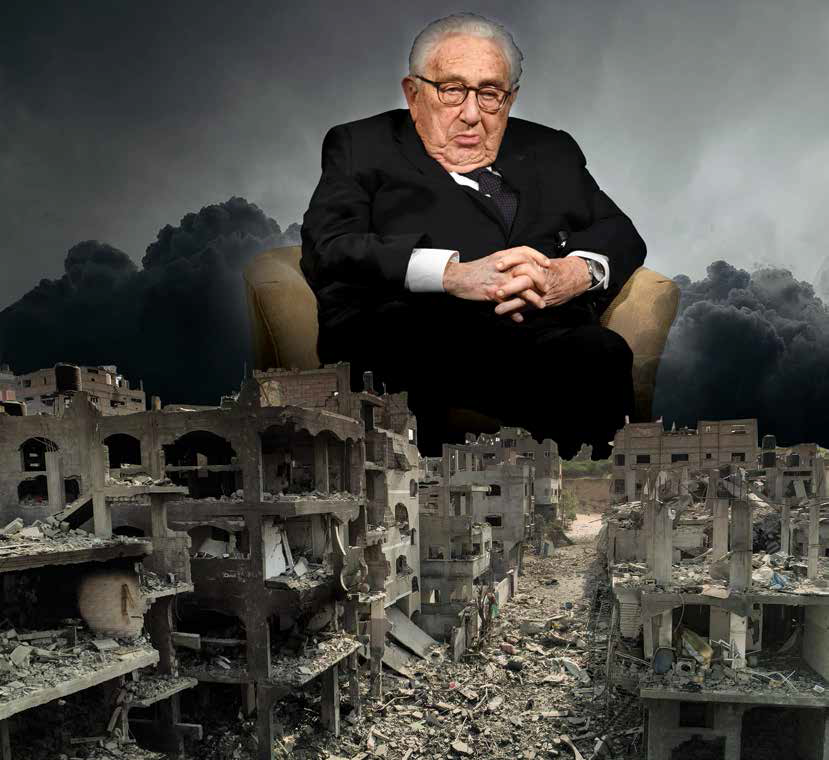
Henry Alfred Kissinger, extolled by his American admirers as a grand geopolitical strategist, fled Nazi Germany in 1938 to become an American citizen. As Harvard faculty in the 1960s, he was a consultant for the John Kennedy and Lyndon Johnson administrations before serving in the administrations of Richard Nixon and Gerald Ford as the US national security advisor and secretary of state between 1969 and 1977.
In the following decades, he continued to influence foreign policy by advising various U.S. presidents while sitting on several government advisory boards. He also exerted influence by authoring several bestselling books covering geopolitical, historical, and diplomatic topics.
He has been hailed for his contribution to détente during the late 1960s to late 1970s. However, while during the détente years, there were notable negotiations and treaties on nuclear arms control and improved diplomatic relations between the two Cold War rivals, détente failed in the last years of the 1970s. The two great powers remained involved in the Soviet-Afghan conflict throughout the 1980s with devastating consequences that continue to haunt the region.
Another achievement touted by his admirers is the role he played in mediating the end of the Yom Kippur War of 1973. But as the ongoing Israeli mayhem in Gaza clearly demonstrates, the Palestinian Issue remains unresolved primarily because of the U.S. backing of Israel. This American partiality can be traced right back to Kissinger’s years in office.
The U.S. opening to China in the seventies is perceived as Kissinger’s successful strategy and diplomatic victory over the USSR. However, this development created space for Chinese economic reforms facilitating Beijing’s participation in the global economy and eventually allowing Xi Jinping to take the competition to the next level. Today, China presents a robust challenge to the U.S. global hegemony and the post-WW2 Western World Order.
According to his biographer Greg Grandin, Kissinger was responsible for the deaths of at least three million people - all in the name of the U.S. national security interests and anti-communism. Kissinger played a key role in prolonging the U.S. military interventions in Southeast Asia, resulting in the deaths of thousands of American soldiers and hundreds of thousands of Vietnamese, Cambodians, and Laotians.
His Cold War era policies were a reminder of military imperialism - whether in Chile where a U.S.-backed coup removed the popularly elected Allende government, replacing it with the murderous dictatorship of Pinochet, or in Argentina where he gave green light to the homicidal military junta that overthrew the government of Isabel Peron.
Kissinger’s preference for militarism was demonstrated in the relentless bombing of neutral Laos and Cambodia; in the US support for violent nationalist groups in Africa and Latin America; in the empowering of dictatorships in the Middle East and Africa and in permitting Suharto and Yahya Khan to opt for militarist solutions to political problems in East Timor and East Pakistan, respectively.
Investigating Kissinger’s actions in his 2001 book The Trial of Henry Kissinger, Christopher Hitchens argues that Kissinger committed numerous war crimes. Yet he was never held accountable. Instead, in 1973 he was awarded the Nobel Peace Prize for negotiating a ceasefire in Vietnam- a pact that was promptly violated by all parties.


The writer is the policy advisor for CSCR, Senior Consultant at IPRI, Visiting Faculty at Foreign Service Academy, Islamabad, and Hon. Research Fellow at the Institute for Conflict, Cooperation, and Security, School of Government and Society, University of Birmingham, UK.
Leave a Reply