



 On December 17, 2020, the Maldivian government approved the Transitional Justice Act in a surprise move. It also established the Office of the Ombudsman for Transitional Justice (OOTJ). This was a historic step by the government to initiate long-overdue reimbursement mechanisms for survivors of past abuses. Even with a super-majority in the Parliament, signing and implementing this Act was nothing short of an uphill task. The law will guarantee legal proceedings when it comes to serving justice.
The Maldives is going through an era of political fluctuations. During such uncertain times, national and international observers need to ascertain that the Transitional Justice Act is implemented in letter and spirit. They must ensure that the government is enforcing the legal framework. The country’s speaker and former president, Mohamed Nasheed, escaped an assassination attempt that speaks volumes of the country’s unstable political environment.
The government must guarantee that the Act will be enforced through systematic institutional security and funding. If this is not undertaken, the survivors and the victims will continue to fall into oblivion without being served with justice.
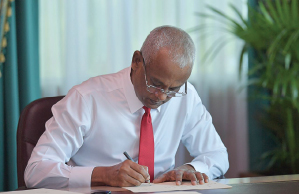
Another historic step taken by the government of the Maldives was to appoint three ombudspersons. This was done soon after the Transitional Justice Act was passed. President Ibrahim Mohamed Solih approved these appointments to establish the Office of the Ombudsman for Transitional Justice. The ombudspersons indeed have a challenge ahead of them. They need to work on redressing atrocities done by the state from January 1, 1953, to November 17, 2018. They would hold current and former public officials accountable for human rights violations. The legislation allows the transitional justice ombudspersons to perform criminal investigations and afterwards initiate prosecutions.
One of the key responsibilities of the OOTJ is to expose the truth about past atrocities, evaluating their causes and extent, and holding committers of abuses accountable. The OOTJ can re-open investigations previously investigated by various state agencies. This will be done especially if new evidence emerges that can change the decision. A Prosecutor General or Attorney General can also be assigned tasks by the OOTJ when needed if the case has many loose ends. The Persecutor General or Attorney General can conduct criminal and civil proceedings. They can also provide legal and non-legal remedies to the survivors and the victims.
 Some view that the survivors may not feel contented if the perpetrators themselves are sitting at the helms of affairs. The survivors or the victims would not be willing to discuss the atrocities they faced in their presence. The Act also implies that the survivors are facilitated to resuming their social life. Moreover, the Act also assures that the reparations are not just monetary compensation. Rehabilitation and peacebuilding, therefore, are a part of the process along with conflict resolution that will ensure the survivors and the victims come out of the trauma and endeavor to live a peaceful life.


The writer has a special interest in the region’s social and political affairs. He can be reached at omariftikhar82@gmail.com
Leave a Reply