



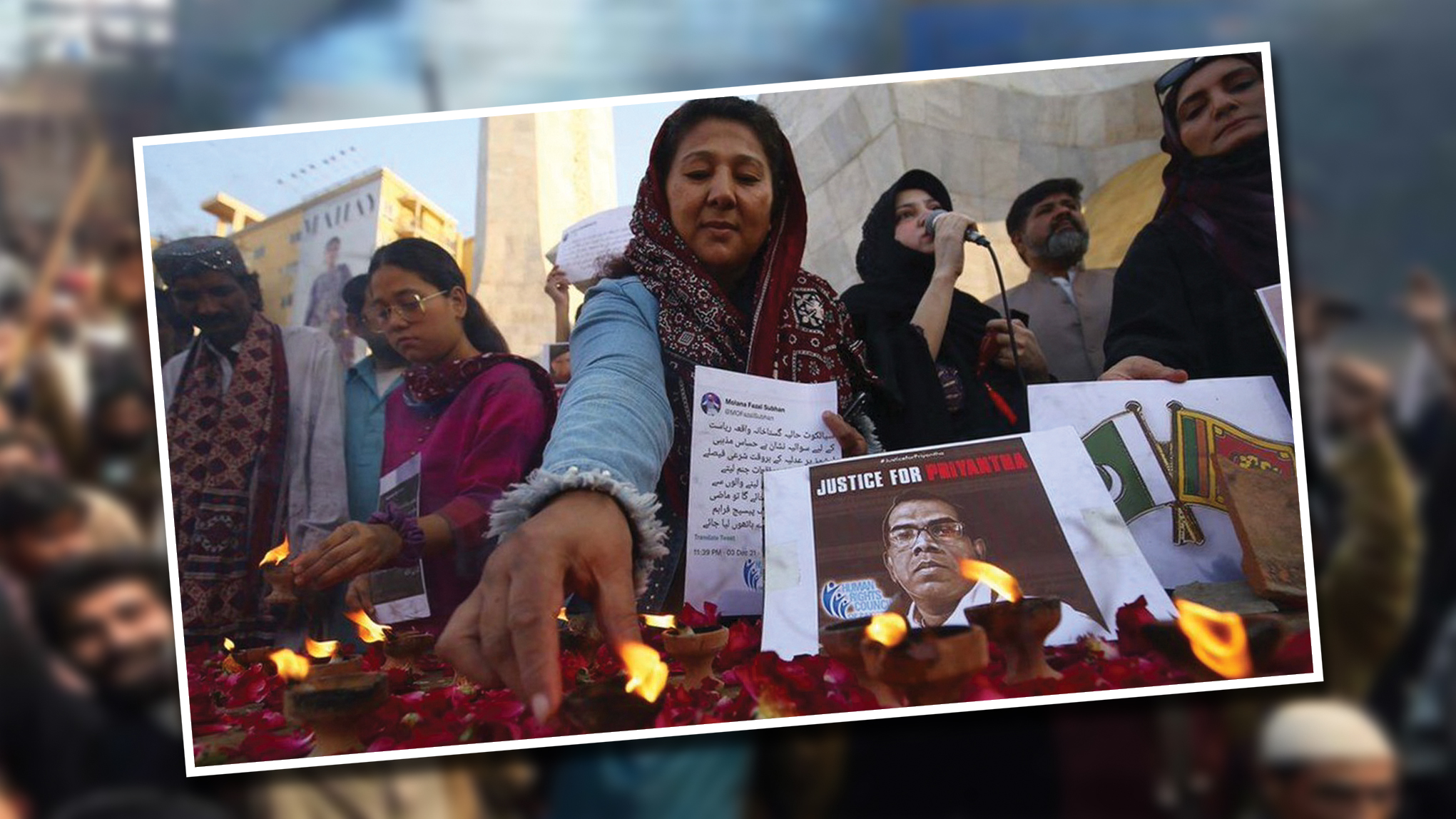
 The world is undergoing many changes. New technology has improved the quality of products. Pakistani industrialists are importing high value heavy machinery, for which there are no technically trained skilled persons in the country and manufacturers are calling in trained engineers from Korea, China and other countries. In this context, the Sri Lankan Priyantha Kumara Diyawadana, the industrial engineering manager of a sports goods factory, was mercilessly murdered inside the factory premises by a horde of angry factory workers armed with rods and batons.
This brutal killing has been strongly condemned across the country. Prime Minister Imran Khan has expressed deep sorrow over the incident declaring it a shameful act, whereas the country's religious leaders and civil society are also criticizing the incident. The country's industrial and commercial circles have demanded that the government should take special measures to provide security to foreign experts. In the past months the killing of Chinese industrial workers and now this incident is a big challenge for the government and it is time to improve the situation so that the process of industrial development is not hampered.
People must think about what they are criticizing. We will lose our ideological base, if religious extremism is not eliminated. it is imperative for us to prevent religious terrorism with strategic thinking.
The biggest problem is the negative role of politicians who only agitate against the so-called incompetence of the present government and demand its elimination. Every day some incident happens which creates a hegemonic situation. The Founder of Pakistan, Quaid-e-Azam Muhammad Ali Jinnah, while addressing the Constituent Assembly on August 11, 1947, had said that we are starting Pakistan’s policies with the basic principle that we are all citizens of the same state and have equal rights. That over time, personally, Hindus will remain Hindus and Muslims will remain Muslims because it is a personal belief of an individual but politically, we will be citizens with equal rights of the state.
Today, 74 years after independence, we are constantly paying the price for ignoring the words of the Quaid-e-Azam. The Western world is calling Pakistan a hotbed of extremism. Prime Minister Imran Khan has repeatedly asked political leaders to come forward with reference to the changes in the country related to the ideology of Pakistan since the goal is to make the country a state like that of Medina.
What is disturbing at the moment is that the religiously bigoted class is not ready to listen to the views of others and accept the rule of the state.
This culture of intolerance has given rise to evils like targeted killings, extortion, looting and robbery. Intolerance breeds extremism and there are many reasons for it, such as ignorance, lack of knowledge, self-righteousness, lack of understanding, social injustice and excess, violence, race and gender discrimination. Understanding, downgrading, etc. are the factors that give rise to a culture of intolerance and then, under certain circumstances, grow into extremism.
Extremist ideologies are a threat to the peace of any country and can lead to instability, chaos, civil war and destruction. The aim of the Rehmat-ul-Alamin Authority which was set up by Prime Minister Imran Khan, was to curb extremism and to promote the teachings of the Prophet Mohammad (PBUH). Presently extremism is like a cancer and can become a catastrophe in the future which is a threat to the integrity of the country. We have the example of Iraq, Syria, Yemen and Lebanon, where sectarian strife by religious extremists has devastated these countries.
In order to bring about change, it is imperative that the armed forces of Pakistan and the civilian government work together to adopt a countrywide soft power strategy, including the use of military and non-military intervention methods. The culture of violence can be controlled in many ways internally.
It is important that the federal government formulate a non-violent response statement at the national level as it is impossible to get rid of the scourge of terrorism without looking at the ideological aspects. Under the Internal National Security Policy, it is the responsibility of the Ministry of Interior to build a front against extremism with the help of religious scholars, intellectuals, educational institutions and the media.
Extremism, be it religious, linguistic, regional, sectarian or political and social in nature, must be denied at every level with great courage and boldness. We need a united front at all levels against those who base their thinking on these negative activities or mislead the people. All parties need to take action against such people on their own internal fronts.
Serious and intellectual members of society should be drawn from all walks of life. Instead of remaining silent against these extremists and their violent tendencies, they should raise their voice and support the forces of good and oppose openly what creates narrow-mindedness in people.
The role of media is also very important. It is also important to look at the hostile side of extremism. The role of civil society is also essential for controlling extremism. Civil society has been taking steps to solve problems, bring peace, pave the way for law enforcement, resettlement and reconciliation. Many NGOs have the potential to create an element of tolerance in society that will ultimately help curb extremism. 

The writer is a socio-economic analyst and can be reached at hamiddawoodi@gmail.com
Leave a Reply