



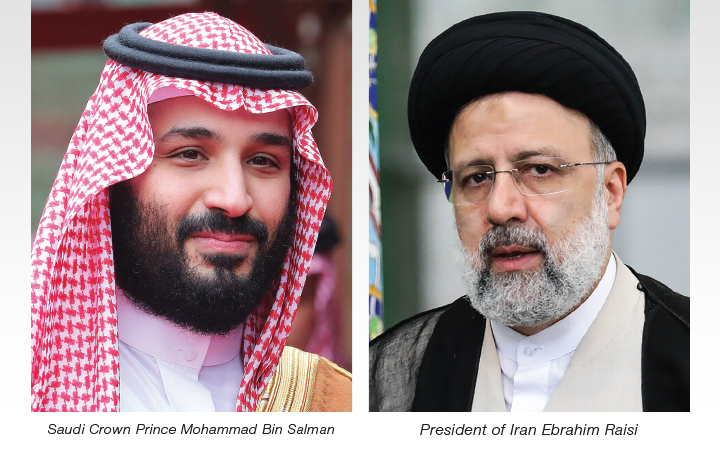
 Saudi Arabia and Iran have been locked in a bitter competition for power and influence in the Middle East for decades. The age-old rivalry between them is aggravated by revolutionary ideology, nationalism, race for regional hegemony, competition for leadership of the Islamic world, alliances with world powers such as the US and Israel, oil price and sectarian differences. Iran largely follows the Shia branch of Islam, while Saudi Arabia views itself as a Sunni power in the Muslim world. Many countries in the Middle East such as Yemen, Syria, Bahrain, Lebanon, and Iraq are marred by proxy warfare between the two countries, where Iran and Saudi Arabia support opposing sides.
Yemen has been a geostrategic battleground for Iran and Saudi Arabia since 2015 — when Saudi Arabia led an intervention to militarily support Mansur Hadi’s government against Iranian-backed Houthi rebels. The on-going civil war in Yemen aggravated by regional rivalry between Iran and Saudi Arabia continues to fuel one of the worst humanitarian crises. Similarly, in Syria, Iran has been supporting Bashar al-Assad’s government whereas Saudi Arabia has been supplying arms and weapons to rebel forces fighting to oust Assad’s regime. Syria’s 10-year long civil war now has become less bloody as it enters an extended end-game, yet it remains highly volatile.
Moreover, the Israel-Palestine conflict has also become entangled in the larger Saudi-Iran power tussle. As tensions between Israel and Hamas flare-up, Saudi Arabia is now more willing to remain silent on the Palestinian issue in exchange for Israeli diplomatic, defence and technological support for containing Iran. The US-brokered diplomatic normalization deals between Israel, UAE and Bahrain formalized a strategic realignment against Iran that had been an open secret in the region. The deals also signify that more GCC countries — which enjoy close ties with Saudi Arabia — could normalize relations with Israel, sans settlement of Israel-Palestine conflict, in a bid to contain Iran.
The fractious Saudi-Iran rivalry is not only limited to the Middle East but spreads to South Asia where it has had far-reaching implications for Pakistan’s security, economy, and society. Islamabad, being a close ally of Riyadh and an immediate neighbour of Tehran, is caught in the crossfire.
It is a Sunni dominant country with Shias in some numbers. The power struggle between Saudi Arabia and Iran have led to the development of some fissures between Shias and Sunnis in Pakistan. After the 1979 revolution in Iran, it sought to bolster its support for Shias in the region. In a bid to contain Iranian influence, Saudi Arabia funded numerous religious seminaries in the 1980s which taught a more puritanical version of Islam than had traditionally been practiced in Pakistan.
The division across sectarian lines and religious polarization in the country also gave birth to a series of sectarian terrorist outfits, such as Lashkar-e-Jhangvi, Sipah-e-Sahaba, and Sipah-e-Muhammad. These extremist outfits targeted leaders of the Shia community, bombed their places of worship and targeted Ashura processions that killed scores of innocent people. Sectarian hate and violence morphed into terrorism and became a serious threat for the national security of Pakistan. Reports of sectarian violence and terrorism have surfaced in virtually all provinces of Pakistan. Areas such as DI Khan, Kohat, Parachinar, Quetta, Jhang and Faisalabad remain hotbeds of sectarian militancy and violence.
 Pakistan has to adopt a cautious policy to make sure that the simmering sectarian tensions stoked by the Saudi-Iran tussle do not come to a boil. It is also pertinent to mention that KSA and Iran hold an immense economic, security and geostrategic significance for Pakistan. To start with, Saudi Arabia has consistently offered generous economic assistance to Pakistan. It announced to provide $4.2 billion worth of economic assistance only recently. It has also been providing consistent economic bailout packages to Pakistan. For instance, in 2018 Pakistan received a bailout package worth $6 billion from Saudi Arabia. Moreover, a large chunk of Pakistan’s workforce — 2.6 million — resides in Saudi Arabia and sends back remittances which are vital in keeping Pakistan’s economy afloat. A report by the State Bank of Pakistan estimates that remittances received from Pakistani workers in Saudi Arabia amounted to US $821.6 million in the 2019/2020 financial year. It shows the enormous economic importance of Saudi Arabia to Pakistan.


The writer is a researcher at the Centre for Aerospace & Security Studies in Rawalpindi. She can be reached at mahamgillani@gmail.com
Leave a Reply