



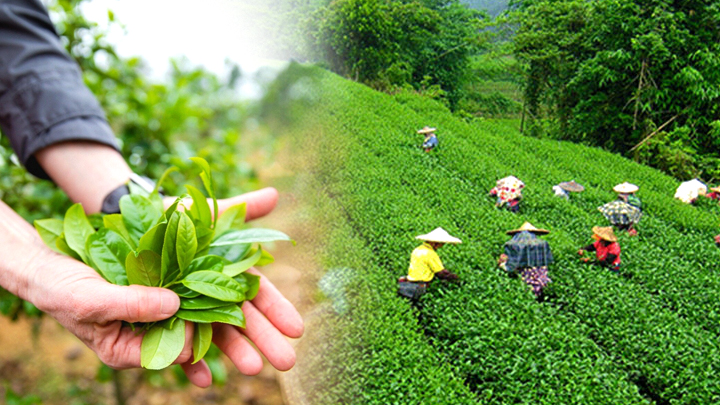
Tea is the most popular drink in Pakistan. In the subcontinent, tea was introduced during British rule and became very popular in this part of the world and. Tea is usually consumed with breakfast and lunch meals as well as in the evening. The British promoted tea culture in its all colonies and snc then it has become an inevitable part of their lifestyle. The British way of consuming tea is contrasted with the Chinese way, where tea was consumed without sugar and milk. Similarly, tea in the subcontinent is served with milk and sugar and works as an energy booster for many people. However, people consume tea excessively and become addicted, which is no doubt harmful.
Pakistan is one of the leading tea importing nations and during 2020, the country spent about $590 million for tea imports. As Pakistan is facing an economic crisis, the import and export balance is out, spending a huge amount of foreign exchange is an unwise decision.
While tea consumption is a luxury and a country like Pakistan cannot afford such a luxury forever, as it also hurts public health. Many people have become addicted to tea, which gives rise to diabetic. Under the given circumstances, people must use local herbs and green tea as an alternative. In many elite families, many health-conscious people prefer green tea, Peshawari kawa, or herbal tea, without sugar. However, there is a need to properly educate people about harmful effects of tea consumption. In this regard, health professionals, medical doctors, scientists, scholars, hakeems, and other professionals must launch a public awareness campaign to inform people about the harmful effects of excessive tea consumption.
“Pakistan can grow its tea in good quality and develop tea exports,” says Hu Haibo, who, in the 1980s, led a Chinese mission to Pakistan to find out and designate suitable areas for tea cultivation and to lay ground for the first modern tea garden for the country.
“It’s been more than 30 years since I left Pakistan. If I get the opportunity, I would like to visit Pakistan again to see the tea garden we cultivated from scratch and visit my old friends there. I miss them very much,” according to Haibo.
Before the 1980s, there was barely a tea garden in Pakistan and the demand for tea could only be met with large imports, which was quite a burden on the country’s foreign exchange reserves. In this condition, planting and producing tea became an urgent task for successive Pakistani governments. In early May 1982, at the request of the then Pakistani government, the agriculture department of China’s Zhejiang Province assigned a Chinese team of experts to explore the prospects of tea cultivation in Pakistan. Hu Haibo, who was an associate researcher of Tea Research Institute, Chinese Academy of Agricultural Sciences (CAAS), served as the team leader. “I was excited when I was chosen for the mission. Pakistan is our ‘iron brother’, and it means a lot to help them with my humble efforts,” he says.
Pakistan is extremely hot and dry, particularly in May and June. The temperature in most areas can exceed 40 degrees Celsius at noon. It was in these very scorching days that the experts visited Khyber Pakhtunkhwa, a northern province of Pakistan to carry out field surveys in the outskirts of Mansehra, Azad Kashmir, Swat, Butgram, and Malakand. During the survey, the Chinese team found the traces of tea trees and measured the altitude, soil value and growth condition of branches, leaves, and roots of the tea trees.
After a three-month survey, the Chinese team submitted a summary report on the feasibility of tea plantation in Pakistan, confirming that 64,000 hectares of land are suitable for tea growing in Mansehra and Swat districts. In Hazara, the area is located in the districts of Mansehra, Battagram, and Abbottabad.
In Malakand, Swat is a suitable area for tea cultivation. In 1985, Pakistan Agricultural Research Council once again invited experts from the Tea Research Institute of China to assist Pakistan in the trial plantation of tea. In January 1986, Hu Haibo, together with other experts, assigned the task of tea plantation. Mr. Hu recalled, “In more than three years, we have done everything from tea garden planning and design, tea garden reclamation, nursery establishment, seeding, to transplanting, drought-resistant irrigation, inter-cropping shading, weeding, and fertilization, etc."
By promoting tea production, together with the cultivation of green tea leaves, Pakistan can save millions of money spent on tea imports. In addition to that, there is a need to promote the consumption of tea without sugar which will improve public health as well as overcome the prevailing sugar crisis too.

Prof. Engr. Zamir Ahmed Awan is a Sinologist (ex-Diplomat), Editor, Non-Resident Fellow of CCG (Center for China and Globalization), National University of Sciences and Technology (NUST), Islamabad. He can be reached at awanzamir@yahoo.com
Leave a Reply