Indian response
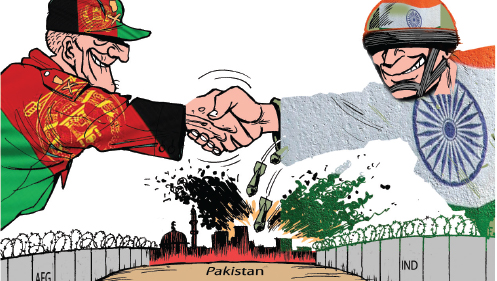
At present, a tense air has taken over the Indian civil-military environment, as the Taliban had made several statements that manifest their unwillingness to allow Afghan soil to be used as a proxy by any country. Hence, the open space that India enjoyed under Ashraf Ghani’s tenure would now be shrunken, which would compel the Indian authorities to gain leverage over the Taliban. By all means, India would intend to pave another passage for itself in the new Afghanistan.
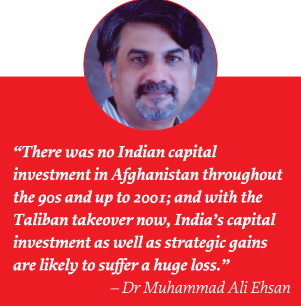
With foreign funding cut off, the new Afghan government is in dire need of investment. India could use this opportunity by investing in Afghanistan as a bargaining chip. Such an investment could generate the Afghans’ economic dependence on India, preparing a basis for exploitation in the coming years.
In the context of forty years of war, there has been no serious attempt by the foreign investors to upscalel the youth of Afghanistan or work in human resource management. Thus, if India tends to invest in Afghanistan, it could also impose its human resource on proposed development projects. Subsequently, many such people would serve under Indian intelligence agencies, providing substantial financial support to anti-state entities, empowering warlords, and disrupting Afghanistan’s law-and-order situation. If then India desires, it could also capitalize on its established human intelligence on the ground by delivering first-hand intelligence to other states.
 Regional partnership could be another exploitative aspect. Since the unfolding of the head-spinning pace of events in Afghanistan, India is unable to unilaterally influence or create a space for itself there. With the US and NATO in retreat and Russia being least interested in engaging with India on the Afghanistan matter, there is a high probability that India would want to form new friendships in the region and, for this purpose, it is prophesying potential in a partnership with Iran. One must reckon, though, that Indian authorities deliberately stalled the development of Chabahar port after the US sanctioned Iran.
In the context of the International North-South Transport Corridor (INSTC) project, Iran is a vital entry point for India into Afghanistan. To further damage Pakistan economically, India would pace up its development of Chabahar port and will convince the new Iranian administration to deal with the Taliban jointly. In this scenario, before sealing any deal, Iran must keenly evaluate India’s strengthened ties with its rival Israel, KSA, and the UAE.
India’s policy shift
Suppose the Taliban’s strict scrutiny over Afghanistan disables India to carry out anti-Pakistan designs and do not allow Indian influence expansion, what alternatives will India have otherwise?
On saving Indian interests, India may opt for a two-dimensional policy shift towards Afghanistan. First, it will passively continue with its flawed approach of finding commonalities with the people of Afghanistan and attempt to exercise its soft power. Second, India would want to reset its relationship with the Taliban.
Most recently, India’s External Affairs Minister underscored India’s consideration to preserve its historical relationship with the Afghan people. The irony is, what kind of historic linkage would they want to nurture when India’s entire folklore and film industry has depicted the Afghan rulers as brutal and inhumane invaders?
India will attempt to hold on to its reducing influence in the region by hopping on the bandwagon of welcoming refugees to India. Mimicking the US advocacy of human rights, India has also conducted evacuation flights in Afghanistan. But those evacuations present a gloomy picture. The process of welcoming refugees has been selective and is only limited to safety for those whom the authority pleases. Afghan MP Rangina Kargar, for instance, claimed to be treated like a criminal at the New Delhi airport and was deported to Istanbul via Dubai within two hours. This discrimination will continue, as gone are the days when India endorsed religious inclusivity. Today the people who do not tow the Hindutva ideology are considered a threat in India. Two other Afghan individuals met the same fate: Sikh MP Narinder Singh and Anarkali Kaur.
Secondly, in order to recalibrate its approach towards the Taliban, PM Modi could abandon India’s harsh stance on the Taliban. To achieve this objective, its sensational electronic and print media will be the first weapon of choice. The anchors-turned-celebrities and the entire Indian media fraternity will fast pace to build ancestry linkages with the Taliban leadership, and that would be captivating to witness. Following the recent public announcement of Indian Ambassador Deepak Mittal meeting with Sheer Mohammad Abbas Stanikzai in Qatar, a renowned Indian media outlet, for instance, discovered overnight Indian roots of the Taliban leader Stanikzai and revealed that the Taliban’s top leader had been trained and graduated from the Indian Military Academy Dehradun in 1979-82.
While half the media would be designated to recalibrate India’s approach towards the Taliban, another half would continue to place Pakistan in a bad light. In an attempt to not upset the Taliban regime and sweep Indian general election of 2024, PM Modi would urge the media to continue accelerating its malicious efforts in selling the narrative that Pakistan is sending insurgents to Indian occupied territory with Taliban’s covert support and India will increase its illegal control over - IIOJ&K. Such influence can come in the form of Modi exercising a free hand to further erode human rights by escalating violence and aggression. Under this clandestine approach, the Hindu fanatics, led by Modi, will continue to suppress the 13 million individuals of IIOJ&K. It is no secret that the Kashmir region has become an open prison for innocent people since the abrogation of Articles 370 and 35(a). If Modi opts for this option, it will further evoke the sense of alienation and oppression in the Kashmiri people. And if Kashmiris resist, that will be labeled as a Pakistan-sponsored campaign.
India must reckon with the fact that an unstable Afghanistan would mean an unstable South Asia. Afghanistan has had enough; there is a dire need for the international community to intervene and scrutinize India’s dubious ends and the means it would engage to befriend the new Afghan Government. While the responsibility is squarely on the international community to become proactive in setting Afghanistan on the path of prosperity and peace, the incumbent Afghan government, in its own national interest, also needs to understand malicious Indian designs and remain vigilant of the consequences. 





Leave a Reply