



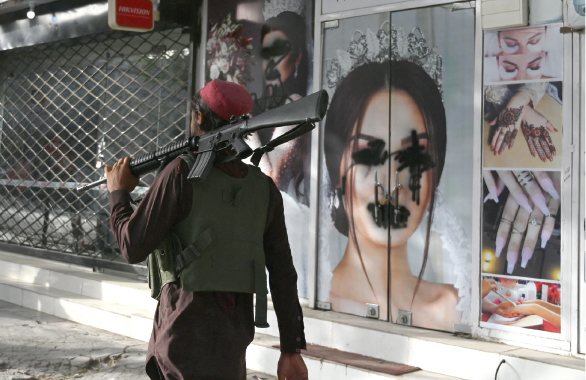
The Taliban emerged in 1994 and are considered internationally as a religious, military and political movement. Their philosophy is based on the ideology of Islamic Shariah Law, with the inclusion of Pashtun cultural and social norms belonging mostly to the Pashtun tribes. The Taliban were in power in Afghanistan from 1996 till 2001 before 9/11, when a strict implementation of Islamic Shariah law was imposed. They were internationally criticized and condemned for their harsh treatment towards Afghans for the enforcement of Shariah.
The year 2021 saw the sudden fall of the USA-established Afghan government by the Taliban. On August 31, the USA’s last batch of military troops left the soil of Afghanistan which resulted in the ending of 20 years of a war. A spokesman of the Taliban, Zabihullah Mujahid while speaking on August 31, 2021 said that “Victory belongs to us all. We want to have good relations with the US and the world. We welcome good diplomatic relations with them all.” He termed the war as a “lesson for other invaders”. The firm belief in Allah and the ideology of the Taliban is seen as being undefeated in their fresh start.
Pakistan’s Foreign Minister Shah Mehmood Qureshi welcomed the Taliban and looked forward to a consensus government in Afghanistan. Pakistan always looks forward to positive relations with its neighbouring country and would like to see them stable politically as well as economically. In terms of a new beginning in Afghanistan under the Taliban, Fitch Solutions is reported to have said that Afghanistan’s economy was expected to collapse with the withdrawal of the US forces. The gross domestic product (GDP) was expected by Fitch to drop by 9.7 per cent in the current year and by 5.2 per cent the next year. Additionally, Fitch Solutions reported that the US’s disruptive withdrawal from Afghanistan and its being taken over by the Taliban means that an acute economic fall will be felt but only for a short time.
According to the Doha agreement of February 29, 2020, as a settlement after 20 years of armed conflict, the Taliban announced that it would address concerns about the protection of fundamental human rights. This included women’s and girls’ education; ending attacks on civilians and the media, freedom of expression and accountability for serious war crimes and human rights abuses. They promised to encourage NGOs imparting community-based education programs. Differences in opinion occurred due to lack of security. Regarding media, women were to be given due participation. Social media restrictions were not to be imposed but everyone was expected to adhere to and reflect local community norms as per Islamic values. It was observed since 2015 that the Taliban ensured internal accountability by their public statements and many cases of abuse in their tenure were termed as violation of human rights.


The writer is a columnist and researcher associated with Universiti Tun Hussein Onn Malaysia (UTHM). She is also a visiting faculty member at Riphah International University in Islamabad. She can be reached at saira.asad2011@gmail.com
Leave a Reply