A group of dedicated young artistes are working hard to revive the art of story-telling to keep the connection between yesterday and today alive.
ByShazman Shariff | August 2021
Can a dastan (tale) still be a crowd puller without its traditional core elements - an ultimate concoction of fantasy, magic, and enchantment? Mahmood Farooqui, a writer and an award-winning dastango (storyteller) from Delhi challenged the long-standing convention of dastangoi by brewing contemporary stories, with a quintessential classical touch to revamp this ancient art of Urdu storytelling. Mahmood’s tryst with the revival of dastangoi started in 2005, inspired by works of Shamsur Rahman Faruqi, a noted Urdu poet and literary critic (and also his uncle) who has authored a four-volume study of the Dastan-e-Amir Hamza called Saheri, Shahi, Sahibqirani.
Mahmood’s foray into dastangoi wasn’t an impulsive move to bring forth ancient folklores like Tilism-e-Hoshruba, an epic tale of fantastic adventures of Amir Hamza; he felt compelled to fulfill an artistic obligation to put into the spotlight an indigenous art forgotten and relegated to the dungeons of oblivion by the hegemonic colonial masters. He strongly believes dastangoi has a bigger role, both socially and politically and “the very act of presenting on stage the appeal, the attraction of the culture reminiscent of yesteryears Nawabi classical period, through language and attire – dopalli topi and angrakha kurta is a political act.” Mahmood, an Oxford graduate, strongly holds the opinion that colonialism spelled doom for various cultural art forms deemed not up the colonists’ level of sophistication.
He has worked indefatigably to make dastangoi apt for modern times as he thinks fresh narratives can reflect the true face of society; his Dastan-e-Sedition woven with metaphorical imagery takes a jab at affairs in contemporary India. Be it Dastan-e-Taqseem-e-Hind, based on the partition of the sub-continent, or Mantoiyyat, which captures the life and times of renowned writer Saadat Hasan Manto, Mahmood, with his team of performers covers topics like literature, politics, culture and humanity. Interestingly, he has also reworked “Alice in Wonderland” as “Dastan Alice ki” to let children relish the charm of the oratory craft.
Works of great Indian Urdu novelist and short story writer, Ismat Chugtai, holds the ultimate charm for Sunil Mehra, who strongly calls her writings “a slap on the patriarchal society”. A veteran journalist and a former professor of English, Sunil took to Dastangoi some years ago as he wanted to convey a social message to the audience, which he feels he could not find through his journalism platform. “It is a fantastic readymade vehicle for me as through entertainment and satire I can raise a voice, register protest and express angst.” An Ismat apa enthusiast, he performs her stories only and terms her stories hard-hitting and politically forceful to shake and lay bare the shallow social attitudes and arguments.
Syed Sahil Agha reciting the "Dastan-e-Amir Khusrau"Sunil feels dastangoi is as old as mankind and storytelling is common to all the communities, a fact which unquestionably unshackles this ancient tradition from the dominance of any one single community or culture. “Urdu is our language”, he stresses, adding “language has no religion.” Strictly following the his own dictum of “Never recite something you don’t want to listen to”, Sunil says, though he retains the conventional style of dastangoi - the white attire, the ambiance - the introductory invocation by rendition of Saqi Nama - he has managed to radicalize the content to make it more viable for the current times. Not to be confused with theatre, he says dastangoi is yet a different art which could be taken up as a passion or an indulgence, but humorously questions the monetary rewards of the profession with words, “When did art pay the bills?
Describing dastangoi as a pure art form he is completely in love with, Syed Sahil Agha, feels there are certain requirements of the craft, ranging from a firm grip over the language be it Hindi or Urdu, to perception of stories. The young performer from Delhi who started his journey almost eleven years ago with a performance at Jama Millia Islami University with an audience of about fifty students, says feeling the pulse of the audience, fathoming their mood and appreciation of dastan being performed are prerequisites to master the nuances of dastangoi. “There have been occasions when I have twisted tales to make them more appealing for my audience as I astutely observe their reaction,” says Sahil, who feels his experience in theatre helps him connect with audiences better.
Blending the classic charm of Amir Hamza’s tales and adding the charisma of Tughlaqnama in his performances though, Sahil follows the 13th century traditional style of dastangoi; he also has introduced some changes in the conventional pattern of the art. ”I have simplified the language as enigmatic Urdu can be beyond one’s comprehension,” says the performer who, however, stands by the core the essence of dastangoi like dress code, refined content and conventional style. He is credited with starting musical dastangoi, which according to him was first introduced by Amir Khusro. And, unlike the established practice of performing in a pair, he prefers to go solo. An avid reader, thorough with the historical background of dastangoi, Sahil has added a feather to his cap by penning Dastan-e-Hind - a compilation of a hundred folklores and aspires to keep the craft alive through the workshops he conducts.
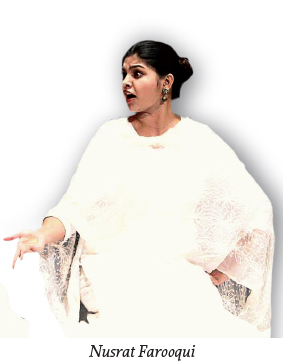
Making headway into dastangoi believed to be an all-male arena, Nusrat Ansari feels it has been a long journey for her right from the time when she felt enchanted by the magnetism of Tilism-e-Hoshraba as part of an audience to the moment she stepped on the stage clad in all white to perform. A young graduate in history and professionally associated with the education sector, she feels though the audience is generous in showering encouragement and appreciation, off stage she can feel the stigma attached to the work.“People don’t see this work as a profession and on top of that if a girl takes it up, more eye brows are raised.” She candidly adds such is the intensity of preconceived notions that they chase away marriage proposals for girls.
She pairs with Ainee Farooqui, a fellow dastango, and the level of camaraderie they both share takes the pressure off during performances. “The mutual understanding often helps us carry forth a dastan smoothly and we cover each other’s mistakes seamlessly”, she says.
Talking about the amount of research and study that goes into furnishing a well-knit dastan, Nusrat says they both have worked together on historical stories based on Jalianwala Bhagh and Bhagat Singh. She feels it is imperative to bring social relevance to the stories and take them to children in the most interesting manner as a platform of this magnitude can’t just be restricted to entertainment.
Dastangoi is rising from its ashes, from its past like the proverbial phoenix-its continuation is not just in the hands of few dastangos who enamoured with the beauty of language and magic of oratory have taken the reigns of its revival, it also needs patronage by the well-heeled. Mahmood is clear with his words, “In olden days kings and queens were there to extend their support to artistes, today the onus lies on Tatas and Birlas to ensure furtherance of such art forms.”




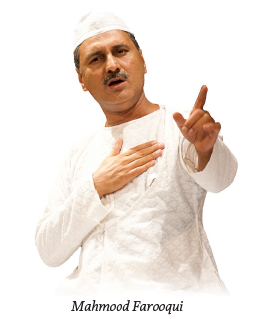 Can a dastan (tale) still be a crowd puller without its traditional core elements - an ultimate concoction of fantasy, magic, and enchantment? Mahmood Farooqui, a writer and an award-winning dastango (storyteller) from Delhi challenged the long-standing convention of dastangoi by brewing contemporary stories, with a quintessential classical touch to revamp this ancient art of Urdu storytelling. Mahmood’s tryst with the revival of dastangoi started in 2005, inspired by works of Shamsur Rahman Faruqi, a noted Urdu poet and literary critic (and also his uncle) who has authored a four-volume study of the Dastan-e-Amir Hamza called Saheri, Shahi, Sahibqirani.
 Works of great Indian Urdu novelist and short story writer, Ismat Chugtai, holds the ultimate charm for Sunil Mehra, who strongly calls her writings “a slap on the patriarchal society”. A veteran journalist and a former professor of English, Sunil took to Dastangoi some years ago as he wanted to convey a social message to the audience, which he feels he could not find through his journalism platform. “It is a fantastic readymade vehicle for me as through entertainment and satire I can raise a voice, register protest and express angst.” An Ismat apa enthusiast, he performs her stories only and terms her stories hard-hitting and politically forceful to shake and lay bare the shallow social attitudes and arguments.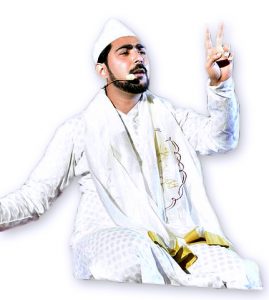
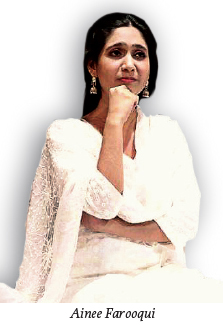 She pairs with Ainee Farooqui, a fellow dastango, and the level of camaraderie they both share takes the pressure off during performances. “The mutual understanding often helps us carry forth a dastan smoothly and we cover each other’s mistakes seamlessly”, she says.

Leave a Reply