



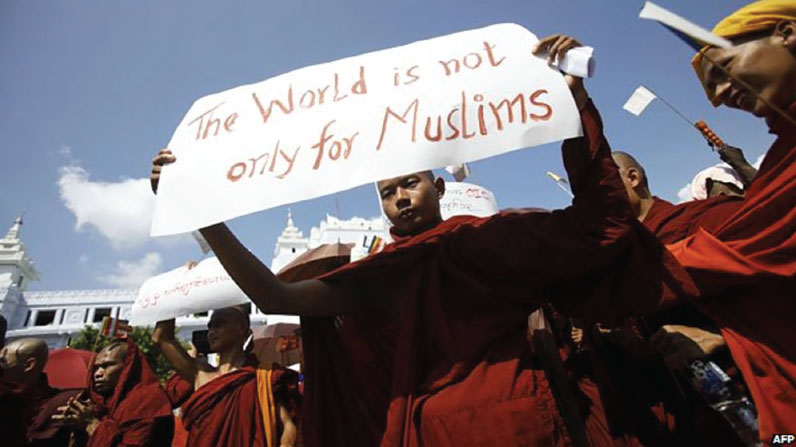
Auddhist nationalism has remained under debate, especially in Myanmar and Sri Lanka. Buddhism is one of the largest religions in the world; it is based on the teachings of Gautama Buddha. The major focus of Buddhism is overcoming suffering by killing desires. The teachings of Buddha preach peace and harmony, but Buddhist nationalism being professed by some extremist elements in Myanmar and Sri Lanka, seems far from the concept of peace and harmony. There is hatred in the minds of some Buddhist nationalist forces against Muslim communities in Myanmar and Sri Lanka. The trend is completely against the teachings of Buddha.
Buddhist nationalism mainly relies on the primordial concept of ethnicity, in which ethnocentrism is evident. This ethnocentrism tells the follower of the primordial thoughts that people belonging to a particular ethnicity are the ‘real’ sons of the soil. This is not wrong. Indigenous communities everywhere should be treated fairly and on a priority basis. Yet, this becomes problematic when ethnicity is linked to a particular religion because religions are universal beyond any limits of ethnicity. Historically, we can see trends of religious nationalism, especially in South and Southeast Asia. However, Buddhist nationalism being practiced in Myanmar and Sri Lanka, unfortunately, acts against the Muslim populations of these countries because Muslims are considered ‘immigrants’ and ‘outsiders’, who entered the Buddhist lands during the British colonization period. About Myanmar Buddhists’ hatred against Muslims, Mikael Gravers writes in his article, published in The Asia Dialogue on March 8, 2019:
“The main ingredients of Myanmar’s nationalism are primordial values. First and foremost among these is belonging to an indigenous race/ethnic group that lived in Burma before colonization in 1823. Muslims and Hindus are considered as immigrants invited in by the British as cheap labour and money lenders, which created widespread resentment and led to serious riots in 1938. The riots were sparked by a Muslim-authored book containing comments about Buddhism which provoked lay people and monks to retaliate with attacks on Muslim shops. The same was seen again during the disturbances in 2012–13. Muslims were accused of forcing their Buddhist wives to convert to Islam or else disinheriting these women and their children. The Burmese nationalist movements involving monks and students used slogans such as ‘master race we are, we Burmese’, and using the title Thakin, or ‘master’, as an anti-colonial riposte to their former colonial masters.”
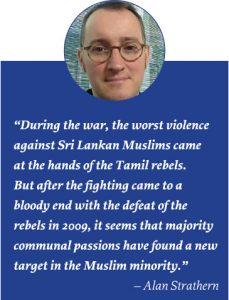 In this context, Buddhist nationalism in Myanmar mainly revolves around this issue as they fear that the Muslim immigrants, specifically Rohingyas from Bangladesh, can convert the Buddhist population into a minority. Interestingly, the fear of Buddhist nationalists has been forcing them to support the military coups against Aung San Suu Kyi’s National League for Democracy party. The reason behind supporting the military rather than democratic forces is to gain power in order to curtail the Muslims’ influence in the country. Though Aung San Suu Kyi also had the same attitude on the Rohingya issue that the Buddhist nationalist have, but Suu Ki has not remained a favourable choice for them.

The writer has a Ph.D in World History from the College of Liberal Arts, Shanghai University, and teaches at the National Institute of Pakistan Studies (NIPS), Quaid-i-Azam University, Islamabad. He can be reached at qasim_shu2016@yahoo.com
Leave a Reply