


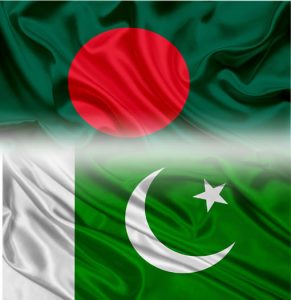
 Relationships between states, nations and entities are based on mutual respect, understanding of aspirations and deference to notions of mistrust. Pakistan and Bangladesh, based on historical complications, do not have such a relationship yet. A synergistic relationship is, however, possible between the two so that a long road of common vision can be established.
Given that we live in a global village, one view is that via third-party linkages, an understanding can be developed which would enable both Pakistan and Bangladesh to gain each other’s trust without losing face in the eyes of their own populations. Such mutually acceptable positions are rare between the two nations, yet they can be workable if based on the issues of Arab/non-Arab Muslim identity, role in China’s Belt and Road Initiative and ties with Russia.
The confidence-building Muslim identity would be the best investment in the Gulf states presently, where enhanced nationalization of high-skilled labour has forced the expat community to solely comprise low-skilled workers. The fact that the Gulf states have non-affinity towards non-Arab Muslim states. Islamabad and Dhaka can synergize each other’s rights to aid their expats to live a life of dignity in these circumstances. However, the hosts would not be particularly happy with such a development.
The non-Arab Muslim identity versus the Arab identity was earlier visiblewhen Turkey’s Tayyip Erdogan, Malaysia’s Mahathir Mohamad and Pakistan‘s Imran Khan formulated a grouping in the wake of a tiff with the Saudi leadership and as a sign of allegiance with the Qatari leadership. It was subsequently realized that this course of action would have been more destructive than constructive.
A commonality in the Pakistan and Bangladesh long-term strategic vision is to boost ties with China. With its flagship Belt and Road Initiative, Beijing is investing billions of dollars in CPEC. Recently, Islamabad showed an interest towards linking CPEC with Sri Lanka.
Such a move would be helpful if offered to Dhaka as an olive branch. Given the complex ties between the estranged nations, China’s Xi Jinping’s leadership is needed to bring in a positive relationship.
Another aspect of keeping Bangladesh in a positive relationship is forming regional mechanisms so that American designs to contain China can be curtailed. Washington is more and more interested in containing Beijing. It is threatening China and wants to be seen as a leader of the so-called free world.
Recently, the American-led Quad grouping, which comprises US, India, Japan, and Australia, sought Bangladesh’s inclusion in containing China. Such a plan of action needs tightrope diplomatic action to keep channels intact with Beijing without affecting its developmental projects.


The writer is a freelance journalist based in Islamabad and a former Dawn and Times of Oman staffer. He can be reached at akhtarns@gmail.com
Leave a Reply